|
South Carolina's handpicked future teachers flock to Carolina to develop their skills for the classroom.
By Chris Horn
Lunchtime is just minutes away at Fulmer Middle School in West Columbia, but Emmylou Davis' classroom shows no sign of slowing down. After counting plastic coins for a math lesson, the students return to their desks and jump into a lesson on the calendar. “Does Halloween come at the beginning of the month or at the end of the month?” Davis asks the class, smiling when she hears the correct answer.
Being a special education teacher demands mental agility and boundless energy, and Davis has both as she juggles separate curricula for each of the students in her class. She is a whir of motion, cajoling, prodding, encouraging, and praising.
Every moment is full of challenge; every gain in student progress is won with perseverance and sweat. Nothing comes easy in this classroom—for teacher or for student—but Davis didn't sign up for a cruise on easy street.
“I love this job, and I love my students,” said Davis, an '04, '06 M.Ed. Carolina graduate and native of Kershaw, S.C. “And I love their parents; they get so involved with the lessons I send home with the kids.”
For being such a new teacher, Davis sounds like a teaching veteran. She's comfortable in the classroom, poised in every situation, and committed to her profession. In short, she's a testament to the success of the state's Teaching Fellows Program and of the University of South Carolina, which attracts more Teaching Fellows than any other institution in the state.
The state awards up to 200 Teaching Fellows scholarships every year to high school seniors in a competitive process that includes interviews and academic review. Those selected get four-year, $24,000 scholarships to attend one of 11 institutions in South Carolina that prepare future teachers. In return for the scholarship, Teaching Fellows commit to teach in S.C. public schools for four years following graduation.
Carolina's Teaching Fellows get student teaching experience; attend professional development seminars; perform community service; and often form special bonds with one another.
“The University is allocated 35 freshmen Teaching Fellows every year, but sometimes we have as many as 40. We always have a wait list, and we've had some students who've turned down the scholarship [if it meant having to attend another institution] so that they could enroll in our College of Education,” said Mary Hipp, director of the Teaching Fellows Program at Carolina.
>Hipp is a former award-winning middle- and high-school English teacher in Columbia and one of the big reasons why so many Teaching Fellows list Carolina as their No. 1 choice for college—and why they perform well upon graduation.
“Mary Hipp put so much effort into each of us as Teaching Fellows,” said Tyler Abernathy, '06, '07 master's, a former Teaching Fellow and newly minted seventh-grade world history teacher at Blythewood Middle School in South Carolina. “She wants all of us to become excellent teachers, and she put so much love and concern and sweat into advising us.”
Ed Dickey, a professor of instruction and teacher education, notes the sense of community that thrives among the University's student teacher community and Hipp's role in fostering that. “Mary builds an esprit de corps among the Teaching Fellows. That's why so many of them want to come here.”
Jessica Burton, '06, '07 masters, was a Teaching Fellow and now teaches second grade at Clinton Elementary in Lancaster, S.C. She always wanted to be a teacher—she was a Teacher Cadet in high school—but it took her experiences at Carolina to cement the idea. “Being a Teaching Fellow changed my perception of what it means to be a teacher,” she said. “I gained a lot more respect for the profession, and learned that becoming a teacher is a process. It's OK to know that I'm not the teacher today that I hope to become.”
Bailey Pettit, '06, a former Teaching Fellow now working on her master's of teaching in secondary social studies, was named a James Madison Fellow in 2006, one of only 40 students across the nation to receive the $24,000 fellowship. Madison Fellowships support graduate study for aspiring or experienced secondary school teachers of American history.
“Being a Teaching Fellow helped me to compete for the Madison Fellowship because they understood that I am definitely going into the classroom, that I've made that commitment as part of being a Teaching Fellow,” Pettit said.
And going into the classroom is what it's all about for Carolina's Teaching Fellows. It's the crucible that refines and polishes their skills and reveals their passion.
“The experiences I have had in the classroom have strongly confirmed my decision to become a teacher,” said Brenna Kendrick, a current Teaching Fellow from North Augusta. “There is nothing more fulfilling than having a classroom of elementary-age students hanging on your every word, participating in your discussions, and learning something that you are teaching.
“There isn't another career quite like it—one that will let you do something different every single day, one that lets you build a community with not only students, but other professionals, and one that lets you make a difference in hundreds of lives.”
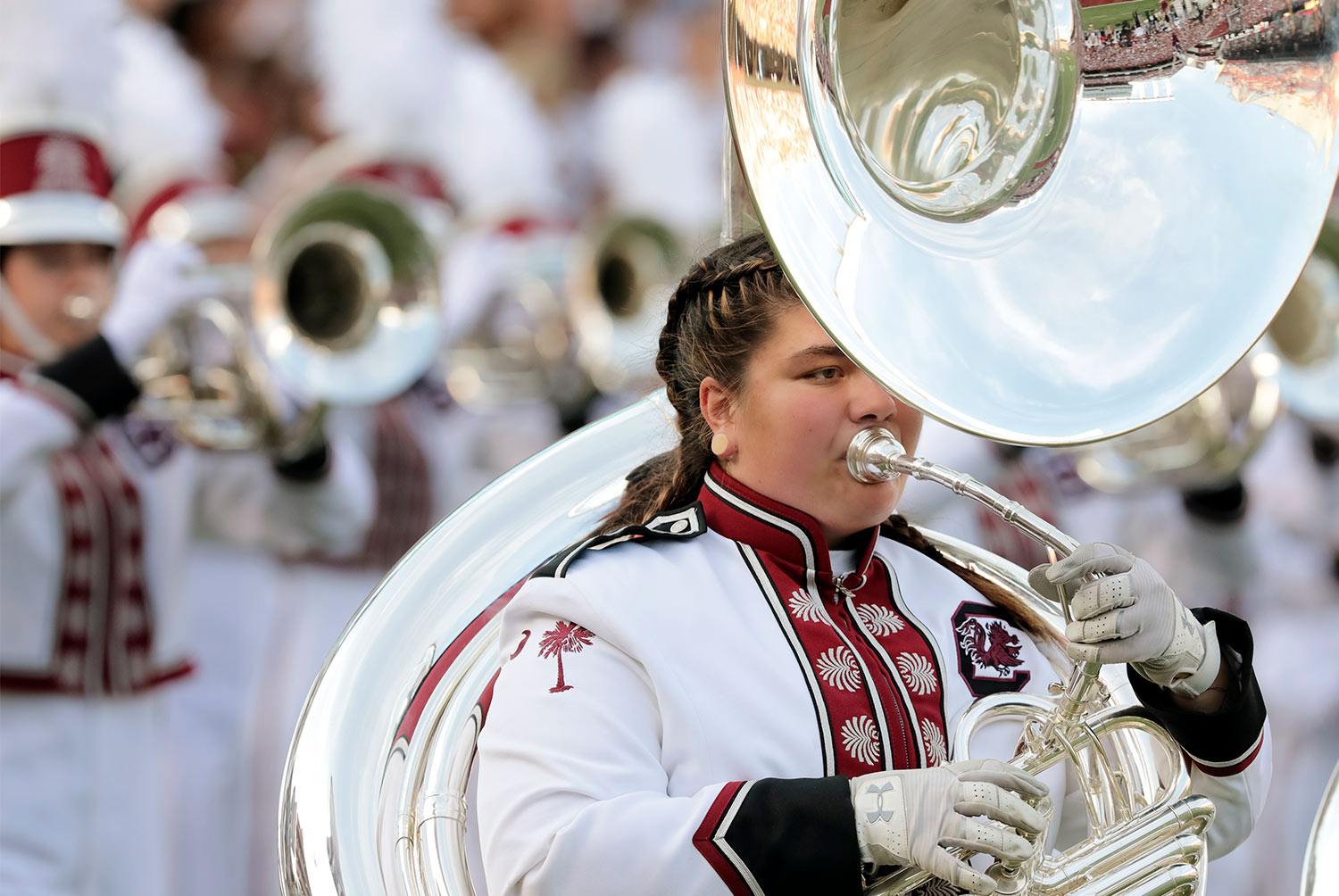
David Carter, a drum major in the Carolina marching band and a Teaching Fellow, has had numerous opportunities to watch experienced teachers and try out their techniques as a student teacher. “Along with the wonderful privilege of being a student teacher, I've had the opportunity to be a student watching the teachers. By observing these teachers, you learn to use and adapt some of their ideas into your own teaching.”
Classroom teaching isn't always a positive experience, of course. Students act up; the lesson plan that seemed so clear and exciting suddenly seems leaden and dull. It's times like that when Teaching Fellows dig a little deeper.
“This is what I'm called to do, there's no doubt in my mind,” said Abernathy, the former Teaching Fellow who's now teaching world history at Blythewood Middle School. “There are days when it's tough, but it's definitely where I need to be—and want to be.”
|