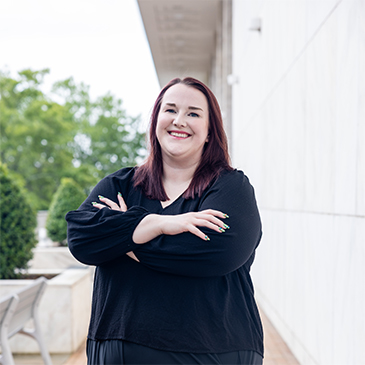
As part of the Student Affairs Fellowship, Hannah McCloy of the Office of Student Advocacy is gaining a broader perspective on the many ways higher education professionals support students.
Originally from Missouri, Hannah studied higher education with a focus on assessment. She brings a natural curiosity and follow through to her work, whether she’s color-coding organizational materials, exploring generational trends or intentionally looking at familiar things through a fresh lens.
She is passionate about lifelong learning and hopes to read more, learn a new language and continue expanding her perspective. Those qualities make her a natural fit for the fellowship, where she is learning from colleagues across the division while also bringing her own experiences and ideas to the conversation.
Hannah credits her mentors and professionals who made a difference during her own higher education journey. Their combination of compassion, honesty and encouragement helped shape the professional she is today — and she hopes to offer that same support to others.
Here are three themes from my conversation with Hannah that I’ll take with me as I complete my own fellowship with Communications and Marketing.
Fellowship Experiences and Goals
Jennifer: Tell me about your fellowship so far!
Hannah: The first part of my fellowship placement was with the Student Success Center, where my main duty was to help plan and execute the Graduate Student Expo. I also helped with some of the welcoming table activities and training as we prepared for the school year.
Now I’m in the Carolina Experience area. I’ll be attending some of their events, but I’ll also be doing such assessment of the data they have, including retention information. I really like that the fellowship is covering all of the “heavy hitters,” so I’m getting exposure to a lot of different areas.
Altogther, what I’m hoping to get out of the fellowship is a broader picture of all the different areas of Student Affairs. I have a degree in higher education, but I started my career in a very niche field. Actually, being with those teams, learning what they do intrinsically and understanding how they support students is really important to me as a professional. I want to learn that so I can share that information with our students.
But I also don’t know exactly what my long-term plans are. Even though I’ve been doing this since 2021, I still consider myself relatively new to higher education, so I’m excited to continue learning and expanding my understanding of opportunities for student development, growth and professional advancement.
Student development is always changing, so we should always look at ourselves as new professionals because there is always something new to learn. Even generational changes — from Millennials to Gen Z and eventually Generation Alpha — are really interesting to me.
It has been really cool to see how different offices are changing and growing to benefit the student experience from start to finish.
Jennifer: What are you hoping to give back to those areas?
Hannah: I’m hoping to give them my passionate desire to support students and an outside perspective. A lot of times when we’re hired into these roles, we get really comfortable because we’re in our work every day and know what we’re doing.
I want to bring an outside perspective based on what I’m seeing across the institution and think about how we can collaborate with my office and other offices on campus. What can we do to expand our services? What opportunities are there for collaboration?
I think bringing that perspective is important. I’m really energized by getting to work with people and learning about all of these different areas.
Supporting Students Through Difficult Experiences
Jennifer: Thinking about the students you work with and the broader higher education environment, what message would you want to give students right now?
Hannah: We’re starting to see students experience difficult feelings and emotions, and I think it’s important to remind them that it’s okay to feel that way. It’s okay not to feel okay all the time.
You’re going to struggle. It’s not always going to be fun, and sometimes it’s going to be uncomfortable. Allowing yourself to sit with that discomfort and feel it is part of how you learn from the experience.
But you also don’t have to experience that discomfort alone. Whether you use university resources, talk to a friend or find another support system, you’re not alone in what you’re feeling. Sharing those experiences with others and making sure you get the help you need is crucial. You don’t have to do everything yourself.
I think that message applies to students and professionals. At the beginning of the academic year, there’s so much effort and energy going into everything. We need to remember why we’re doing it.
Finding Your “Why”
Jennifer: What is your “why”?
Hannah: I think it’s easier for us in the fellowship to think about our “why” because we’re expanding our horizons. We’re looking at different offices and having different experiences.
For me, there’s also a personal component. I wanted to learn and grow professionally, but I also wanted the fellowship to benefit me in the role I’m currently in.
I think a lot of people enter higher education because they want to give something back. They want to support students and make sure students have as positive a journey as possible so they can achieve whatever their goals may be.
But when we get overwhelmed by everything happening at the start of the year, it can
be difficult to remember that.
I think even when we’re feeling discomfort, burnout or overwhelmed, it’s important
to remember that we’re not alone in that either. I never went into it thinking, “This
is going to be easy.” There are a lot of complicated things that come with working
in higher education, and that’s just the nature of it.
But clearly, you’re here because you want to give something back. For me, I grew up in a tiny town of about 1,600 people. Most people in my hometown don’t necessarily get out and experience different places. My parents always encouraged me to explore.
When I initially left home, I wanted to just go back. My parents told me, “You can absolutely come back if you want to, but that’s your choice. We want you to explore something different.”
They encouraged me to go to college, go to a trade school, travel the world — just go somewhere else and experience something different before deciding where I wanted to be.
I ended up going to college, and my experience actually wasn’t the best at the beginning. I didn’t make the best decisions as a student, and I really had to learn from those experiences. But I also received so much support. I got to work with professionals who were incredible. They offered me kindness when I needed it, but they were also honest with me when I needed to hear it.
They would say, “Hey, this needs to change. We’re not going down a good path.”
That kind of support truly improved my experience, and I want to be able to provide that for somebody else.
A Fresh Lens on Student Affairs
Hannah’s story is a reminder that professional growth doesn’t always come from having all the answers. Sometimes, it comes from being willing to ask questions, explore something unfamiliar and see an experience from a new perspective.
Throughout our conversation, I was struck by Hannah’s openness, authenticity and her commitment to lifelong learning. She is eager to understand the work happening across Student Affairs, but just as importantly, she wants to understand how that work connects — and how those connections can ultimately better serve students.
Hannah, thank you for sharing your time, your experiences and a little more about your “why.” More than anything, thank you for being a caring and advocating presence on campus — someone who brings optimism, a fresh lens and a willingness to see what might be possible from a new perspective.
I’m excited to see where this fellowship takes you and the impact you’ll have along the way.
This story was written by Jennifer Jackson, who is completing a yearlong fellowship with the Communications and Marketing team.