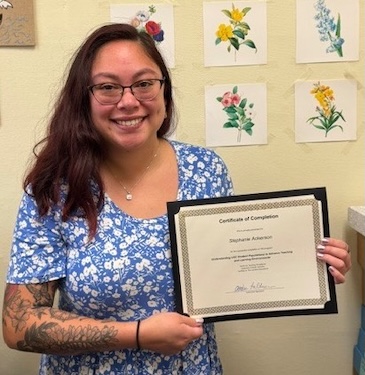
For Stephanie Ackerson, the first day of class this fall looked a little different.
Instead of spending the entire period walking students through a syllabus, the biological sciences instructor plans to begin with something more personal: an introduction to who she is, a chance for students to connect with those around them and a conversation about the practical skills that can help them navigate college.
“We didn’t start with content day one,” Ackerson says. “We actually talked about the stuff that will help a student succeed through all four years.”
It is a small change with a larger purpose. Ackerson, who teaches genetics, cell and molecular biology and introductory biology, regularly works with students at different points in their University of South Carolina journeys. Through the Understanding USC Student Populations to Advance Teaching and LearningEnvironments certificate, she has found new ways to better understand their experiences and to respond in the classroom.
Created by Carolina Experience in partnership with the Center for Teaching Excellence in 2024, the certificate is open to faculty, instructors, staff and graduate students. Its sessions explore the experiences of specific USC student populations and pair local and national data with teaching strategies, campus resources and conversations among colleagues.
The certificate grew from a question Amber Fallucca, director of Carolina Experience, heard often from faculty: Who are the students in my classroom?
“Faculty were curious who was in the classroom with them,” Fallucca says. “They would say, ‘I just wish I knew more about my students.’ And so that was really the genesis of the idea of a certificate program.”
Carolina Experience’s work is informed by nearly a decade of cohort-based survey data, including feedback from sophomores, juniors and transfer students. That local perspective helps the certificate move beyond broad trends, giving participants a clearer understanding of how USC students experience academic life, connection and career preparation at different points in their college journeys.
Faculty, staff and graduate students have two years to complete the certificate, which includes two required workshops and three electives. This fall’s required workshops, “What Do Students Want from Their Faculty?” and “Unpacking USC Data to Support Experiential Learning and Career Readiness Across Transfer, Sophomore and Junior Year Experiences,” will be held Sept. 15 and Sept. 29, respectively.
One of those required workshops, “What Do Students Want from Their Faculty?,” is led by Dan Friedman, assistant vice president for University 101 Programs and the National Resource Center for the First-Year Experience and Students in Transition. Fallucca says Friedman uses an interactive, game-based approach to help participants consider national student data alongside their own experiences with USC students. For Ackerson, the session offered a helpful reminder to approach students with curiosity and avoid letting a small number of difficult interactions shape expectations for an entire class.
“Dan told us, and this really stuck with me, to stop treating our students like they’re trying to burn us because the vast majority are not,” Ackerson says.
Elective offerings explore the experiences of first-generation students, student-athletes and students beyond their first year. Participants can also earn elective credit through Mutual Expectations, another Carolina Experience program that brings students, faculty and staff together to understand each other through discussions on key topics like artificial intelligence and free speech in the classroom.
For Ackerson, those conversations reinforced both how much faculty and students have in common and where students may need more guidance. She recalled students asking for advice about communicating with professors, using office hours and navigating expectations that may feel obvious to longtime faculty members but unfamiliar to students.
“I really try to do these certificates and these different sessions because I need to find other ways to help my students,” Ackerson says. “The way I think about a problem is not the same way they do, and it’s just helped give me more tools to better help them.”
Those tools have already found their way into her teaching. In one session, Ackerson learned about quick classroom assessment techniques that help instructors better understand where students are struggling. She now includes QR codes in her presentations that direct students to answer questions through a Google Form, allowing her to see in real time what concepts need more attention.
“There’s just small classroom assessment techniques that you can use that don’t take a lot of time but do engage your students and help give you information on what they’re tripping up on,” she says.
The certificate also offers a reminder that student success is shaped by more than course content. Ackerson has noticed that many students are hesitant to speak up, ask questions or risk being wrong in front of their peers. Her revised first-day presentation this year addresses those concerns directly, offering guidance on how to study, communicate and use available resources while helping students see their instructor as an approachable partner in their learning.
For Carolina Experience, that kind of connection is the goal. The office works to support students throughout their undergraduate journeys, with particular attention to transfer students and students beyond their first year. The certificate extends that work by inviting the broader campus community into the conversation.
So far, nearly 20 members of the USC community have completed the certificate, forming a group Fallucca sees as key partners in extending Carolina Experience’s work across campus.
“It’s just nice that we have a ready-made interested group that can give feedback on an initiative with Carolina Experience,” she says. “They’ve completed the program and they’re excited, but they’ve also learned a lot about our student population, so they have a pretty good understanding of who we serve.”
Learn more about upcoming sessions and the Understanding USC Student Populations to Advance Teaching and Learning Environments certificate through the Center for Teaching Excellence.