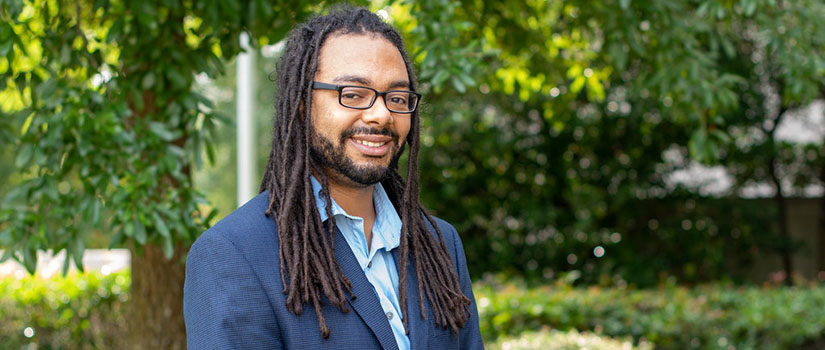
Forest Agostinelli has earned one of the National Science Foundation’s most prestigious honors for early career faculty: a five-year, nearly $500,00 CAREER Award to develop artificial intelligence that can find solutions when researchers know what they need but don’t know how to get there.
The computer science and engineering assistant professor and AI Institute researcher is developing new AI methods that could eventually help address problems ranging from teaching robots to perform complex tasks to identifying molecules with properties needed for new medicines.
Agostinelli’s research will focus on pathfinding, the process of determining the steps needed to move from a starting point to a desired outcome. Pathfinding is used in areas such as robotics, chemical synthesis, computer programming and quantum computing. But the challenge becomes more difficult when the desired outcome can be described only in broad terms. In these instances, properties of the goal can be specified, but neither outcomes that satisfy these properties nor the process for satisfying these properties are known.
Agostinelli wants to develop AI algorithms capable of finding the path on their own. He illustrates how a crossword puzzle is an example of a pathfinding problem.
“We visualize what makes sense before filling in squares,” Agostinelli says. “We think about what we’re going to do before we do it. For this project, machine learning will guide the search, and the logic part tells the search what the solution should look like. The only part a human has to do is describe the solution, and AI does the rest.”
The approach could have applications in chemical synthesis and drug discovery. For example, researchers could describe the characteristics they need in a molecule and use AI to search for candidates that meet those requirements. Agostinelli points to treatments for progressive diseases such as Alzheimer’s and Parkinson’s as examples of areas that could eventually benefit from such advances.
“We may not know of a specific molecule that has the properties necessary to treat a disease, but through the process of solving the problem with high level goal specifications, we can discover the solution,” Agostinelli says. “We are creating novel AI algorithms to solve pathfinding problems based on the end goal we’d like to reach.”
The research will also explore how AI systems can learn from unsuccessful attempts. By understanding why a potential solution failed, an algorithm could refine its approach and make better decisions during subsequent searches. Agostinelli also hopes the research will identify ways to solve pathfinding problems more efficiently. This advancement could have significant pharmacology implications, such as more affordable prescription drugs.
Agostinelli’s research team is composed of five graduate students along with Integrated Information Technology Professor Dezhi Wu, Assistant Professor Francisco Leon from the College of Pharmacy, and Professor Matthew Irvin from the College of Education.
The interdisciplinary team will also help fulfill the education and outreach component of each CAREER Award. Agostinelli will work with Wu and Irvin to evaluate how AI can support student learning. University of South Carolina students participating in the project will gain hands-on experience, exposure to real-world applications, and engagement with current research challenges that build both practical skills and deeper conceptual understanding.
This project builds on Agostinelli’s other work in the AI Institute, such as AI systems that can learn how to solve problems when only given only a description of a pathfinding domain in the form of a sequence of images. In these instances, researchers capture examples of the pathfinding domain, but do not explicitly define it. In simulation, machines learned how to solve the Rubik’s Cube using pictures to determine how to manipulate the cube. Similar methods could have applications in manufacturing, where robots are taught to assemble machinery.
According to Homayoun Valafar, chair of the Department of Computer Science and Engineering, the department has an NSF CAREER Award success rate of approximately 80%, demonstrating the exceptional quality and national relevance of its research.
“Dr. Agostinelli’s CAREER Award recognizes research with the potential to make artificial intelligence more capable of solving complex, real-world problems. By enabling systems to navigate toward high-level goals, even when the precise solution is not already known, his work could accelerate advances in areas ranging from robotics to molecular discovery.”
Valafar added that the award reflects the department’s growing strength in impactful, interdisciplinary AI research and in preparing students to contribute to it.
For Agostinelli, the goal is to give AI systems a greater ability to work toward solutions when the destination is clearer than the path for getting there – a challenge shared across fields from robotics and manufacturing to medicine.