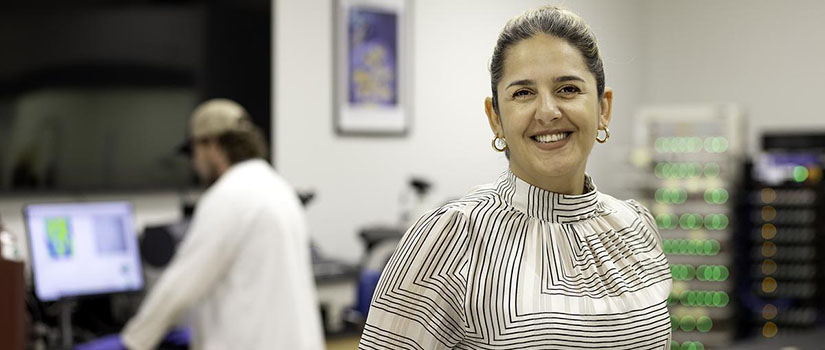
University of South Carolina Chemical Engineering Assistant Professor Golareh Jalilvand has received a five-year, nearly $550,000 National Science Foundation (NSF) CAREER Award to investigate new ways to help rechargeable batteries store more energy and last longer. The award is one of the NSF’s most prestigious honors for early-career faculty.
Her research could inform batteries that help electric vehicles travel farther, allow phones and other devices to run longer between charges, and improve energy storage for the power grid.
At the heart of the project is a deceptively simple question: How can scientists get more energy out of the chemical reactions taking place inside a battery?
Jalilvand is studying a class of chemical reactions known as multi-step multi-electron conversion reactions. These reactions can theoretically produce large amounts of energy, but as they occur, the materials involved undergo chemical and structural changes. Those changes can prevent batteries from reaching their full energy potential.
“The advantage of these types of reactions is that we get a lot more energy,” Jalilvand says. “But right now, those reactions are not providing the energy they theoretically could due to limitations that occur as a result of dynamic changes. We are trying to mitigate those limitations so we can capitalize on the increased capacity for energy.”
While this transformational research has a broad range of applications, she is particularly interested in what it could mean for energy storage.
“This work can help us build batteries with a much higher energy density, or more energy with a single charge,” she says. “This can be applied to longer-lasting electric vehicle batteries, greater grid energy storage and defense applications—basically any application requiring rechargeable batteries.”
To better understand what happens inside a battery, Jalilvand’s research team will use lithium-sulfur batteries as a model. They will examine the reactions at different scales, from individual atoms and molecules to larger structures, and identify the changes that limit how much energy a battery can deliver.
The project also has an artificial intelligence component. Computer science and data experts will help develop a machine learning model that can use information from experiments to predict battery performance.
For Jalilvand, who has long been interested in batteries and electric chemical systems since her undergraduate studies, her passion for research is centered around her team, a group of 12 undergraduate and graduate students working alongside her in the Carolina Battery Institute.
“I love interacting with students, and my team is the most fun part of what I do,” Jalilvand says. “Even if they aren’t working directly on this project, they all have a footprint in it. It’s a continuous learning process. Whatever they do in the lab, whether it turns out wrong or perfect, gives us insight and guidance for the next step.”
That emphasis on student involvement is an important part of the CAREER project.
“The prestigious CAREER Award is a well-deserved recognition of the high impact materials research and education activity being conducted in Professor Jalilvand’s laboratory,” says Chris Williams, chair of the Department of Chemical Engineering. “One of the most impressive aspects of her efforts is her inclusion of undergraduates in her research activity at a very high level, allowing them to take ownership of their projects and be full contributing members of the research team.”
Jalilvand is extending those educational efforts beyond her laboratory. She serves as a battery boot camp instructor for the South Carolina Council on Competitiveness, where she teaches industry and government officials about battery technology and efforts to advance the state’s battery sector. Twice a year, she also welcomes high school students into her lab for hands-on experiments that give them experience in building batteries.
She also plans to bring lessons from the CAREER research into college classrooms through new instructional materials and course modules.
Chemical Engineering Distinguished Scientist Ralph White says Jalilvand’s curiosity and hands-on approach have helped make her an effective researcher and mentor.
"She is constantly developing new and novel methods of improving our understanding of prior art and developing new materials and analysis procedures that yield valuable new information,” White says. “She is an inspiration to all of us on the faculty, and her students love her hands-on approach to mentoring.”
By the conclusion of the five-year CAREER project, Jalilvand hopes the discoveries and insights from her work leads to exciting advancements in electrochemistry and materials science that will help researchers better predict how battery materials behave and ultimately design energy-storage systems that are more efficient and capable of holding more energy.
But for Jalilvand, the project is more about what happens inside a battery. It is also about the students and future researchers who will carry those discoveries forward.
“This work has so many aspects of outreach and learning, involving all levels of education, and that is really what is so inspiring to me,” she says.