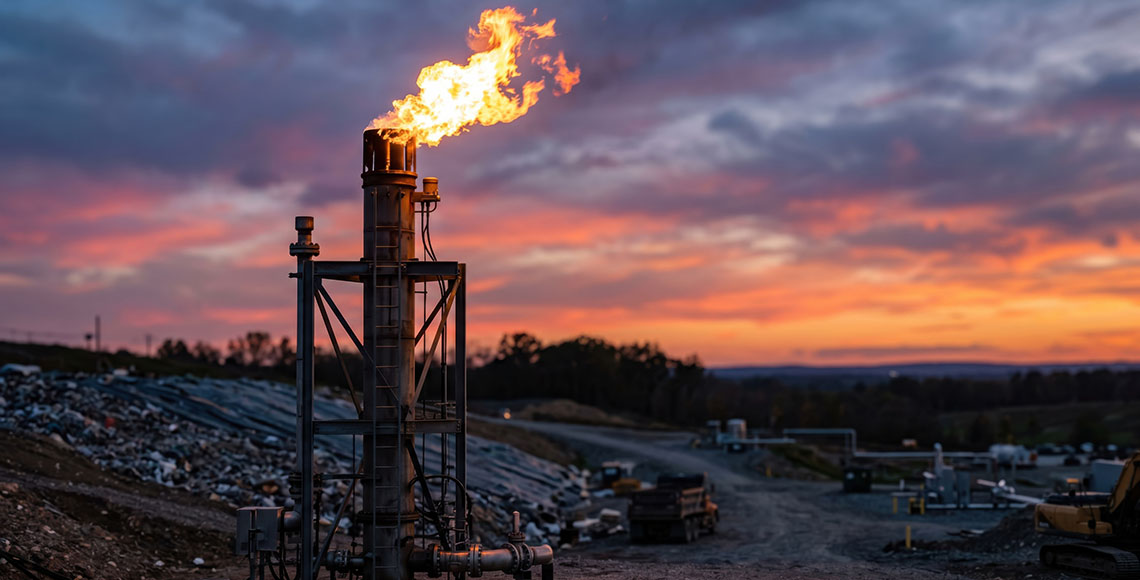
New patented technology developed by Molinaroli College of Engineering and Computing researchers removes damaging contaminants and could improve renewable energy production.
A landfill is more than the final destination for our garbage. They also produce methane that can be used to generate electricity. But a common contaminant in that gas can damage engines and make the fuel difficult to use.
To help address this issue, Civil and Environmental Engineering Associate Professor Shamia Hoque and Mechanical Engineering Professor Tanvir Farouk have patented new technology that removes the contaminant siloxane while converting it into a material with potential commercial uses.
Siloxanes are chemical compounds found in cosmetics, personal care products and many industrial materials. When they end up in landfill gas and are burned, they form silicon dioxide, which can damage turbines and industrial engines by creating abrasive deposits.
Current methods for removing siloxanes are expensive and the process typically captures the compounds before sending them back to the landfill.
For the past six years, Hoque and Farouk have worked on a different approach. Their patent, “Siloxane removal off landfill gas using dielectric barrier discharge plasma,” was filed in 2020 and issued this past June.
The project began with a simple question: Could siloxanes be removed from landfill gas using plasma’s unique selectivity, thereby enhancing its use as an alternative fuel source?
Leveraging Farouk’s expertise in plasma devices, a dielectric barrier discharge (DBD) plasma system for contaminant removal was developed. During early testing, Hoque and Farouk discovered that the plasma converted siloxanes into polydimethylsiloxane, a stable compound used as an anti-foaming agent, a lubricant and in the construction of microchips.
"The idea was that instead of removing siloxane and sending it back into the landfill or into the environment, could we form a loop?" Hoque says. "We were successful in removing siloxanes from the gas stream and converting them into a solid phase that potentially could be reused as a raw material."
Initially the project focused on a practical application, such as determining if landfills could utilize the DBD plasma system technology.
"It was more the need for a practical solution rather than looking at the fundamentals and coming up with the application, which was a reverse way of normally doing things," Farouk says.
Traditional methods for removing siloxanes often rely on high-temperature combustion, which consumes significant amounts of energy. In some cases, the energy needed to clean the gas can offset much of the power the landfill would otherwise generate. Farouk says plasma offers a more targeted alternative.
"We picked plasma, and especially the dielectric barrier, because of its chemical selectivity," he says. "Instead of using the same process, it can target specific molecules because it's an all-electric field-driven reaction carried out by energetic electrons."
Unlike many plasma systems that treat material in batches, Farouk and Hoque’s design continuously processes gas as it flows through a tubular arrangement surrounded by two ring-shaped electrodes.
"The design is simple and small," Farouk says. "For industry, it's basically an add-on/retrofit unit to any of their piping systems that doesn't need a lot of changes."
Testing also showed the system performed well even as siloxane levels changed.
"One of the tests we did was to determine if the plasma still operated no matter how much the siloxane concentration varied," Farouk says. "The DBD checked the box of all our targets because the precipitation rate of siloxane was the highest."
As the patent application moved through the approval process, Hoque and Farouk continued testing the technology. What they initially designed for a single siloxane compound proved effective across multiple types.
"With every iteration, we realized that it worked for any kind of siloxane," Farouk says. "It operates in all atmospheric conditions and doesn't need a special vacuum system, which gives it versatility."
Hoque also studied how mixtures of different siloxanes affected the system's performance.
"It was interesting to see how different types of siloxanes can influence how much would be removed, but in all circumstances, we achieved efficient removal," she says.
Although the patent has been issued, the research continues. Hoque and Farouk are now focused on improving the reactor's design so it can process larger volumes of gas without increasing energy use.
"We have looked into the design to see if we can actually use the same power and expose the gas in a more efficient manner," Hoque said. "It's just one of many areas we have to keep exploring."