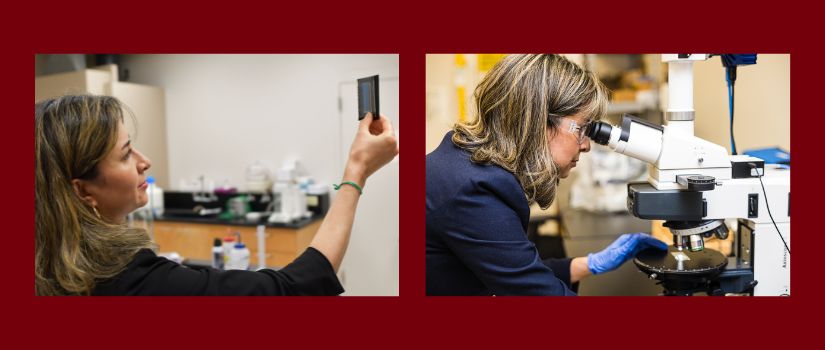
Chemical Engineering Associate Professor Sanaz Sadati has earned a highly competitive National Science Foundation grant to explore a bold new approach to materials design: turning defects, typically seen as weaknesses, into an advantage.
Sadati recently began a two-year National Science Foundation (NSF)-funded project with Mechanical Engineering Associate Professor Andrew Gross serving as co-principal investigator. The project is funded through NSF's Early-concept Grants for Exploratory Research, or EAGER, program, which supports potentially transformative research ideas that are considered high risk but could lead to significant advances.
At the center of the project are liquid crystals, materials best known for their use in electronic displays. Liquid crystals flow like liquids, but their molecules maintain some of the organization found in solid crystals. Disruption in that molecular order can produce tiny, localized defects at predictable locations.
Sadati believes those defects could serve as a template for building new materials at the nanoscale. Most people think of defects as flaws and weak points in a solid material that can lead to unpredictable behavior. But these defects are different: they form within the organized molecular structure of a liquid crystal.
"We want to leverage these defects for function," Sadati says. "If we can control exactly where they appear in the liquid, we can use those locations to guide polymers to those defect regions and build new structures with nanoscale precision.”
The process begins by introducing a polymer precursor, which is a starting chemical compound, into a liquid crystal. Sadati’s goal is to engineer the defects to form a well-defined network. At the right material conditions, the polymer precursor will then be precisely localized into these defect regions, where it is locked into place through polymerization. Once the liquid crystal is removed, the polymer structure that preserves the nanoscale architecture of the original defect network remains.
"It's like having a blueprint embedded within the liquid crystal itself, showing the polymer exactly where to go," Sadati says.
The result could be a porous network made up of extremely small strands of polymer. Sadati compares the structure to a net, with openings approximately 200 to 400 nanometers across and individual strands measuring about 10 to 30 nanometers. For comparison, a human hair is roughly 50,000 to 100,000 nanometers wide. That extremely small scale could be important to the material's strength.
We hope this work will open up a new approach to designing materials and creating structures that would be difficult to achieve through conventional methods.
- Sanaz Sadati
Larger materials can contain microscopic cracks and other imperfections that create weak points. As structures become smaller, there is less space for those flaws to develop. By creating structures at the nanoscale, Sadati hopes to produce materials that combine high strength with the low weight of a porous structure.
"From a defect, which is not desirable, you are getting this nanoscale organized structure," Sadati says. "It's basically using the defects to your advantage."
This approach could also offer an alternative to additive manufacturing at the nanoscale. Additive manufacturing builds structures layer by layer and can create increasingly small and complex designs. But current manufacturing methods have limitations when structures reach extremely small scales. Rather than relying on a machine to construct every nanoscale feature, Sadati's approach would allow the molecular arrangement of the liquid crystal to serve as the manufacturing template.
In effect, the liquid crystal itself guides how the structure forms.
"What we are doing is essentially additive manufacturing at the nanoscale,” Sadati says. “But instead of a machine placing material layer by layer, we use the liquid crystal’s molecular organization to guide where the material is built.”
If successful, the technique could provide a faster and potentially scalable way to manufacture nanoscale structures. But getting the polymer into exactly the right places remains one of the project's biggest challenges. While the concept is feasible, Sadati’s next step is determining the right combination of materials and processing conditions, so the polymer moves into only the defects before it is permanently locked into place.
"We still need to optimize the conditions,” Sadati says. "We need to make sure the polymer reaches the defect regions before we lock the structure into place.”
Another aspect of the project will examine what happens when the liquid crystal is removed and test the resulting polymer structures to determine their mechanical strength. Gross will lead the mechanical characterization of the structures.
“We will conduct micropillar compression testing on blue phase lattices that can apply load to these materials inside a scanning electron microscope,” Gross says. “This allows us to make measurements of their mechanical properties, such as strength as stiffness, as well as put together videos that resolve how the nanoscale members in these lattices deform under load.”
The project’s idea grew from Sadati's NSF CAREER Award research, which also focuses on liquid crystals. That work examines their photonic properties and ways to improve their stability across a wider range of temperatures.
As Sadati's group studied those materials, the research raised another possibility: Could the same liquid crystals be used not for their optical properties, but as a platform for manufacturing new materials? That question led to the EAGER project.
"To our knowledge, no one has explored using these defect networks to create mechanically strong materials," Sadati says.
It is also why the research fits the EAGER program's high-risk, high-reward approach. If her concept works, it could introduce a new way to design and manufacture materials at scales that are difficult to reach with existing techniques.
For Sadati, that uncertainty is also part of what makes the project worth pursuing.
"Researchers love to push the envelope and see how far they can go," she says. "We hope this work will open up a new approach to designing materials and creating structures that would be difficult to achieve through conventional methods.”