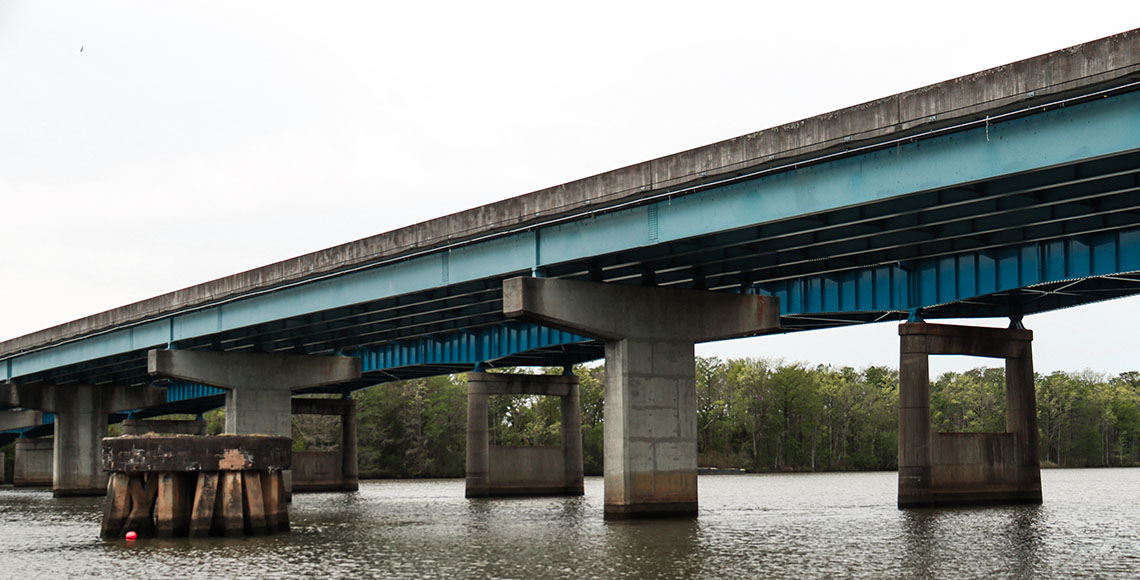
What lies beneath a bridge can be just as important as the structure above it. Because soil conditions vary widely across South Carolina, the foundations that support bridges must be designed for the ground beneath each site.
Civil and Environmental Engineering Professor Sarah Gassman is leading a three-year project to help the South Carolina Department of Transportation (SCDOT) use state-specific data to design bridge foundations that are safe, reliable and potentially more cost-effective.
“Every soil behaves differently,” Gassman says. “This project gives us an opportunity to use site-specific data from tests in South Carolina to calculate resistance factors and see how they compare to the national resistance factors.”
The project began in July and focuses on developing South Carolina-specific design factors for deep foundations – foundations that extend deep into the ground to support a bridge. Gassman is working with Civil and Environmental Engineering Associate Professor Joseph Flora and doctoral student William Gieser, who is also project engineer at F&ME Consultants.
We know the properties of steel with a high confidence but have a much lower confidence on the properties of soil.
- Sarah Gassman
Engineers use the design method known as load and resistance factor design, or LRFD to account for uncertainties in the materials and conditions that affect how a structure will perform. For deep foundations, one of the biggest uncertainties is the ground itself.
Current bridge design specifications use resistance factors to help engineers account for uncertainty in how reliably soil can support a foundation. These factors are based on data from across the country and are included in SCDOT’s design manual, but they may not fully reflect the soil conditions and foundation performance found in South Carolina.
Feedback from engineers has indicated that greater optimization could help prevent foundations from being either overdesigned, potentially adding unnecessary construction costs, or underdesigned. Historically, engineers addressed uncertainty by applying a factor of safety to a design.
“You make the design calculations for a structure or a foundation to hold a certain load,” Gassman says. “If a foundation needs to hold 100 kips [kilo-pounds], you want to design it to hold more to protect against uncertainties and changing conditions.”
LRFD allows engineers to take a more targeted approach. Instead of applying one overall safety factor, engineers can account separately for the uncertainty associated with different materials and parts of the structure.
“You can apply a different resistance factor to concrete, steel and soil,” Gassman says. “We know the properties of steel with a high confidence but have a much lower confidence on the properties of soil. This gives us the ability to apply different factors of safety to different parts of the structure to get a better design.”
Gassman’s team has begun examining how other state departments of transportation have developed their own resistance factors and determining which approaches could be applied in South Carolina. Among the information available are results from pile driving analyzer (PDA) tests. Engineers drive steel piles deep into the ground to support bridges and other structures. Sensors attached to a pile during installation can help engineers understand how the pile and surrounding soil respond as it is driven. Gieser brings field-testing experience from his work as a consultant and has access to more than 250 PDA test results from projects throughout the state.
“SCDOT takes the data they've collected on previous projects and does a numerical analysis to make sure they're not being too conservative or getting too close to the edge of their design,” Gieser says. “The idea of the research is to take all the test data we have and develop geotechnical resistance factors based on geologic formations to account for the variability inside of those formations.”
The results will be paired with information about soil profiles and site investigations to build a comprehensive database. Flora will then develop a numerical model to analyze the information and calculate potential resistance factors. This will compare how much support a foundation needs with how much resistance the surrounding soil can provide.
“My experience will be used to turn SCDOT’s foundation testing data into reliable, practical design recommendations,” Flora says. “The computer code will be used to analyze uncertainty, ensure consistent results, and allow SCDOT to update its design standards, leading to bridge foundations that are both safe and cost-effective.”
By grounding design guidance in South Carolina’s own soil conditions and foundation-test data, the research could help SCDOT design bridges with greater confidence. The result could be foundations that provide the needed safety and reliability without adding unnecessary material or construction costs.