A design can work perfectly on a computer screen. But can someone actually build it?
Through a distinctive, hands-on partnership, University of South Carolina aerospace and mechanical engineering students and Midlands Technical College machine tool technology students are answering that question together – before either group enters the workforce.
The collaboration connects the people who design components with the people who bring them to life. USC students apply engineering analysis to develop a design. Midlands Tech students review it through the practical lens of manufacturing, recommend changes and ultimately fabricate the finished part. In the process, both groups gain firsthand experience in communication, problem-solving and mutual respect that effective engineering and manufacturing require.
This semester, Mechanical Engineering Associate Professor Andrew Gross is once again partnering with the machine tool technology program at Midlands Tech for undergraduate students in his finite element stress analysis course. The partnership makes the classroom project more than an academic exercise, pairing future engineers and machinists as collaborators on a shared outcome.
“When our engineering students enter the workforce, they will not manufacture their own designs,” Gross says. “This lets our students see their designs come to life, while also mirroring real world interactions between engineers and machinists.”
That interaction is central to a successful design. Engineers may use calculations and computer models to develop a design, but machinists understand the equipment, materials and processes needed to turn those plans into physical parts. Working together can reveal potential problems before manufacturing begins, saving time and reducing costs.
For USC students, the partnership reinforces that correct calculations are only one part of good engineering.
“Something can look great from an engineering standpoint, and the math or analysis may even be optimized, but that doesn’t necessarily mean it makes sense to fabricate it that way,” says Bea Acylar, a mechanical engineering major who is enrolled in Gross’s course. “As engineers, we don’t always know what is most practical once a design reaches the shop floor.”
From the classroom to the shop floor
Mechanical and aerospace engineering juniors and seniors will work in teams of four to design a beam structure to explore requirements for strength, weight and cost.
Each team is paired with a Midlands Tech student who will review the design from a manufacturing perspective and provide feedback and a cost analysis. USC students will then have an opportunity to revise their work before the Midlands Tech students manufacture the final designs. The exchange reflects the back-and-forth that takes place every day between engineers and machinists in industry but gives students a chance to build those relationships while they are still learning.
“I appreciate having someone with that perspective challenge the way we approach it,” Acaylar says. “That collaboration is where the design becomes more complete, because we’re bringing together what works theoretically with what can realistically be manufactured.”
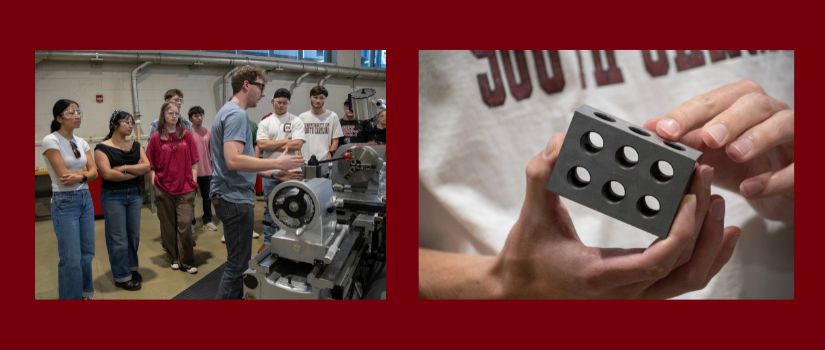
Gross’s students recently visited Midlands Tech to see the manufacturing facility and equipment that will be used to turn their designs into physical components. Midlands Tech students will use equipment such as computer-controlled milling machines, band saws and drill presses to fabricate the parts. Later this semester, Midlands Tech students will join Gross’s class in his lab to put the finished components to the test, comparing how their computational predictions line up with the real structural performance of their designs.
Learning from each other
The partnership benefits both institutions’ students because it gives each group a meaningful role in the entire process. Midlands Tech students are not simply receiving instructions for a part; they are involved early, reviewing designs, identifying manufacturing considerations and communicating directly with the engineers who created them. USC students, meanwhile, learn how to explain their design choices clearly and incorporate insight from manufacturing experts.
Engineering and manufacturing require people with different areas of expertise to work together. Acaylar already has an interest in working across technical fields and sees the project as preparation for the collaborative environment she expects to encounter after graduation.
“Their knowledge is incredibly valuable to understanding how an engineering decision translates into something that can be made,” she says. “Having the opportunity to learn from that perspective now, while also practicing how to communicate my own reasoning, will help me approach future designs with more than just the engineering side.”
The benefits also extend to the Midlands Tech students. Instead of simply receiving instructions for a part, they are involved earlier in the process, reviewing designs, identifying manufacturing challenges and communicating directly with the engineers who created them.
Together, the students experience both sides of a relationship that will be common throughout their careers. For Gross, putting those students on the same team makes an important lesson tangible: A good engineer does not design in isolation.
“We're teaching students at both campuses to talk with professionals in other roles,” Gross says. “Mirroring this real-world interaction in the classroom is a powerful tool to prepare our workforce.”