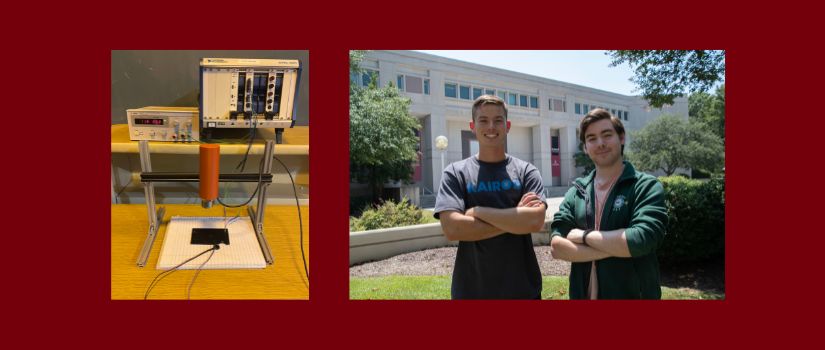
Left: The PATCH Hardware Development Kit is placed under the Optris thermal Camera. Right: Undergraduate students David St. John and Patrick Wynne.
Senior aerospace engineering major Patrick Wynne is trying to teach a child-sized fitness watch to calculate heart rate on its own. Junior mechanical engineering student David St. John is figuring out how much energy it takes to do it.
Today, these two undergraduate researchers in Mechanical Engineering Associate Professor Austin Downey’s Adaptive Real-Time Systems (ARTS) Lab are tackling engineering problems that could help University of South Carolina researchers build a better tool for studying children’s health.
The device, called the Platform for Accurate Tracking of Children’s Health, or PATCH, was initially developed in 2020 as part of the Arnold Healthy Kids Initiative, a multidisciplinary research group focused on childhood obesity. PATCH is an open-source, wrist-worn device developed to collect data about children’s everyday activity. Now Wynne and St. John are working to make the technology smaller, more energy efficient and capable of analyzing some of its data as it is collected.
For Exercise Science Associate Professor Bridget Armstrong, a center scientist with the Arnold Healthy Kids Initiative, the collaboration highlights the value of bringing together researchers from different fields. She says Wynne has been instrumental in connecting her team’s focus on practical solutions to public health questions with the detailed engineering required to design, build and improve the device.
“When we started, our goal was essentially to recreate an open-source Fitbit for kids,” Armstrong says. “Along the way, we’ve discovered an entirely new area of research that challenges assumptions we thought were already settled.”
Designing that technology involves more than shrinking an adult fitness tracker. Children have smaller bodies and different physiological characteristics, and researchers need access to raw sensor data to develop and test methods tailored to them.
Currently, PATCH collects raw sensor data, stores it on a microSD card and relies on a separate computer to process and analyze the information. Wynne, who joined the project in January 2025, is exploring whether some of that work can happen on the wearable itself.
“My code collects the raw data and computes heart rate as close to real time as I can get and stores it to the SD card,” Wynne says. “But the goal is to have the device self-contained with no extra processing. The current device is not wired to behave like that, so we’re trying to explore this algorithm to help guide future hardware aspects.”
Getting a small wearable device to perform those calculations is more complicated than it might seem. The software must operate within the device’s limited memory and computing capacity without sacrificing accuracy. It also needs to consume as little energy as possible to extend battery life.
This is where St. John’s work comes in.
St. John, who joined the PATCH project this past spring is helping researchers better understand that energy use. He designed a custom development board that places the device’s components farther apart, allowing the team to measure how much power individual components consume.
“Using this board, we can watch components cycle on and off in real time,” St. John says. “For example, Patrick’s code writes data to an SD card every five seconds. Watching a video through a thermal camera, we can clearly see a distinct spike on the SD card every time an operation occurs.”
Wynne is also studying another challenge: Processing information as it is collected can be more difficult than analyzing data after it has already been recorded.
“For example, we can easily calculate an SD card with four days of hardware data,” Wynne says. “But what if I had to collect data and process it at the same time? Because there’s so many things that could go wrong, it’s hard to tell without running a test.”
Then there is the child wearing it.
According to Wynne, movement adds another complication. Even a slight shift of the device can create a false spike in a heart rate reading.
“Wearable heart rate monitors, especially commercial ones, always struggle with high-intensity activity,” he says. “Right now, we’re not trying to make a perfectly optimized code. We’re making something that works. We would eventually like to refine it to deploy in clinical trials.”
The immediate goal is not to turn PATCH into a finished medical monitor. Instead, the team is developing a research tool scientists can understand, modify and test specifically for children.
“Bridging engineering and applied public health has led to exciting collaboration and uncovered a host of interesting engineering and research problems to solve,” Armstrong says.