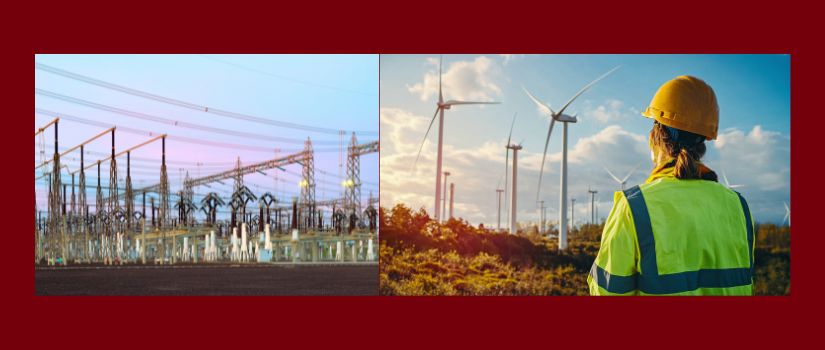
USC researcher develops new optimization methods to help grid operators maintain reliability as wind, solar and other inverter-based energy resources grow.
Reliable electricity is easy to take for granted, that is until a disruption affects the homes, hospitals and industries that depend on it. As the U.S. power system incorporates an increasingly diverse mix of energy resources – including wind, solar and nuclear energy storage – maintaining grid stability is becoming a more complex, consequential challenge.
University of South Carolina Molinaroli College of Engineering and Computing Electrical Engineering Assistant Professor Xin Fang is leading National Science Foundation-funded research to help grid operators keep power systems stable and responsible as inverter-based resources, including wind and solar, account for a growing share of the nation’s electricity supply.
The challenge lies in the changing makeup of the grid. While most nuclear plants and other conventional generators use large rotating machinery that naturally helps steady the system after a disturbance, wind, solar and other inverter-based resources respond through programmable controls.
In August, Fang started a three-year project to develop new optimization methods that could help operators manage a power grid with a growing number of inverter-based resources while maintaining frequency stability and controlling operating costs.
“We want to handle the multi-scale frequency stability in power systems because with more inverter-based resources, the system frequency becomes more vulnerable,” Fang says.
That stored energy essentially provides a cushion when the grid experiences sudden disruptions due to the generation trip or load increase, such as the data center load changes. If a power plant unexpectedly goes offline or electricity demand changes sharply, the rotating machinery in a traditional generator can help slow the resulting change in the grid’s frequency.
Most wind and solar resources operate differently. They connect to the grid through power electronic devices known as inverters and do not have the same rotating mass as conventional generators. Instead, their response to disruptions is largely determined by their control systems.
That difference creates a challenge — but Fang also sees an opportunity.
“Even though inverters don’t have a fixed physical inertia or rotating mass, we can control their dynamic response by designing their control algorithm on the inverter,” Fang says.
Keeping electricity in balance
For power grid operators, maintaining stability is a constant job. Electricity production must closely match how much homes, businesses, factories and other customers are using. When that balance shifts, the grid’s frequency can change. A sever frequency deviation can cause significant consequences, even cascading blackouts.
Traditionally, operators determine which generators should be running and how much electricity each should produce based on forecasted demand. Those decisions must account for reliability and cost while being made quickly enough to be useful for operating the grid. As inverter-based resources become a larger part of the electricity supply, Fang says operators may eventually need to make another decision: not only how much power those resources should provide, but how they should respond when something goes wrong.
“Right now, we schedule the power to balance the system, but in the future, they’ll not only schedule the power but also the dynamic response,” Fang says.
Fang’s project aims to build that additional consideration into the decision-making process. Working with Yong Fu, Tennessee Valley Authority Endowed Professor at Mississippi State University, Fang plans to develop models and optimization methods that could help operators determine how inverter-based resources should respond under changing grid conditions. The work will account for both electricity production and frequency stability when determining how resources across the grid should operate.
Instead of treating the response of an inverter as fixed, operators could potentially adjust it based on the grid needs at a particular time.
“The operator can adaptively change the dynamic response based on the system requirement,” Fang says. “It’s more flexible.”
Solving a bigger problem — quickly
Adding those decisions also makes an already difficult optimization problem considerably more complex.
Since grid operators work under strict time constraints, they cannot simply calculate the best solution whenever one becomes available. For example, decisions regarding which generators will operate the following day must be made early enough for those resources to be scheduled.
Fang and Fu plan to develop algorithms designed to break a large, complicated problem into smaller pieces that can be solved more efficiently. The goal is to give operators useful answers within their limited time to make decisions.
“We need to design advanced algorithms to make sure that we can get that solution within a very limited time window,” Fang says.
The goal of the project is to provide grid operators with a new way to think about inverter-based resources; not simply as sources of electricity, but as resources whose response can be adjusted to help keep the larger system stable. Fang hopes the research eventually can be used by independent system operators, which are the organizations responsible for coordinating electricity generation and transmission across large portions of the country.
“I think it will have a broad impact for the industry,” Fang says. “We want to collaborate with them to make sure that our algorithms can help them in the future to maintain system stability.”
For Fang, the project is also part of a broader effort to understand what happens to the power grid as inverter-based resources become more common. His current work focuses on frequency stability, but he hopes to eventually apply what he learns to other challenges facing future electric power systems using advanced artificial intelligence-based control and optimization methods. The larger goal is to ensure that as the sources supplying electricity change, the reliability people expect when they flip a switch does not.
“We want to get a better understanding of the system stability with very high penetration of inverter-based resources,” Fang says. “We want to automate that system to make sure that the system can not only meet the energy demand but also stable and resilient.”