

Imagine a nation with oil reserves larger than Saudi Arabia’s: enough energy wealth to power prosperity for generations. Now imagine that same nation plunged into darkness, with rolling blackouts, fuel shortages, and an economy in freefall. This is Venezuela’s reality, and it reveals a crucial truth: Possessing energy resources and securing energy access are two very different things.
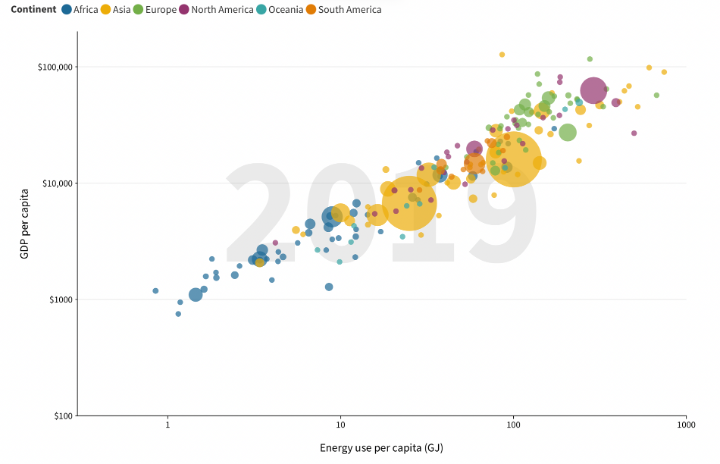
Reliable energy access underpins modern life. It powers our defense, heating/cooling, raw/finished materials, water/food/healthcare systems, digital communications, jobs and tax revenues. As shown in Figure 1, there is a strong correlation between per-capita energy consumption and national income levels: Countries that use more energy per person consistently achieve higher GDP per capita. This relationship highlights that affordable, reliable energy is not a luxury; it is a prerequisite for economic and social development.
Figure 1: GDP Per Capita vs. Energy Use Per Capita (2019)
Source – Boston University - visualizingenergy.org
A Tale of Two Systems: Venezuela and the United States
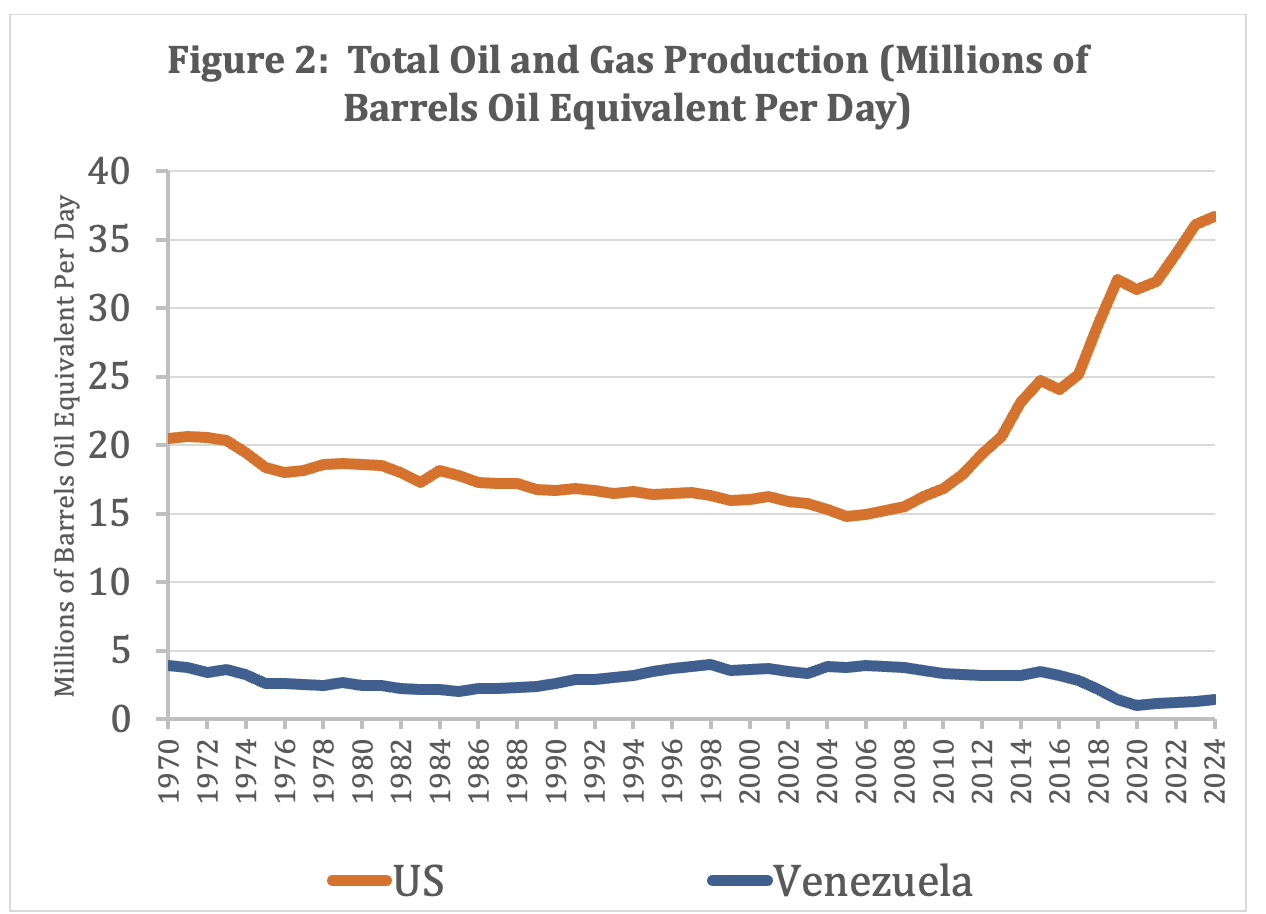
Venezuela demonstrates how a nation can be rich with energy resources yet become energy insecure. Despite holding the world’s largest proven oil reserves (estimated as high as one-fifth of the world’s total reserves), production declined from approximately three and one-half million barrels per day in the late 1990s to roughly one million barrels per day in 2025. This precipitous decline demonstrates how political instability, anti-business rhetoric, and policies affect a country’s ability to retain and attract private investment, technology and talent. This collapse has contributed to widespread energy shortages, economic contraction, and human hardship.
Figure 2 overlays oil and gas production for Venezuela and the United States, measured in millions of barrels of oil equivalent (BOE) per day. Venezuela now sits at roughly one-third of its historical peak, while U.S. output has more than doubled, enabled by technology deployment, and relatively clear consistent legal, regulatory and investment frameworks.
Source: OWID Energy Dataset (based on Energy Institute Statistical Review)
The U.S. Model: Energy Security as National Security
By contrast, the United States—despite a smaller resource base—maintains a resilient energy system supported by private investment, legal stability, and technological innovation. U.S. oil production now enables both domestic energy security and reliable exports to global markets. This stability enables economies to function in a lower cost and more predictable environment and strengthens national security by reducing vulnerability to supply disruptions and price shocks.
Commerce in Lieu of Conflict
In Venezuela, foreign energy companies (twice) experienced expropriation and asset seizures totaling billions of dollars, with arbitration awards left unpaid. Such actions deter investment and trap energy-rich countries in energy poverty.
A more sustainable path is commerce in lieu of conflict, where protected private investment, transparent regulation, and mutually beneficial trade replace coercion and political confrontation. This approach benefits both resource-holding nations and international partners, creating sustainable conditions for long-term development. Now Venezuela faces an uphill battle against history to attract private international companies and convince them that conditions won’t change. This is key to reactivating the country’s economy and chart the course to uplifting the lives of many Venezuelans.
Human Capital and Renewed Optimism
Beyond infrastructure and policy, energy security depends on human expertise. The U.S. energy sector has benefited from global talent influxes including thousands of Venezuelans who emigrated during the national industry collapse.
I experienced the prosperity, capabilities, and potential of pre-collapse Venezuela during visits in the 1990s. Watching the decline, despair, disruption, and exodus over decades has been heartbreaking. Today, many of my Venezuelan colleagues express renewed optimism about their homeland’s future, anticipating that a return to the rule of law, democratic governance, and open markets could allow their expertise to translate into opportunity and prosperity for Venezuela. An unintended consequence of this exodus is that thousands of Venezuelan energy professionals now work at leading international companies. The challenge and opportunity lie in channeling back their enhanced expertise toward their country’s reconstruction. Energy security is built by people as well as policies.
Global Implications
Energy security is not solely a domestic or even regional concern. Reliable energy supplies stabilize economies, support international trade, and reduce geopolitical risk. Nations that protect investment, encourage innovation, and secure energy infrastructure are better equipped to promote both prosperity and peace. A prosperous, stable Venezuela is good for energy prices worldwide and for North America. In particular, having neighboring Guyana (threatened by the Maduro regime) and Venezuela producing at their potential could yield more than five million barrels per day of supply in close proximity to U.S. Gulf Coast refining capacity.
In a world where energy equals opportunity, no society should be left in the dark. Human prosperity depends on secure energy systems, predictable investment conditions, and policies that favor cooperation over confrontation.
Note: The views expressed are the author’s own, subject to change based on new information, and do not represent any current or former affiliation.