print Print this page.

About the Program
The USC School of Music offers an excellent undergraduate program that has a national reputation. Fully accredited degree programs, an award-winning faculty, and superior facilities are a few of the reasons why we are rated as the most comprehensive music program in the state and one of the best in the Southeast. We offer two undergraduate degrees in music:

• The Bachelor of Arts is a traditional liberal arts course of study combined with a major in music.
• The Bachelor of Music provides professional training with emphases in performance, theory, composition, jazz studies, music education–choral, and music education–instrumental.

We also offer outstanding graduate programs that are fully accredited by the National Association of Schools of Music. Through our Bachelor of Music program in music education, we participate in the teacher education programs of the University, which are accredited by the National Council for Accreditation of Teacher Education.

Career Opportunities

Career opportunities for graduates with a baccalaureate degree in music are as varied as the specializations within the field. Opportunities for music majors include:

• music educators
• professional musicians or vocalists
• performers in symphonies, opera companies, musical or theatrical groups, the entertainment industry, and the Armed Forces
• composers, educators, and music arrangers
• voice, piano, and organ specialists who serve community and church-music programs

The University Career Center is available to assist you in choosing a career direction and in increasing your marketability upon graduation. For additional information, call the center at 803-777-7280.

Admission/Progression Requirements

To be admitted into the School of Music, you must meet all University admissions standards and School of Music requirements. University requirements for freshmen include a completed application, nonrefundable application fee, high-school record complete up to the time of application (including record of at least 20 academic units of study earned as required by the University), and entrance examination scores (either SAT or ACT). Details for all applicant categories can be found in the Undergraduate Bulletin. Acceptance as a music major does not guarantee progression to the upper division. To remain in a degree program offered by the School of Music, you must make satisfactory progress toward the degree. At the end of your sophomore year, your progress toward completion of lower-division requirements will be evaluated.

Your acceptance into the USC School of Music is pending a successful audition. After your audition, you can be considered for scholarship awards. Several dates are available for on-campus auditions. Generally, you should be prepared to perform two selections with contrasting styles. You will also be required to take applied study in your primary performance area each semester. Students typically perform in one or more ensembles during a semester. Requirements vary slightly by instrument, so please review your instrument’s requirements before scheduling an audition. To progress to the School of Music’s upper division, you must complete piano proficiency requirements, sight singing and ear training courses, and music theory courses. You must also successfully complete at least 60 credits with a cumulative grade point average of 2.50 in music and music education courses and a 2.00 in all courses. As a Bachelor of Music student, approval of the applied jury is required to progress to upper-division courses that are appropriate to your chosen degree program.

Program of Study (120–132 hours)

The Bachelor of Arts in Music (120 hours) provides for eight semesters of study. Thirty-two to 41 hours will come from general education requirements such as English, history, and natural sciences. You are also required to earn 21 hours in humanities and fine arts courses, nine hours of cultural awareness requirements, and 49 hours of music courses ranging from Applied Music to the History of Western Music. Your cognate or minor courses will comprise 12 to 18 hours, and your studies will be rounded out by up to six hours of nonmusic electives. The Bachelor of Music with emphases in performance, theory, composition, or jazz studies (128 hours) requires 38 hours of general education requirements and 90 hours of major requirements. The Bachelor of Music with emphases in music education–choral or music education–instrumental (132 hours) requires 38 hours of general education requirements, 49 hours of music requirements, 23 hours of music education requirements, and 22 hours of professional education requirements.

Of Special Interest
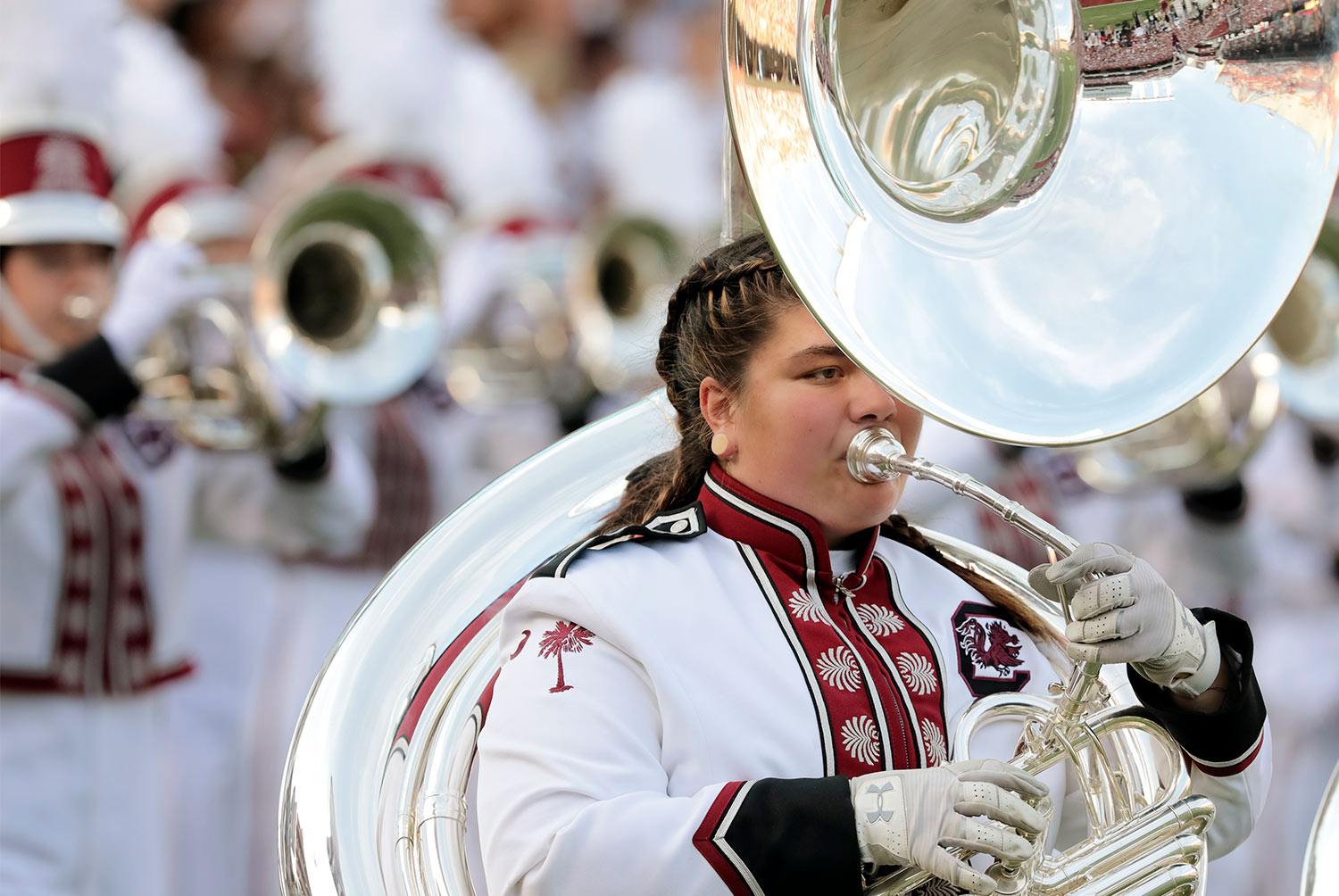
The School of Music’s home is adjacent to the University’s Koger Center for the Arts and features modern studios, classrooms, library facilities, rehearsal rooms, a recital hall, and the newest technologies. We sponsor more than two dozen musical organizations, including marching and symphonic bands, the Concert Choir, the University Chorus, a symphony orchestra, opera and conductor’s workshops, symposia, conservatories, and jazz ensembles. Our faculty members and student ensembles tour regularly and have appeared on concert stages in more than 30 countries and five continents. We emphasize maximum interaction between faculty members and students who have common performing areas. Individual instruction is available in all instruments and voice. Our faculty members are respected performers, conductors, and scholars. Their areas of expertise include piano, orchestra, and voice. They have performed with the Boston Symphony, Chicago Symphony, London Philharmonic, Berlin Opera, and many other professional ensembles.The South Carolina Commission on Higher Education has rated the School of Music as having the most comprehensive music program in South Carolina.

School of Music Web site

print Print this page.