AT and Mental Retardation

Assistive technology is the term used to describe devices used by people with mental retardation and/or other disabilities that help compensate for functional limitations and increase learning, independence, mobility, communication, environmental control and choice. This term also refers to direct services that assist individuals in selecting, acquiring or using such devices.

How do people with mental retardation use assistive technology?

Communication: Technology can substitute as a voice for a person who cannot communicate with his or her voice, due to physical and/or cognitive reasons.

Environmental Controls: Devices to control the environment are important to people with severe or multiple physical disabilities and/or cognitive disabilities, who have limited ability to move about in their environment or control electrical appliances. Technology allows a person to control electrical appliances, audio/video equipment such as home entertainment systems or to do something as basic as lock and unlock doors.

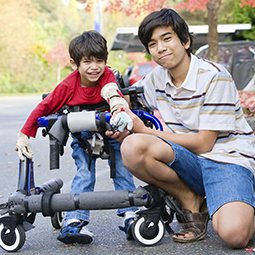
Mobility: Simple manual to sophisticated computer-controlled wheelchairs and mobility aids are available for a person who cannot walk.

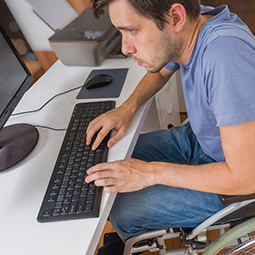
Education: The computer can be a tool for improved literacy, language development, mathematical, organizational, and social skill development. Alternative ways to access computers are available for people who cannot operate a keyboard. Software can be regulated so it runs at a slower pace if a person needs this type of modification.

Activities of Daily Living: Examples are:

  • Devices to assist a person with memory difficulties to complete a task or to follow a certain sequence of steps from start to finish, such as making a bed or taking medication
  • Directional guidance systems with auditory cues to help a person travel from one place to another
  • Devices to help a person shop, write a check, pay the bills, or use the ATM machine

Employment: In response to the Americans with Disabilities Act, employers are making the workplace more cognitively accessible. This may require worksite modifications by the employer, to permit the employee to perform a job. For example, an audiotape might be used to prompt a worker to complete each task in a job.

Sports and Recreation: Adaptations can be made to computer games which allow the game activity to be slowed down for a user who cannot react as quickly to game moves and decision-making. Specially adapted sports equipment is available to compensate for functional limitations, such as specially designed ball ramps that are used in bowling.

How can assistive technology benefit people with mental retardation?

Assistive technology can help people with mental retardation overcome barriers towards independence and inclusion. Technology can compensate for a person’s functional limitations. People with mental retardation should be introduced to assistive technology as early as possible. The AT device should be available for use throughout the day and in all settings, including home, school, work and recreation. There should be consistency in the kind of technology available, how it is used, and methods for instructing the user on operating the device. Transitions from one device to another should be made as smooth as possible by building on and integrating previously learned skills. Technology solutions should be flexible and customized to accommodate the unique abilities of each person with mental retardation. There is a growing use of assistive technology with infants and young children, particularly with communication devices introduced to facilitate early language development.

What are some considerations before using assistive technology with a person who has mental retardation?  

  • What functional limitation does the person with mental retardation have that might be helped by assistive technology?
  • Have professionals conducted a comprehensive assessment to determine what assistive technology might be beneficial?
  • Will the technology be available for the person to use at all times in all environments where needed, and if not, what alternatives exist in other environments?
  • Will the assistive technology be a tool, or will it inhibit the person’s development or acquisition of skills?
  • Is there a professional support system for the successful application and use of the identified technology?
  • Can parents, teacher, and/or the person with mental retardation obtain training in the use of technology?
The Arc National Headquarters
1010 Wayne Avenue Suite 650
Silver Spring MD 20910
(301) 565-3842
http://www.thearc.org

The content of this fact sheet was developed by the Arc. References include:
The Arc. (1991). Assistive Technology Position Statement.
Copel, H. (1991). Tech Use Guide: Students with moderate cognitive abilities (Technical Report). Reston, VA: Center for Special Education Technology.

Brown, C., Sauer, M., Cavalier, A., Frische, E., & Wyatt, C. (1991). The assistive dining device: A tool for mealtime independence. Proceedings of the RESNA 14th Annual Conference (pp. 341-343). Kansas City, MO: RESNA.


back to top