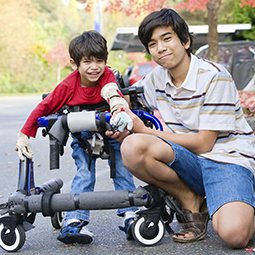

AT and Transition
The transition services requirements in the Individuals with Disabilities Education 1997 Reauthorization Act (IDEA P.L. 105-17) are intended to improve the quality of life of young adults with disabilities. The basic purpose of the legislation is to better prepare students with disabilities to enter the workplace, go on for further training, become as independent as possible, and contribute to society. It also enables students to gain access to the services that are necessary for them to accomplish the outcomes they desire and to have services in place before they leave school.
The term "transition services" is defined as: a coordinated set of activities for a student, designed with an outcome-oriented process, that promotes movement from school to post-school activities, including post-secondary education, vocational training, integrated employment (including supported employment), continuing and adult education, adult services, independent living, or community participation. The coordinated set of activities must (1) be based upon the individual student's needs; (2) take into account student's preferences and interests; and (3i) include instruction, related services, community experiences, the development of employment and other post-school adult living objectives, and, when appropriate, the acquisition of daily living skills and functional vocational evaluation?
The law mandates that transition services must be part of the child's Individualized Education Plan (IEP). Beginning at age 14 and annually thereafter, the IEP for each student must contain a statement of his or her transition service needs relating to the student's courses of study. Beginning no later than age 16 actual transition services are to begin, including any interagency responsibilities. If the IEP team determines that services are not needed in one or more of the areas specified, the IEP must include a statement to that effect and the basis upon which the determination was made.
The transition process must assure that persons with disabilities receive:
- appropriate services in school which prepare them for adult life in the community,
- planning and referral to adult service agencies prior to exiting school,
- appropriate community based adult services immediately upon exiting school,
- access to appropriate assistive technology devices and services upon exiting school.
An assistive technology (AT) device is any item, piece of equipment, or product system, whether acquired commercially, off-the-shelf, modified, or customized, that is used to increase, maintain, or improve a person's functional capabilities. An assistive technology service is any service that helps an individual select, acquire, or learn to use an AT device.
The need for assistive technology must be considered for all students. All states must have interagency agreements so that all public agencies (including Medicaid) that are responsible for providing services which are also considered special education services (including assistive technology), fulfill their responsibilities.
Under the 1997 reauthorized IDEA, participation in the IEP meetings has been expanded to include students, parents, and agencies which would be involved in providing transition services. The public education agency has the primary responsibility to organize, initiate, and conduct these meetings. However, students, parents, and agency representatives are all active participants in developing, reviewing, and revising the transition components of the student's IEP.
A successful and meaningful transition process results from planning done by a comprehensive team which is driven by the dreams, desires, and abilities of the youth. The process should enhance not only the youth?s participation in school, but also his or her home and community living as well. A transition plan provides the basic structure for preparing an individual to live, work, and play in the community as fully and independently as possible.
Examples of basic areas of the student's life that a transition plan should address are:
Future Employment
- Where will the person work?
- How will he or she manage financially?
Home Living
- Where will the person live?
- What independent living skills will he or she need?
- How will his or her health needs be met?
Recreation
- What will the person do for fun and leisure?
- How will he or she develop and maintain relationships with friends and family?
Community Participation
- How will the person travel within the community?
- How will he or she access community services?
Post-secondary Job Training
- If the person is interested in pursuing continued education, where will the training occur, and what supports are necessary?
Assistive Technology
- What type of devices and services he or she utilizes now?
- How will he or she continue to communicate in the community?
For more information on transition services in South Carolina,
contact Joy Godshall Ivester at
(803) 935-5229.
Other Resources
National Collaborative on Workforce and Disability providing information on employment and youth with disabilities. http://www.ncwd-youth.info
EEOCs website that contains information explaining the different types of job discrimination that young workers may encounter and suggested strategies they can use to prevent, and if necessary, respond to such discrimination. http://youth.eeoc.gov
Wells Fargo Bank training with modules for youth and adults. A free copy of the CD can be requested by calling Wells Fargo at (866) 650-6228. It is also on the web if your computer will allow you to download the Macromedia Flash Player program. http://www.handsonbanking.org
back to top