University Libraries’ special collections are expansive, diverse, and, in some areas, among the finest in the world. From the premiere collection of South Carolina history to one of the largest collections of F. Scott Fitzgerald material to the most comprehensive Scottish literature collection outside of Scotland, USC Libraries hold an impressive array of distinctive research materials.
But using these unique materials brings some unique challenges. Their rarity, value, and fragility mean that users can only interact with them onsite. While students, faculty and staff at the university can schedule appointments to work with these items, visiting scholars must travel to see them. What about K-12 students across the country, or home-grown researchers, or people who just want to see cool stuff and can’t make the trip to the university to see them? Digital collections are the answer.
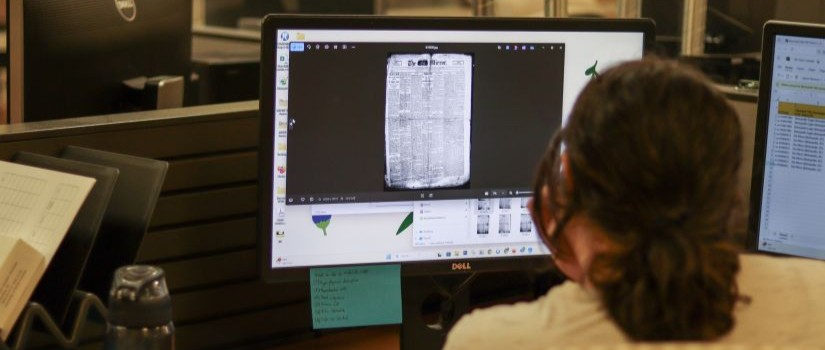
One of the tasks of Digital Collections at University Libraries is to make special collections accessible worldwide by scanning singular (and sometimes fragile) materials held by University Libraries and publishing them online for researchers on campus and around the world. “Not every single person can come up and touch a medieval manuscript, because that could destroy it” said Kate Boyd, Director of Digital Research Services. “But we can share it out online and users can download the image, read it, and study it.”
Nearly unlimited access means that instead of traveling to a reading room with restricted hours and ability, researchers can take their time with the image, even going so far as to print it out and make notes in the margins.
But that is just the image. There is much more information to be found when looking at an item online. According to Boyd, the real accessibility comes from the metadata her team provides for each scanned item.
Metadata is everything that makes the item findable when it goes up online. That may include the name or title of the item, the date, the creator, a description of the item, and sometimes even a transcription. “The more data we can put online and make machine readable for these materials, the more accessible they become in different types of research and projects,” said Boyd.
This is where the real work begins, according to Digital Collections Librarian Katie Hoskins. If there is no textual information with the item, then keyword or subject searching is impossible. Therefore, the digital collections team, made up of student workers and support staff, enters descriptive terms for materials at the collection level and sometimes down to the item level. This ensures that researchers can search and find items even if there is no information to be found from the image alone. To ensure that this information remains consistent, the descriptions apply terms from controlled vocabularies such as from the Library of Congress.
“We do a lot of behind-the-scenes work to maintain and improve the quality of the descriptions and the items that are in the repository,” said Hoskins. “This is the information that actually allows you to search and browse through the collection.”
With artificial intelligence (AI) and other technologies, users may assume that software somehow generated the descriptions, but that is often not the case. Someone must research and physically enter all this data for researchers to be able to access it. Making these collections accessible in such detail aids the seasoned researcher, but it also makes a world of difference to someone using these materials for the first time.
Many local public schools visit University Libraries to experience a research library for the first time, possibly for the only time in their lives. Along with viewing some items in person, students gain experience searching digital collections, which leaves them with a little something to take home with them after the library doors close. Students from Fairfield Middle School in Winnsboro, SC, recently got the chance to have hands on experience with collections at the South Caroliniana Library.
“A lot of the students thought the lesson was just going to end at the end of the day once they wrapped up with the tours,” said Brittany Champion, Instruction and Outreach Librarian at the South Caroliniana Library. “But what they didn’t realize is that they still had access to the tools that I had talked about that day.”
Digital collections allow K-12 students everywhere with an internet connection to view these rare and historic items, even if they never step foot on campus. Digital images, records and metadata open worlds of possibilities for research and bring rare historical material to their classrooms.
“We are a flagship public institution. Taxpayers have helped us acquire these materials over time,” said Boyd. “Their investment has helped us preserve them and make them available for use. Technology now allows us to share our materials freely online for the public.”
Learn more about and view University Libraries’ digital collections on their website.