
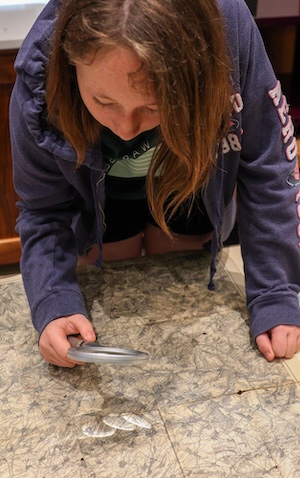
Millions of high school students read F. Scott Fitzgerald’s iconic novel The Great Gatsby every year. But how many of them have the opportunity to see the original proof of the novel with Fitzgerald’s edits penciled in the margins? Or handwritten accounts of The Swamp Fox’s military operations during the Revolutionary War? Thousands of South Carolina students have been able to see all of these things and more when their classes visit – or are visited by – Special Collections at University of South Carolina Libraries.
Both the Irvin Department of Rare Books and Special Collections and the South Caroliniana Library regularly open their doors to K-12 students from all over South Carolina to interact with rare and special materials that offer a unique vantage point on a shared cultural heritage.
Through encounters with special collections materials, students gain a more holistic experience of the books they’re studying. For example, they may see not only the first editions of a famous works of fiction, but also the materials from the author’s personal life that surround and inform it. Letters, diaries, photographs and ephemera provide students with a richer understanding of the bigger picture of who these people were and why they are important today.
“Students can practically meet these historical figures through their materials,” says Dr. Michael Weisenburg, Director of the Irvin Department of Rare Books and Special Collections. “Seeing notes and letters humanizes the authors and makes our relationship with them more intimate and accessible.”
Throughout his time at University Libraries, Weisenburg has welcomed many K-12 students from all over the state, including middle and high school as well as homeschooled and Montessori students. Weisenburg feels that bringing students in to see these materials they won’t be able to see anywhere else makes them feel closer to the authors and connects students to a lineage of scholars throughout time.
When the Libraries had its Much Ado About Shakespeare exhibit in the Spring of 2016 over 300 high school students came through the exhibit in just one day to see multiple editions of the literary icon’s folios as well as other items contemporaneous with Shakespeare. A local Montessori school toured the exhibit and learned how the books were made. They sent back handmade quarto style booklets of their adventure to the library.
Most of the exhibits put on by University Libraries connect to the learning outcomes set by the state, which is by design. This is especially true at the South Caroliniana Library, as every South Carolina student is required to take South Carolina history as part of their primary education curriculum.
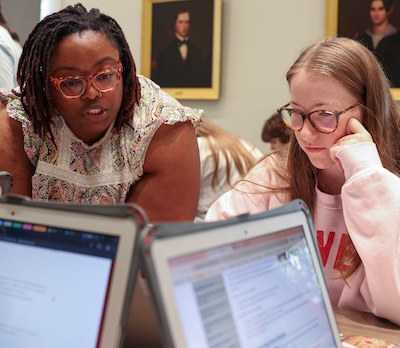
Brittany Champion, Instruction and Outreach Librarian at the South Caroliniana Library, wants to make sure students get the chance to see these important historical documents for themselves. For Champion, it is important that students have the chance to work with primary sources so that they can think critically about the information they are taking in. Having hands on access to these resources allows students to gain experience with critical thinking. By interacting with primary sources, such as Civil War letters, WWI diaries, photographs from the Civil Rights movement and more, students develop skills that strengthen their ability to understand their importance as well as learn valuable lessons from them.
“Primary source literacy is really important and that really is the prime focus of my work here at South Caroliniana and my special collections instruction,” Champion says.
When Champion stepped into this role in January of 2025, she knew that a key goal throughout her tenure would be to build relationships with K-12 schools and the community. By bringing these schools into the South Caroliniana Library, Champion hopes to not only connect them to their shared history, but to teach them how to critically analyze and research that history in a comfortable and welcoming space.
“We all know sometimes folks experience a little library anxiety, so I like to open up the session with objectives, so they know what they are going to cover for that day,” says Champion. “When they see my cart and it is full of boxes, they know that we are each going to take our time to break these things down together.”
Champion hopes that by seeing local schools come into the library that others will see this as an opportunity that is available to them and their students as well. Both the Irvin Department and the South Caroliniana Library continue to foster and build lasting relationships through these visits.
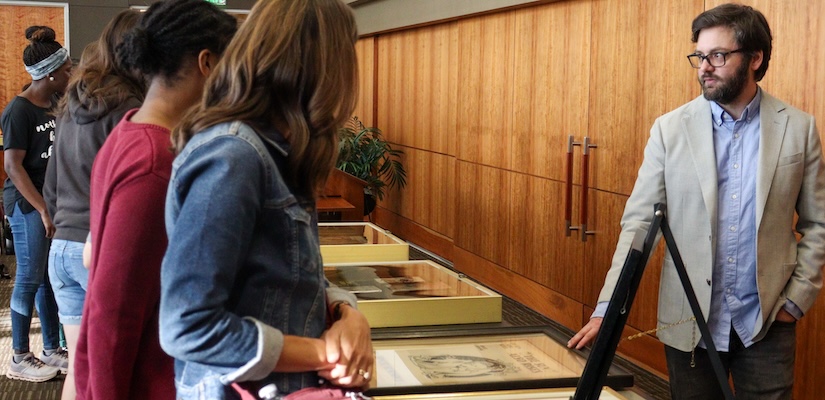
Spring Hill High School, a local public high school, has been visiting the Irvin Department for over a decade. This continuing relationship has fostered a connection between the school district and the University and has provided a positive touchpoint for students who might want to come to the University of South Carolina. For many students, a field trip to Hollings Library may be their first interaction with the University in an academic setting, and University Libraries strives to make it one to remember.
“I’m not trying to oversell us, but they probably, in part, start to think more towards South Carolina than other options because of that experience,” says Weisenburg. “Because they felt welcomed as high schoolers, because they could see themselves being students here and because they could understand that this was a place that really does have very cool opportunities for them, whether they are students or not. It has a ripple effect that is probably much larger than we can measure.”
Being exposed to these kinds of experiences makes young students realize that they can take advantage of and participate in these kinds of experiences at a Research-1 institution. These visits “spark a seed” in students, according to Champion. She witnessed this firsthand during one of her recent sessions, which welcomed students from Fairfield Middle School to University Libraries.
“Some of the students had conversations about how they never thought this was an opportunity for them, or they thought about going to another institution. But now folks are re-considering and thinking ‘maybe USC is the place for me,’” says Champion. “These are the conversations that spark from bringing K-12 students onto these campuses and being able to do the work. They start to realize that they can do this kind of work.”
These visits not only open intellectual doors for students, but they oftentimes provide them with a once in a lifetime experience that they can carry with them for the rest of their lives. Special Collections at University Libraries gives K-12 students the opportunity to step on to campus and see that they could belong here.