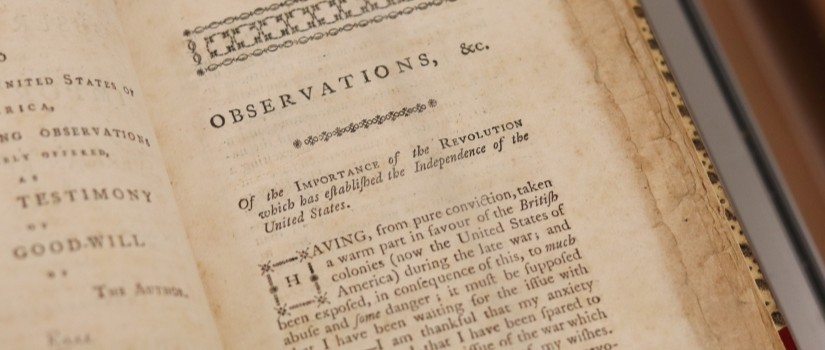
Through its collaborative yearlong exhibit Echoes of Independence: 250 Years of Revolution and Memorialization, University Libraries celebrates 250 years of revolution and memorialization, both in South Carolina and across the nation.
“How does a nation remember its founding?”
This was the central question the exhibit’s curators, Dr. Michael Weisenburg, Director of the Irvin Department of Rare Books and Special Collections, and Dr. Nathan Saunders, Associate Dean of Special Collections, considered. Drawing on items from both the Irvin Department of Rare Books and Special Collections and the South Caroliniana Library, the exhibit uses these materials to look deeper into the revolutionary history of the state alongside the ways in which the nation remembers and memorializes its own history.
As one of the original thirteen colonies, South Carolina holds a pivotal place in that historical narrative. Historians have long acknowledged South Carolina’s central role in the nation’s early history, including the Revolutionary War. The materials on display show the state’s significance through items like Brigadier General Francis Marion’s muster roll, maps and letters from colonial South Carolina, and the seal of the Lords Proprietors of Carolina. Visitors to the exhibit can see contemporaneous documents from the Revolutionary War era and before, along with some of the United States’ earliest published histories.
“The United States is an early and influential example of a modern nation-state that grounds its legitimacy and identity in foundational texts; one that treats its written constitutional commitments as a continuing source of national self-definition,” says Weisenburg.
The Irvin Department’s contributions to the exhibit also showcase perspectives from outside South Carolina, as well as outside of the United States. Novels, newspapers, and pamphlets illustrate what the world was thinking as it watched the United States carve out its place in the international community.
Supplementing these primary documents are items that convey the national public’s perception of the war as well as personal recollections and perceptions. Manuscripts and published materials reveal how the nation has defined itself through its memorialization. “Visitors will see the public wrestling with and discussing the events that took place during the Revolutionary period,” says Saunders. “People talking about the revolution, but also how different generations of Americans commemorated it in their respective cultural moments, such as the Centennial and the Bicentennial.”
By the nation’s centennial in 1876, remembrance had become a spectacle both for the country and its writers, but that doesn’t mean all was calm throughout the nation or the state. Visitors will get to see examples of Walt Whitman’s special centennial editions of his poetry as well as a copy of Louisa May Alcott’s Independence: A Centennial Love Story. Though much of the nation was celebrating its centennial, pockets of the nation, South Carolina among them, were experiencing strife in the aftermath of the Reconstruction period. The Bicentennial brought about its own complexities with The American Freedom Train carrying historical artifacts around the country, while comic books featured Superman and Captain America taking up the patriotic cause, which visitors to the exhibit can see.
Along with significant academic and research related relevance, Echoes of Independence speaks directly to South Carolina state educational standards. K-12 students from all over South Carolina will have the opportunity to see primary documents that directly relate to what they learn in school. They will see Francis Marion’s handwritten documents, maps documenting the layout of Charles-Town’s ports and more, along with comic books and pop culture items that reflect the memorialization of the Revolution. Visiting the exhibit allows these students not only to see these items, but to take part in the act of memorialization themselves.
“This exhibit is something that will provoke thought and curiosity, not just about our founding as a country, but also about how we have thought about the founding,” says Saunders.
By spending time with these items, and stories, students form their own opinions and memories of United States history, inaugurating them into the story of remembrance. But this sentiment goes beyond K-12 students. The exhibit is open to the public, and University Libraries invites all visitors to take part in the act of Revolutionary remembrance, as well as learn more about South Carolina’s vital role in our ever-evolving history.
The rare books, pamphlets, ephemera, and commemorative materials gathered here from across the University Libraries’ Special Collections demonstrate that the meaning of 1776 is never fixed. It is continually reinvented through publishing, performance, protest, and popular culture in an ongoing dialogue between past and present that reveals as much about who we are as who we were.
Echoes of Independence will be up until January 2027. The exhibit is located in the Hollings Library, which is accessible through the main level of Thomas Cooper Library at 1322 Greene Street, Columbia, SC. Visiting hours are Monday – Friday from 9 a.m. to 5 p.m.