Special collections are by their nature esoteric. That, for many people, also makes them intimidating. But University of South Carolina Libraries is strongly committed to making its special collections available to everyone in the university community and beyond. And in the two years since she joined the South Caroliniana Library as its inaugural Instruction and Outreach Librarian, Brittany Champion has found that making people feel more welcome to engage with the library’s collections is one of the most rewarding parts of her job.
Formerly a research and instruction librarian at Furman University, Champion had little prior experience with special collections but was drawn to the South Caroliniana Library by the size and scope of its collections. In her current role, Champion has welcomed many people into SCL for the first time, including K-12 students, first generation college students, and public school educators, along with countless university classes from History 101 to upper-level Spanish.
Champion has not only expanded awareness of the South Caroliniana Library and its collections throughout the campus community and beyond, but she has also provided the library with a new level of accessibility, showing students of all ages, skill levels, and expertise that they can find a place at the library.
We sat down with Champion to ask her about the lessons she has learned during her first two years at the South Caroliniana Library. She discusses how the collections at University Libraries have provided her with insight into working with a variety of diverse primary sources from all over the state, as well as how her experiences with a range of classes and community groups have brought new audiences through the Library doors.
How did you approach this position when you started?
When I started, Nathan Saunders (Associate Dean for Special Collections and Director of the South Caroliniana Library) really gave me the freedom and creativity to approach instruction the way I felt was fitting for me.
It was really cool to be able to watch in real time, to see how students were responding to things that I was saying, and how I navigated the catalog and ArchiveSpace, how I began to talk about how those two mingle together to give you a more holistic experience using USC library resources. You know, and in those [first few] sessions, I got a chance to really see what instruction and special collections looked like. And it is very different. The way I approach research is a bit different now that I'm focused on archival research.
Has your instructional style evolved over your time at the Caroliniana? If so, how?
Oh, it has. It definitely has. Professionally, I have had my first Spanish class. I've had my first social work class ever. I had my first music class in the fall. Being able to work with these collections is a privilege that I don't think I recognized when I first began working here.
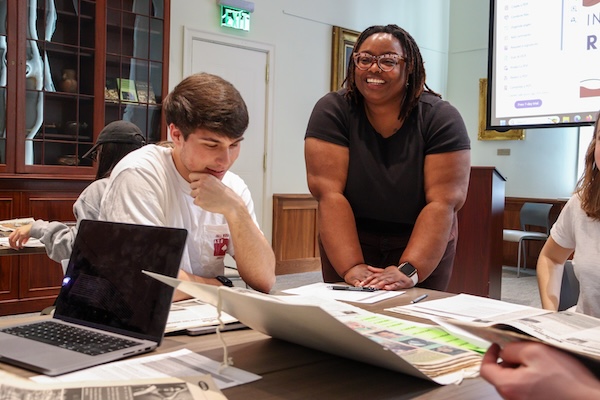
I like to believe that my instruction spaces are a space that welcomes healthy dialogic communication. And I want students to feel comfortable being able to question the norm, what they have been taught, whether that's in classroom discussions, maybe teacher feedback, maybe things that they read from one book. These primary sources really do challenge you to read across the collection, to make connections between secondary and tertiary sources and for you to come up with your own ideas.
And sometimes that's scary. Sometimes it is really something that forces you to pause a little bit when you come across things and you are trying to think of who the creator was, what is the overall mission of this material and why is it placed in this collection? Why do we as a library possess this collection? What am I supposed to get from it?
It’s not to say that I wasn’t able to do these things when I was a bibliographic instruction librarian, but it was different because in secondary sources, you can see that we all possess a bias, and this is something we have a conversation about every class. We all possess a bias, and how we are talking about things, it determines how readers receive it. And with primary sources, you're having to rely on yourself, your own thoughts, and how you're going to receive the information. How you disseminate that information is equally important. That is the theoretical and analytical piece of primary source work. How are you going to disseminate that information in an ethical way so that others, when they approach your material, can think about it with a clear mind too.
What do you notice in the students, whether they be K-12 or college aged, when they work with these primary sources for the first time?
I think one of the first things that I notice when I'm working with K -12 is that little bit of excitement meshed with library anxiety. What does it mean to be able to step foot on a university campus and be able to use these resources? Are they allowed to touch them and handle them? It’s always exciting to be able to witness the questions they ask and the connections they make between yesterday and today.
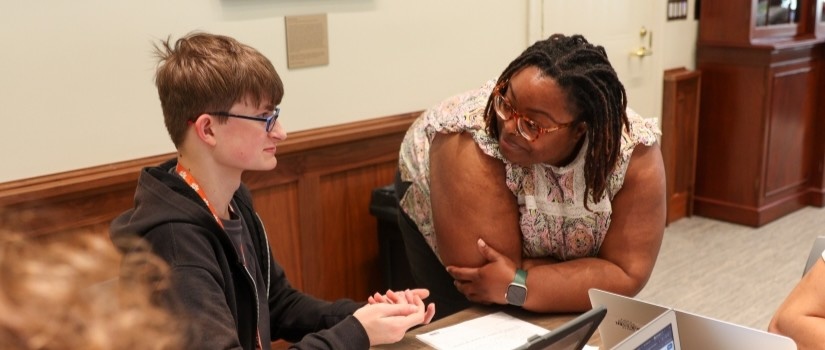
I think that creating that welcoming space is important. Being able to sit down with them at eye level, pulling up a seat, and showing them that they belong. Even just showing them that it can take time for someone to read the old writing, even for someone who knows how to read cursive. It takes time to be able to decipher those things. And again, to ask questions like ‘why might this exist?’ or ‘who would use it?’ and I think that really does open their eyes a little bit more to what this environment could be like for them.
Especially those that might not really be considering college in that moment. You never know what that interaction might do to them, sparking a new dream, you know? I think what I would like to see is an increase in those who might be interested in working in special collections and archives and seeing that this could be a career option for them.
What are the biggest lessons you’ve learned during your time here?
I think one of the biggest lessons is that I had to learn how to ask for help, especially when I didn't know. Professionally, I'm not a trained archivist. So, there's terminology that is new to me. People might say things and I have no idea what it means. And I have to be mindful of what's being said and how it's being used, and in what context, so when I go back and I deliver it to students, that it's clear. And it has been a great time being able to navigate this space when I've had a very supportive team behind me.
Whether it’s putting together exhibits, or being able to be present at outreach tabling events and things, having someone who is out there with me a couple of times every other visit has been helpful because sometimes they're sharing wisdom that I have no knowledge of. I'm taking notes just like everybody else. And so, I think I like to show those vulnerable moments for others too because it really does display that learning is something that you should continuously do so that you can evolve. And I do believe that it just makes you a stronger scholar overtime.
Do you have anything else you would like to add?
I want to emphasize the importance of being curious. The art of curiosity really does spark inspiration and not just inspiration for new ideas, but inspiration for encouragement to get the answer to that question.
And that is not to say that everyone doesn’t have a little curiosity in them, but I want them to also feel empowered to come in and use special collections in addition to other library services and resources. That is what I want other people to feel empowered to do.
Sometimes when you step outside and you look at the building of the Library, it can be intimidating, but this really is a space for everyone, no matter the discipline. This is a spot for all disciplines to be able to engage, and there really is something for everyone from ledger books, recipes, postcards, or photos. We’re all just coming together to learn from one another. Sometimes all it takes is that special trip into special collections.