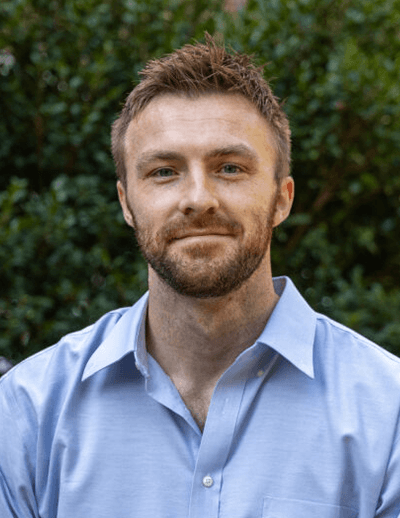
Joining the McCausland College from Philadelphia, Alex Millen completed graduate school at the University of Pennsylvania. Originally from Portsmouth in the United Kingdom, his work focuses on class politics and the literary and cultural history of imperial Britain.
He shared with us about his background, professional journey and his intriguing past as a karate black belt.
Where do you call home? What brought you to USC? Tell us about your academic and professional journey so far.
Portsmouth will always be home in an important sense. But I lived for eight years in Philadelphia, attending graduate school at the University of Pennsylvania. I was already aware of the excellent scholarship coming out of USC’s English department when I saw the opportunity to work here, so I’m especially excited to join the department.
What first drew you to your main area of expertise? What do you love about it?
Reading and loving some of the major Victorian novelists and poets was certainly formative, but it was in graduate school that I realized my separate interests had converged. I knew I wanted to study the literary and cultural history of imperialism in modern Britain, its relation to class politics and transformations in the form of the novel. What I love most is spending time with books that I love (and a few that I don’t).
How would you describe your research to someone who hasn’t studied this field before? What do you hope the impact of your research will be?
My current project focuses on Britain during the Age of Empire (1875–1914), a time of both massive imperial expansion and an uneven journey toward democracy. I study the literary history of class antagonism in this national-imperial society across a wide range of genres and forms, from celebrated works still read today to lesser-known writers such as Ethel Carnie. I hope my research will contribute to debates about British history and to the broader field of literary studies.
Tell us about your approach to teaching. Do you have a favorite topic or class to teach? What do you hope your students will take away from your classes?
I believe artworks can jolt us out of our workaday habits of thought and provide a pleasurable shock of recognition that makes us see the world differently. My role is to help students be in a position to experience that, whether by offering historical context or pairing a text with something from our own cultural moment. I especially enjoy teaching poetry, as well as novels by George Eliot and Virginia Woolf, and I hope my students see how literary works not only reflect the world but also challenge it.
How are you finding the USC community so far? What is something new you’ve discovered about life as a Gamecock or here in the Columbia area?
Campus is bouncing with energy and spirit. I’ve enjoyed exploring the campus, especially the libraries and their special collections, which my students are already using to study publication history. As for Columbia, I’ve discovered how fond I am (truly) of the ceaseless screaming of insects in the night.
Tell us a bit more about you! What do you enjoy doing in your free time? What’s one fun or unexpected fact about you?
I enjoy playing and watching football (though I may finally start calling it soccer) and recently visited Congaree National Park, which I know I’ll return to often. A fun fact is that I have a black belt in karate (but please don’t put that to the test, it was a long time ago).