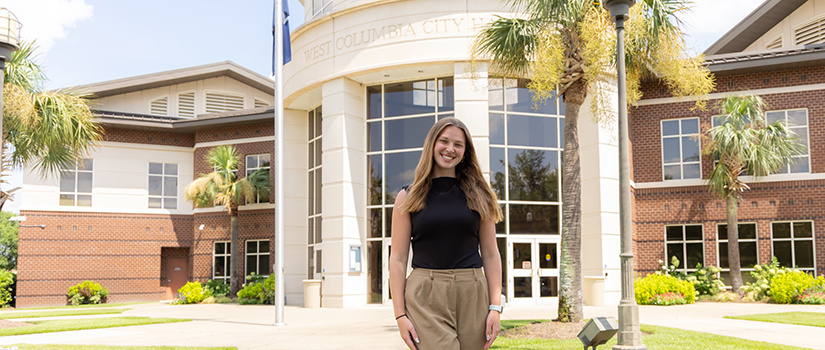
Claudia Case has the perfect last name for a detective. Other than that, you don't pick up any clues that the University of South Carolina senior spent her summer solving crimes―no badge, no magnifying glass, no uniform. She’d blend in with most of the other students in Thomas Cooper Library this summer afternoon.
Not that she’s hiding anything, though. Ask about her summer internship at the West Columbia Police Department, and she's glad to tell you about stopping drunk drivers and car thieves with the power of Microsoft Excel and tracking down suspects from her computer.
The internship allowed Case to combine her longtime interest in law enforcement with the technical and analytical skills she’s developed at USC.
“My classes have really prepared me with hands-on experience,” she says.
Case is majoring in cyber policy and ethics, a program she discovered during orientation just before her freshman year. She realized that this major gave her a unique pathway into a law enforcement career, which she had always found interesting.
The program gives students the flexibility to combine courses from a wide range of subjects, including politics, information security, data analysis, criminology and foreign languages. Some students use it as a gateway to the cybersecurity field, but others use it to prepare to work in national intelligence or to fight internet crime, which the FBI says accounted for $16 billion in damages in 2024.
The major also prepares students to use technology to beat crime on the streets. One of Case’s most important tasks at the West Columbia Police Department was analyzing crime data to help police determine where to patrol. Her emphasis was on reducing drunk driving and preventing the theft of vehicles or valuables left inside them. Rather than hit the streets herself, she hit the spreadsheets.
My classes have really prepared me with hands-on experience.
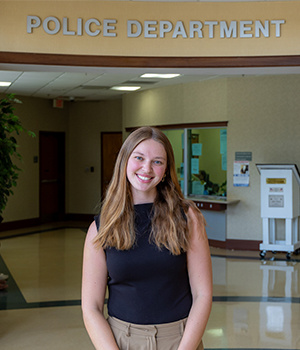
“I look at their reports and I collect information about how many crimes we had that month, where crime is happening and when it's happening,” Case says. “I take the data, put it in an Excel spreadsheet, sort it and organize it. I look for patterns and put it into a map.”
Those patterns tip her off on streets the police should patrol, and when. Her work has made a dent in the crime statistics she reviews each week.
“Crimes are going down in those areas because they're seeing blue lights,” she says. “I can see the numbers of crimes decreasing in each area.”
Case took on other tasks to help investigators, such as identifying and locating suspects with the help of social media and public records. She is developing a computer program that would update the department’s crime map automatically, allowing police to map up-to-date information on command.
The internship allowed Case to practice skills that she had learned in the classroom. Cyber policy and ethics courses combine foundational knowledge with real-world experience, she says. For example, her class on financial crimes was co-taught by a law enforcement officer who walked the students through investigations he had worked on. Other courses feature debate and discussion about emerging trends in technology.
Case says it’s been interesting to study these topics while artificial intelligence has become more widespread during her college years. Going forward, it will be her generation that helps guide the ethics of rapid technological advances.
“We're the ones going into the workforce, figuring out what is needed, what needs to grow,” she says.