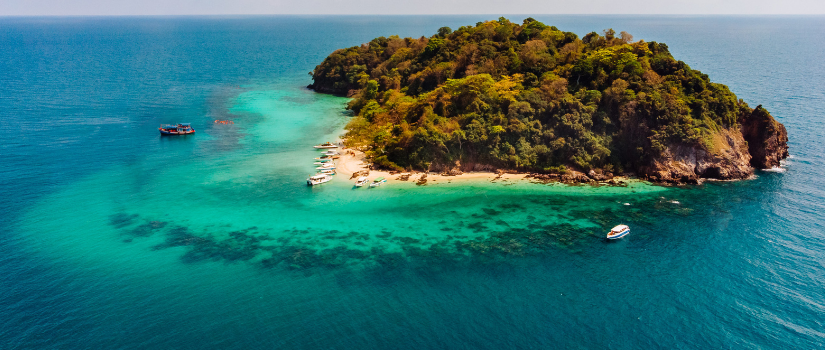
In the Galápagos Islands, University of South Carolina scientists are investigating a global health mystery: could bacteria in drinking water be associated with certain infections that affect hundreds of millions of people worldwide?
Meanwhile, back in Columbia, South Carolina, art education scholars are gathering data that could prove what creatives already know — the arts can shape emotional health and empathy in young learners.
These projects, both funded by major national grants, show how faculty members in the McCausland College of Arts and Sciences are transforming ideas into work that strengthens communities both locally and globally.
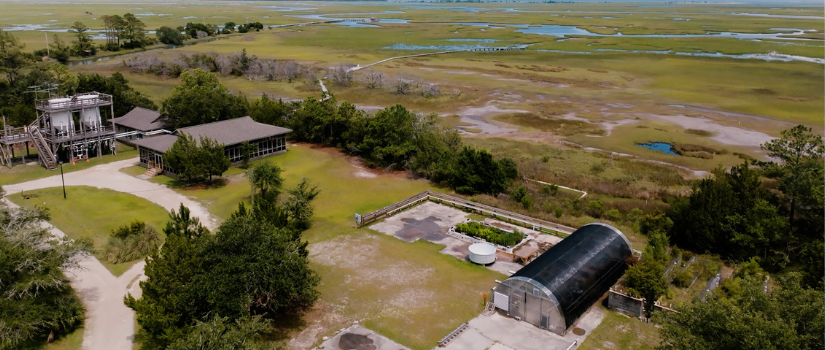
Science at the water’s edge
Jill Stewart, director of the Baruch Institute for Marine and Coastal Sciences, is leading a transformative study on water safety and disease prevention. She recently received a substantial grant through the National Institutes of Health’s Fogarty International Center. Her team aims to uncover how environmental factors shape the evolution and spread of E. coli in natural water systems.
The research could fundamentally change how scientists understand and prevent urinary tract infections (UTIs), which affect more than 400 million people globally each year.
“This work has the potential to revolutionize our understanding of how UTIs are transmitted,” Stewart said. “If contaminated water is indeed a source, it could reshape both clinical prevention and public health strategies.”
The project builds on surprising data from San Cristóbal Island in the Galápagos, where UTI rates fell after the installation of a new water treatment plant.
Working with the Galápagos Science Center, Stewart’s team of microbiologists, epidemiologists, anthropologists and engineers will trace bacterial transmission and antibiotic resistance.
Even if water turns out not to be a major source, the findings will still help Stewart’s team discover when and how water systems are most vulnerable to contamination and develop models to help communities predict and prevent outbreaks. These insights could guide infrastructure upgrades worldwide, including in South Carolina, where aging water systems pose similar challenges.
“Global challenges are local challenges,” Stewart said. “The water quality issues in the Galápagos mirror those in rural and underserved communities across the U.S. Whether it’s an island in Ecuador or a county here in South Carolina, the goal is the same — safe water for all.”
Art as a pathway for emotional health

Where Stewart’s research seeks to protect physical health, Hyunji Kwon’s project focuses on emotional well-being. An associate professor of art education in the School of Visual Art and Design, Kwon is leading a National Endowment for the Arts-sponsored study exploring how visual art and creative writing can help children build social and emotional skills.
“There’s not much systematic research on how art and writing actually build social-emotional skills,” Kwon said. “People rightfully assume they do — but we need data to understand and strengthen that impact, especially after COVID, when children’s emotional needs have grown significantly.”
Working with the Downtown YMCA and One Columbia for Arts and Culture, she and her collaborators are designing a 14-week after school program for children ages 8 to 10 from underresourced communities.
The curriculum, co-developed with fellow researchers and professional artists, integrates visual art and writing lessons. Kwon’s team will collect data by analyzing children’s writing and artwork, conduct interviews and classroom observations and then measure growth in social emotional awareness, empathy and behavior.
The program will culminate in an exhibition next May at the Richland County Main Library where students will curate and display their own work for families and teachers.
“This kind of interdisciplinary program that bridges art, literacy and psychology is rare,” Kwon said. “We hope it will serve as a model for how schools and communities can integrate the arts to support emotional development, especially for children who might have limited access to these resources.”
Kwon’s inspiration stems from her earlier work with trauma-informed art education for underserved adult populations.
“I wanted to bring that experience to younger students,” she said. “Elementary-age children are just beginning to understand and express complex emotions — this is the right time to help them develop those skills.”
Global challenges are local challenges. The water quality issues in the Galápagos mirror those in rural and underserved communities across the U.S. Whether it’s an island in Ecuador or a county here in South Carolina, the goal is the same — safe water for all.
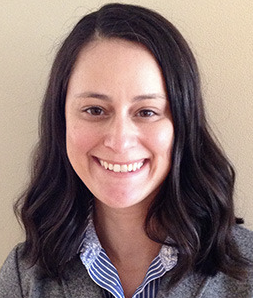
Behind every success, a team that makes it possible
Turning ideas like Kwon’s and Stewart’s into funded research takes more than scientific and creative vision; it takes infrastructure. That’s where the McCausland College Grants Operations team, led by Alysia Bridgman, comes in.
The grants office manages the administrative side of research funding, helping faculty navigate complex proposal systems, interpret federal and university policies and develop detailed budgets. Once an award is made, the team tracks spending, prepares financial reports and ensures compliance so researchers can focus on discovery.
“We handle the paperwork, the forms, the financials — some of the things that allow faculty to stay focused on their work,” Bridgman said. “Our job is to make sure their great ideas have every chance to succeed.”
“Alysia was my lifesaver throughout the process,” Kwon said. “I’m trained in academic writing, not grant writing. She helped me understand everything from budgets to logistics. I couldn’t have done it without her.”
Each year, the grants team supports up to 500 external proposals, roughly three-quarters of which go to federal funding agencies. As the college’s research enterprise grows, so do its resources. Plans are underway to add a team member who would assist faculty in preparing to apply for grants and to expand services for research hiring and lab support.
“Every proposal we support is an investment in the future,” Bridgman said. “Seeing a project come to life — and knowing our office played a part — is what makes this work so rewarding.”
Faculty can stay informed about upcoming opportunities by subscribing to the Research Development Listserv (RESDEV@listserv.sc.edu).