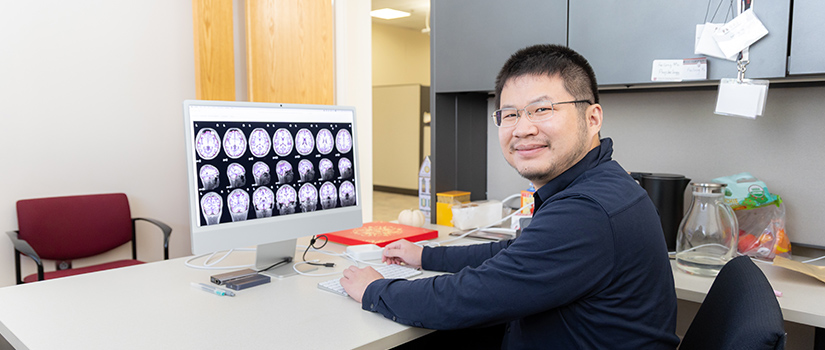
The question of how the human brain works has motivated Feilong Ma in his scientific journey from Beijing, China, to Hanover, New Hampshire, and now Columbia, South Carolina. He joined the Department of Psychology in the McCausland College of Arts and Sciences this fall.
Across his career, Ma has developed methods to map and decode brain functioning. His work has appeared in leading journals such as Nature Methods, eLife, Proceedings of the National Academy of Sciences and Nature Computational Science.
With his first semester at USC under his belt, Ma spoke with us about how he’s enjoying the city, his fascination with individual human brains, and how he hopes his research will improve lives.
Q: How are you settling in at USC and in Columbia?
The USC community has been incredibly welcoming and supportive. I’ve especially enjoyed the collaborative atmosphere among faculty and students, as well as the support from leadership and administrators. They have made my transition to USC smooth and enjoyable.
I have explored several places in Columbia, such as the Congaree National Park, the Koger Center for the Arts and a lot of local restaurants. I love the Southern hospitality and the vibrant culture here. I’m looking forward to discovering more about Columbia and South Carolina.
Q: What first sparked your interest in your research area?
I’ve always been fascinated by how the human brain gives rise to our thoughts, emotions and behaviors. Early in my training, I was introduced to fMRI, and I was amazed by the idea that we could non-invasively observe the living brain in action. That experience also deeply shaped my interest in linking how people differ with how their brains differ.
Later, I became captivated by brain decoding — computational approaches that reveal the information contained in complex brain activity patterns. I love these methods because they lead to both scientific insights and practical applications, including potential new treatments for neurological and psychiatric disorders.
Q: How would you describe your research to someone new to the field?
Essentially, I study how the brain shapes who we are. My research focuses on understanding how brains differ from one another, how these differences develop and how they relate to individual variation in behavior, cognition and clinical outcomes.
A major part of my work involves developing computational methods to align brains based on their function so that we can make meaningful comparisons across individuals. I am very excited about this new chapter of my research at USC. I hope to work with my wonderful colleagues here to apply these methods to study the neural mechanisms of various disorders, such as aphasia, misophonia, autism spectrum disorder and dementia.
Q: What is your approach to teaching?
I teach several methods-focused courses, and I genuinely enjoy helping students learn the tools behind discoveries in neuroscience. I believe good science requires both an important question and the right methods to answer it. My goal is for my students to learn how these methods are used in scientific discoveries, and how to choose and apply the right methods to answer their own research questions.
I also love tailoring my mentoring for junior members of the lab. Every student is different, and I aim to shape their research projects around their interests and strengths so that their projects directly support their career development.
Q: What do you enjoy outside of work?
I have a variety of hobbies, though I may not be very good at many of them. I started swimming and practicing nunchaku when I was in college, and I still enjoy them. Recently, I developed an interest in archery and have enjoyed practicing it with my friends.