Jie Li, associate professor of chemistry and biochemistry at the University of South Carolina, is on a mission to answer pressing health questions. His lab explores how microbes—tiny organisms that live in the environment and inside our bodies—produce unique molecules with the potential to fight disease. From antibiotic discovery to anti-cancer compounds, Li’s research bridges foundational science and real-world impact.
A nationally recognized researcher and mentor, Li has received major honors from the National Science Foundation and the National Institutes of Health. Now, he’s received USC’s 2025 Distinguished Undergraduate Research Mentor Award, which celebrates his commitment to guiding students through hands-on, meaningful research experiences. At USC, undergraduates in his lab don’t just assist with projects—they help drive discovery.
“This recognition motivates me to keep investing in undergraduate students,” Li says. “Mentorship is a mutual process—I learn and improve through it, too. When students trust me enough to ask for guidance about their futures, that means we’ve built a meaningful connection, and I really value that.”
In this Q&A, Dr. Li shares why undergraduate research matters, what his lab is working on and how students can get involved—no matter their background.
Q: What makes undergraduate research such a vital part of the student experience in
the sciences?
A: Textbooks provide foundational knowledge, but applying that knowledge in a lab
helps students retain it, expand on it and see how it connects to real-world science.
When students go through the full process—from designing experiments to doing the
benchwork, analyzing data, presenting findings and even publishing—it gives them a
deeper kind of training that goes beyond the classroom.
It also prepares them for future careers, even if they don’t go into research. Critical thinking, communication, planning and teamwork are all transferable skills. And learning to face failure and push through challenges builds perseverance—something every student benefits from.
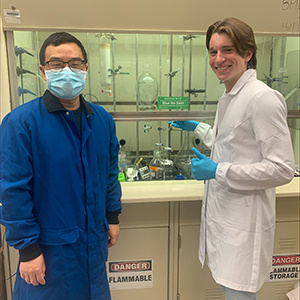
Dr. Li ensures that all his students first develop an understanding of why they are conducting each experiment and how each experiment connects with each other. This approach has been instrumental in my success as a student and undergraduate researcher. Dr. Li has been by far the most important faculty member in my academic life at USC and has given me a massive head start, for which I am eternally grateful.
Q: Can you explain your research in simple terms and how it relates to human health?
A: In my lab, we study microbes and the molecules they produce. We analyze microbial DNA to understand what enzymes they encode, how those enzymes trigger chemical reactions and what kinds of bioactive compounds result. Our goal is to identify new enzymes and molecules that haven’t been studied before.
This research expands our understanding of bioorganic chemistry and could have real-world impact. Some of the molecules we’re investigating show potential for antibiotic, anti-inflammatory or anti-cancer properties, which could eventually support drug discovery and development.
Q: How do you help students build confidence in the lab while also encouraging independence?
A: It starts with meeting students where their interests are. If someone is drawn to genetics, we train them to analyze genes and predict enzyme production. If they’re more interested in analytical chemistry, we show them how to use instruments to identify molecules. Others may focus on biological applications like testing compounds for antibiotic activity or evaluating cell cultures.
In the beginning, undergraduates work closely with graduate students or postdocs who guide them through lab techniques and the research process. As they build skills and confidence—especially those who stay for multiple semesters—they gradually take on more responsibility.
Q: What advice do you give to students who are curious about research but unsure where
to start?
A: There are many great resources available. Some students start by approaching their
professors in subjects they’re passionate about. Others visit department websites
on sc.edu or reach out through the Office of Undergraduate Research, which helps match
students with labs that align with their interests.
Student organizations are another good place to find guidance—upper-level students can offer advice or connect peers to faculty members.
Q: What do you hope your students take with them—not just as scientists, but as people—after
working in your lab?
A: I hope they learn to take initiative. Planning and coordination are important not
only for research, but for life. Working in a lab teaches the value of time management,
teamwork and communication. These are skills they’ll carry with them no matter where
they go next.
Research Funding to help you
Looking to get started in research? Connect with opportunities for funding, mentorship and real lab experience—starting as early as your first year.
- Get paid to do research during the semester or summer
- Strengthen your resume with grant writing, lab skills, and presentations
- Present your work at Discover USC or even national conferences
Check out the Office of Undergraduate Research to find the right fit and get started.