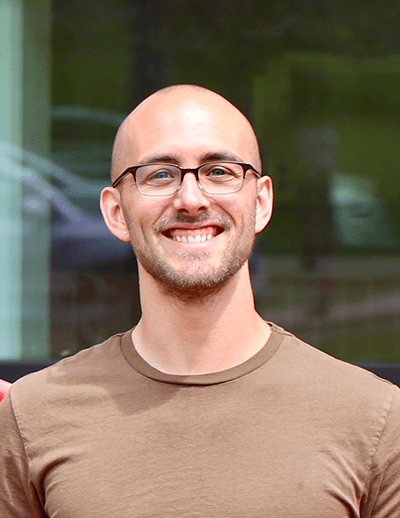
Sean Ehlman will join USC’s Department of Biological Sciences in January 2026, bringing expertise in animal behavior and evolutionary ecology. His work investigates how animals develop individualized behaviors and how those behaviors help species adapt to rapid environmental change. At USC, he looks forward to building a research program that connects cutting-edge technology with fundamental questions about the natural world.
We spoke with Ehlman about his love for animals, sparking curiosity and his upcoming chicken coop build.
Where do you call home? What brought you to USC? Tell us about your academic and professional
journey so far.
I grew up in northern Kentucky, earned my bachelor’s degree at the University of Kentucky,
my Ph.D. in animal behavior at UC Davis and am finishing a postdoc in Berlin. Early
research experiences shifted me from pre-med to basic science, focusing on animal
behavior and evolution. USC’s strong research infrastructure and initiatives in AI
and emerging technologies make it an exciting place to launch my program.
What first drew you to your main area of expertise? What do you love about it?
I’ve always loved the natural world, but Darwin’s theory of evolution hooked me on
understanding why animals behave as they do. Applying evolutionary logic to behavior — and
studying animals outdoors in their environments — still excites me.
How would you describe your research to someone who hasn’t studied this field before?
What do you hope the impact of your research will be?
I study how environmental factors shape animal behavior during development and how
species adjust to changing conditions. Using fish in aquatic systems, I apply AI-powered
behavioral tracking to understand these processes at scale. My goal is to improve
predictions of species’ responses to environmental change.
Tell us about your approach to teaching. Do you have a favorite topic or class to
teach? What do you hope your students will take away from your classes?
Teaching is an inspiration generator for me, and I see teaching as sparking curiosity.
I aim to help students think critically, apply the scientific process and reason through
their observations. If they leave my class more curious and analytical about the natural
world, I’ve succeeded.
What are you looking forward to most about life as a Gamecock or here in the Columbia
area?
The USC community has already impressed me. Though I don’t officially start until
January, I’ve received enthusiastic messages from students eager to do research and
warm welcomes from faculty. I’m excited to be on campus soon.
Tell us a bit more about you! What do you enjoy doing in your free time? What’s one
fun or unexpected fact about you?
I enjoy reading, knitting, traveling, hiking, camping, biking, yoga and weightlifting.
I also want to learn carpentry — my first South Carolina projects will be a chicken
coop and a mobile sauna.