A maladaptive integrated stress response (ISR) involving dysregulation of eukaryotic translation initiation factor α (eIF2α) signaling is observed in several types of inherited primary dystonia. In the case of secondary dystonia resulting as a side effect of various antipsychotic and antiemetic drugs, the involved molecular pathways have not been characterized. In this study, Dr. Patel's lab investigated the contribution of the ISR pathway to drug-induced dystonia. Using murine neuroblastoma-derived Neuro-2a (N2a) cells, they investigated the ability of antipsychotic drugs to induce ISR. They tested eight drugs reported in the literature to cause dystonia as a side effect. After the N2a cells were treated with these drugs at their reported plasma concentrations, the cell extracts were analyzed for ISR induction by Western blot analyses.
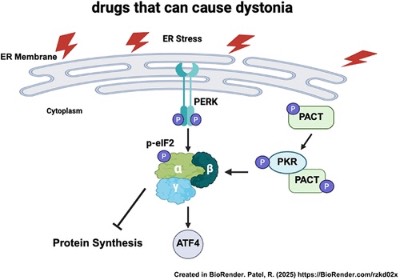
The involvement of PKR (protein kinase, RNA-activated) and PACT (PKR activator) was evaluated by coimmunoprecipitation analyses, and the ability of luteolin to disrupt the PACT–PKR interaction to suppress ISR induction was tested by coimmunoprecipitation and Western blot analyses. Their results indicate that the antipsychotic drugs induce ISR by activating PERK (PKR-like endoplasmic reticulum resident kinase) as well as PKR, resulting in eIF2α phosphorylation. PACT associates with PKR after exposure to antipsychotic drugs, causing PKR activation, and luteolin disrupts the PACT–PKR interaction to suppress ISR. Based on Dr. Patel and her lab's studies, ISR induction is identified as a pathomechanism for secondary dystonia for the first time, and luteolin can be explored further for its ability to suppress ISR and avoid or alleviate secondary drug-induced dystonia.