The rate of nutrient supply is often a central limiting resource for phytoplankton growth. Molar dissolved inorganic nitrogen:phosphorus (DIN:DIP) ratios are frequently used as a tool for inferring nutrient limitation. Marine systems are thought to follow the “Redfield ratio” of 16:1, reflecting the average ratio at which these elements are found in phytoplankton. Ambient conditions frequently stray from this ratio, but the Redfield ratio has been used as a starting point to examine the status of nutrients in a body of water and indicate potential nutrient limitation on phytoplankton growth. Ratios less than 16 may infer N-limitation, and ratios greater than 16 can signal P-limitation, though it is important to note that estuaries are dynamic and may defy this pattern. These ratios describe ambient nutrient concentrations, however limitation is determined by the rate of supply. This is particularly important in estuaries and coastal systems facing high and variable allochthonous nutrient input.
Courtesy: Cat Schlenker.
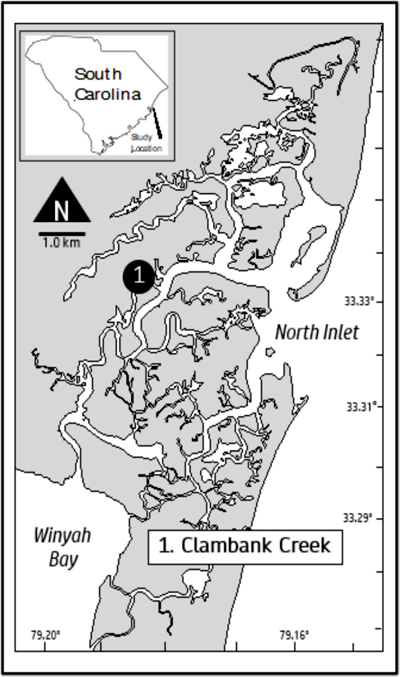
Due to differences in aquatic and marine nitrogen fixation rates, sediment–water column fluxes, rates of other bio-geochemical processes such as denitrification, and nutrient sources, estuaries have generally been considered N-limited, while freshwater systems are thought to be P-limited. However, in recent decades, there have been many demonstrations of primary P-limitation in estuaries and coastal systems. In North Inlet Estuary, nutrient loading has changed such that dissolved inorganic nitrogen (DIN):dissolved inorganic phosphorus (DIP) ratios increased from ca. 7 to 20 between 2002 and 2021. This suggests that primary production in North Inlet Estuary may be transitioning from N-limitation to NP co-limitation or primary P-limitation. To test this hypothesis, graduate student Cat Schlenker and her mentor Dr. Jay Pinckney measured phytoplankton biomass and community composition by high performance liquid chromatography after addition of different combinations of dissolved inorganic nutrients to the water. Their study demonstrate that nitrogen was the single or primary limiting nutrient during the 2023 growing season in North Inlet Estuary despite the high N:P ratios , indicating that ambient nutrient concentrations and ratios are an unreliable indicator of nutrient limitation in this estuary and should not be used to infer limiting nutrients.