Ward Belfield Watt (1940 - 2024) was a scientist and scholar with a passionate interest in natural history and evolution that started in his childhood, first collecting seashells, then butterflies around his local neighborhood. He was also an avid photographer and jazz clarinetist, later adding the banjo to his repertoire, and an enthusiast of fine wines. Known for his precise mind, sharp wit, and kind demeanor, Ward was a devoted mentor for students and junior colleagues, and greatly enjoyed lively discussions over dinner or out in the field.
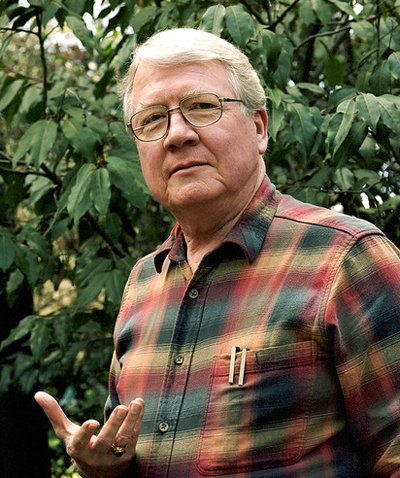
Ward and his wife Carol Boggs left Stanford to join the faculty at the University of South Carolina in 2013. When asked what he studied, Ward’s response was invariably “how evolution works.” Ward used sulfur butterflies as a study system, exploring their ecology and evolution from the level of molecules to populations and communities. He focused on enzymes of central metabolic pathways, examining the role of selection in shaping their function. His work demonstrated that the operation of evolution can be seen over short time scales, as well as the longer geological scales associated with speciation. Beyond field work in the Gunnison Basin, Ward also led expeditions with family, students, and colleagues to northwestern Canada and Alaska in 1965, 1976, 1998, and 2007 to collect butterflies and run experiments. Ward published 75 articles in major scientific journals and co-edited a book on butterfly ecology and evolution.
Across the course of his long career, Ward graduated over 60 honors research undergraduates, nearly half of whom went on to earn the PhD. He was among the first awardees of the Allan Cox Medal for Excellence in Fostering Undergraduate Research at Stanford. He also graduated 21 PhD students and advised 7 postdoctoral fellows, and was a dedicated and loyal mentor for each of these.
Please read the recent publication from Drs. Adriana Briscoe, Johanna Schmitt, and Bruce Tabashnik to learn more about Ward's stellar career and legacy.