By Bryan Gentry
Updated July 17, 2026
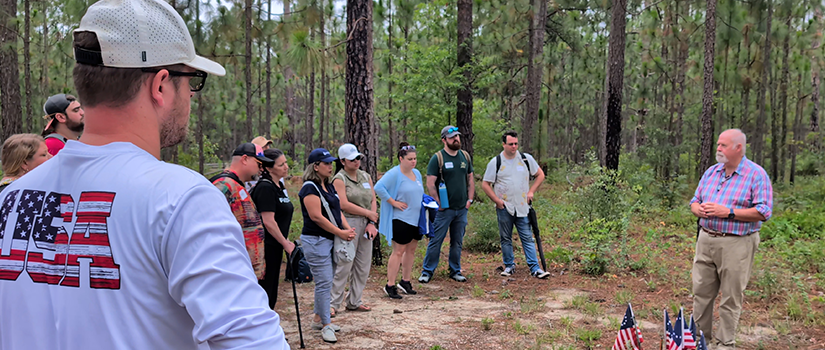
Not long after Independence Day, 40 South Carolina social studies teachers paced in
the footsteps of Revolutionary War soldiers.
Along with University of South Carolina faculty, they explored the site of the Battle
of Camden, where thousands of patriot soldiers gave their lives. As a historical interpreter
explained the battle and the scientific studies shedding light on its history, the
teachers took photos and made notes to take back to their classrooms.
The teachers are the first to participate in a USC program that aims to improve teaching
about American history and government. After months of weekend seminars and after
a brief summer break, the teachers returned to USC in mid-July to continue their course.
“These experiences shore up their content knowledge while deepening their enthusiasm
for teaching history in South Carolina, hopefully making the past more meaningful
and relevant to them and their students,” said Jennifer Marler, a USC instructor of
history who co-teaches the seminar.
USC faculty in the College of Education and McCausland College of Arts and Sciences
developed this program with input from public school teachers and administrators.
Education faculty Kenneth Vogler and Susan Schramm-Pate received a grant from the
Department of Education titled “Our Founding Principles: Preparing Educators for America’s
Semiquincentennial and Beyond” to pay for the program for three years. The program
includes in-depth lessons about about history, civics and America's founding documents
while developing new techniques for teaching about them.
Sarah Bowers, a social studies teacher at Chapin High School, has been teaching for
30 years, but she jumped at the chance to learn more and connect with other teachers
from around the state.
“Although teachers spend all day with students, we do not always have the time to
connect with our colleagues both in our own schools and also across our communities,”
Bowers said. “As a person who loves history and also the creativity of instruction,
I have appreciated getting to know teachers across the state and to learn about their
best practices.”
The seminars have covered major debates in the history of American government and
constitutional law. Marler teaches the seminars along with Vernon Turner, a clinical
assistant professor in the Department of Teacher Education.
“We always strive to both discuss and model social studies teaching practices that
our students can use in their own classrooms," Turner said. “This looks different
every week, intentionally, because we want our students to see different approaches
they can take back to their classrooms.”
The combination of course content and technique is intentional.
“The project’s motto is ‘you can’t teach what you don’t know,’” said Vogler, associate
professor in the Department of Teacher Education. “This combination is designed to
advance participants’ expertise in American history, civics and government and geography
content and provide instruction on how to use pedagogically appropriate ways to provide
factual and conceptual background information.”
Kendall Deas, an assistant professor in the Department of African American Studies,
is assisting as a member of the internal advisory board of the Center for American
Civic Leadership and Public Discourse. While his main research area is education policy,
Deas has developed courses and teaching resources related to America's founding documents.
"The founding documents teach students about America's origins as a democracy and
what constitutes a democracy. Having this knowledge helps students to understand that
to maintain a healthy democracy, they must be more civically engaged," Deas said,
noting that a decline in civic education has led to less civic engagement — less familiarity
with government, low voter turnouts and looser ties to community. "Teaching founding
documents lays the groundwork to address these current challenges."
The program already has made an impact in classrooms. While teaching her Chapin students
about World War I and World War II this spring, Bowers was able to teach about controversies
related to civil liberties during those eras. Looking ahead, Bowers looks forward
to teaching her students about the debates that individual colonies had as they created
their own constitutions during and after the American Revolution.
“These state-level debates concerning personal rights and liberties and the placement
of power in branches are fascinating and provide nuance and context for the debates
over states' rights and national power that continue into the present,” Bowers said.
In addition to the Camden battlefield, the teachers visited USC's South Caroliniana
Library, the South Carolina State Museum, the Confederate Relic Room and Military
Museum, and the Cayce Historical Museum. Marler said these experiences can help South
Carolina's past come to life for the teachers, helping them to do the same for their
students.
“I hope that by engaging with local history, teachers can make Revolutionary era South
Carolina history more relatable to their students, showcasing South Carolina history
in our own backyard,” she said.
“Students often forget that our foundational documents are living, breathing documents
that are as relevant today as they were when they were written," Bowers added. "This
class is providing me with additional tools and knowledge to help students make connections
between the past, the present, and their future lives as citizens.”