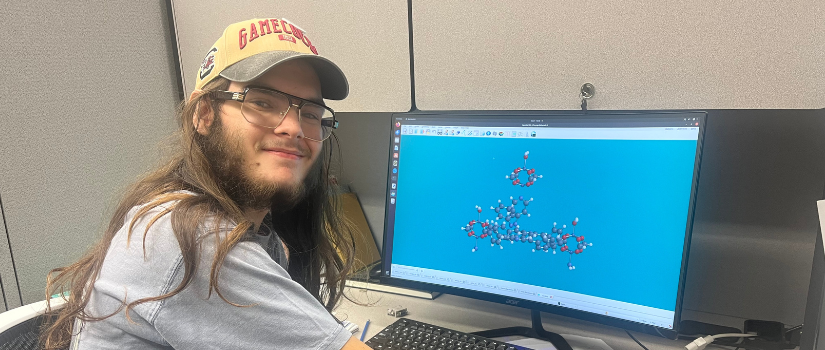
Ethan Irizarry, a Class of 2028 Biochemistry major on the pre-med track from Myrtle Beach, SC, knew that research would be an important component of his medical school applications, but that wasn’t the only reason he chose to become involved in Undergraduate Research. In fact, he pursued it for almost the opposite reason. “I wanted to try something else,” he said. “If I went to medical school, that would be my whole life—so I chose chemistry research to see if that was really where I belonged.” Instead, research strengthened his resolve to pursue medicine and helped him discover new confidence in his ability to learn.
Encouraged by Dr. Stephen Thompson, Faculty Director of the First-Generation Living and Learning Community, Ethan applied for a Magellan Journey Grant through the Office of Undergraduate Research. This grant assists students in finding a faculty mentor and provides funds up to $1000 to be used as student salary for research projects in collaboration with that faculty mentor.
Through the Journey Grant, he was matched with the research group of Dr. Sophya Garashchuk and Dr. Vitaly Rassolov in Fall 2024, diving into computational chemistry, an area he initially found intimidating. His contribution involved learning and utilizing molecular modeling software and computer clusters to assist experimental researchers from Dr. Natalia Shustova’s lab in exploring complex processes that occur in metal-organic frameworks -- porous materials developed for biological sensing, catalysis, separation and energy applications.
The learning curve was steep. “I had to be around people talking on a level completely above me,” he said. “But I kept listening, asking questions, and trying to understand.” Over time, his capabilities grew, not just in using the software and chemical processes, but also learning how to learn- how to ask better questions, manage his time, and stay persistent even when the material felt overwhelming. With support from his mentors, he developed the confidence to immerse himself in unfamiliar topics and emerge with real understanding. These experiences helped him build essential career competencies such as critical thinking, communication, problem-solving and self-development that will serve him well in medicine and any future professional environment.
Because of his inquisitiveness in the classroom and in his research, his drive and eagerness to learn was noticed by faculty from the Department of Chemistry and Biochemistry. In Spring 2025 Ethan was awarded the Joseph W. and Julia L. Bouknight Scholarship, one of the department’s premier undergraduate scholarships.
Ethan’s dedication paid off in other ways as well. His work involving molecular modeling software to describe photo-switching molecules within the metal-organic frameworks earned him a co-authorship on an article published in the prestigious Journal of the American Chemical Society on November 4, 2025, which is a big achievement for a second-year student. This honor was possible because of his hard work and early involvement in undergraduate research.
For Ethan, his biggest revelation wasn’t scientific, it was reflective. He describes how his grant from the Office of Undergraduate Research put his research mindset into motion. “Magellan Journey put the idea in my head that I can do it, that I can apply myself, and I can do these (hard) things- as long as I am passionate and honestly trying the best that I can.”
Ethan has found that faculty at USC are very invested in undergraduate students, even with their high level of expertise and dedication to research. “It’s easy to put professors and grad students on pedestals,” he said. “But they’re people. They love to teach. They’re more interested in your desire to learn than in what you already know.”
That supportive environment was embodied by his mentor, Dr. Garashchuk. “She’s amazing,” Ethan said. “She’s kind and approachable and is always supporting me in learning.”
Now a Resident Advisor in the First-Gen community, Ethan encourages other students to silence their self-doubt. “I worried I didn’t know enough to do research,” he said. “My best advice is to throw yourself into the fire. Take opportunities. Talk to faculty. They’ll teach you what you need to know.”
As Ethan looks ahead to medical school and a career as an anesthesiologist, he carries with him confidence, curiosity, and resilience shaped by his undergraduate research. What began as an experiment to explore a new path became the catalyst that confirmed his passion for medicine and proved that he can rise to any challenge. “You don’t have to know everything to start,” he said. “You just have to be willing to learn.” For Ethan, that willingness has already opened doors, and this is only the beginning of his research journey.