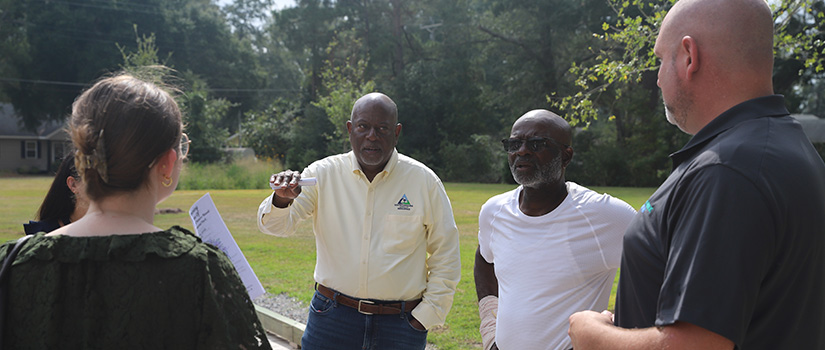
One early October day in 2015, it started raining in South Carolina and didn’t stop for five days. The historic flooding brought on by Hurricane Joaquin killed 19 people, destroyed thousands of homes and caused nearly $1.5 billion in damage across the state. A year later, Hurricane Matthew brought widespread flooding again.
The back-to-back disasters exposed a challenge: Without a coordinated plan for disaster recovery, South Carolina was not ready for such major natural disasters.
Ben Duncan, an experienced state leader and a graduate of the University of South Carolina, was on the frontlines with other state leaders to lead the recovery from those floods. Today, he leads the South Carolina Office of Resilience, which was created to lessen the impact of future disasters across the state.
Duncan began working in state government in 1984 after graduating from Benedict College and steadily moved into positions with greater responsibility, from human resources, finance and IT, to serving in the Governor’s Office under four consecutive S.C. governors. As his career progressed, he realized earning a master’s degree would help him remain competitive, and public administration was a natural fit. He earned his Master of Public Administration degree from the USC’s Department of Political Science in 1998.
In the MPA program, Duncan learned to connect the theories he encountered in the classroom with the work happening around him every day. One lesson from a public policy course taught by Professor Mark Thompson has remained with him for nearly three decades: “Advantages go to those who pay attention.”
“If you pay attention to what is going on in the public realm, you’ll have the opportunity to affect decision making,” Duncan said. “That hit me because that’s what we do. We pay attention and ask, ‘How can we fix that problem?’”
In 2015, South Carolina suddenly had a very big problem to fix.
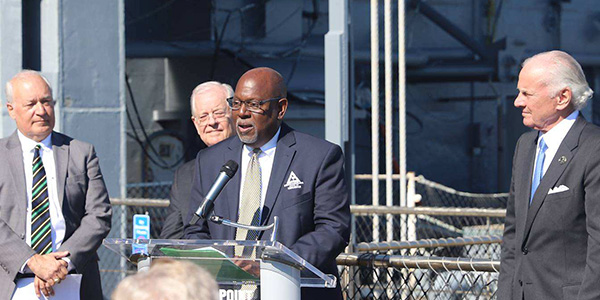
Duncan was serving as deputy director for administration at the S.C. Department of Insurance when he and a group of state officials were tapped to administer the state's disaster recovery efforts following the historic 2015 floods. The state received $126 million from the U.S. Department of Housing and Urban Development to repair and replace homes for low- and moderate-income residents.
The state expanded its efforts to include voluntary home buyouts in repeatedly flooded areas, stormwater drainage projects and flood planning for communities that lacked the resources to address those problems themselves. In 2020, the state established the South Carolina Office of Resilience as a permanent state agency, with Duncan appointed as the first chief resilience officer. The S.C. Office of Resilience is responsible for planning and coordinating statewide resilience, disaster recovery and hazard mitigation.
Today, that office oversees about 85 stormwater projects and has helped conserve more than 100,000 acres of land, including wetlands that hold water to reduce flooding. The resilience office also helps communities continue recovering from Hurricane Helene and is leading the development of the Strategic Statewide Resilience and Risk Reduction Plan to help South Carolina better prepare for and recover from future natural disasters.
Deciding how to direct limited resources draws directly on lessons Duncan learned in USC’s MPA program — budgeting, finance and public policy. Government, he said, sometimes requires tough choices because there is rarely enough money to address every need.
Duncan’s office weighs costs and benefits while prioritizing vulnerable communities, including residents who may not have insurance or other resources to recover from a disaster.
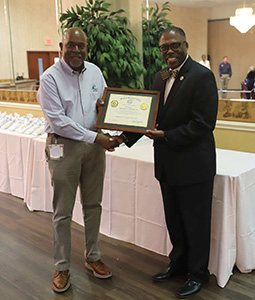
His public administration training, leadership development and guidance from experienced mentors helped prepare Duncan to work with local governments, nonprofits, and state and federal agencies to make those solutions possible. Throughout his career, he has continued learning how to improve government programs and better serve South Carolina communities, something he hopes to inspire future public servants to do, too.
“If you have the heart to assist citizens of South Carolina, public administration is a fantastic area to go into,” he said, “because you’ll find a way to make a difference.”
For Duncan, the impact of his work comes down to the people it helps. He thinks of someone like the 65-year-old woman he met whose home had been destroyed, whose health was failing and who had nowhere else to turn. When his team helped put her into a new home, the policies, budgets and programs became even more meaningful.
“When you go home and lock your door, you want to be secure,” Duncan said. “You don’t want to think about rain coming through your roof. You want to be safe.”
Turn your commitment to service into impact
USC’s Master of Public Administration program prepares students to lead in government and nonprofit organizations. Build skills in budgeting, public policy and management to help communities address challenges and improve lives.