The words “all men are created equal” are among the most familiar in American history. But who has been able to claim the freedom and citizenship promised by the nation’s founding ideals, and who has had to fight to make those promises apply to them?
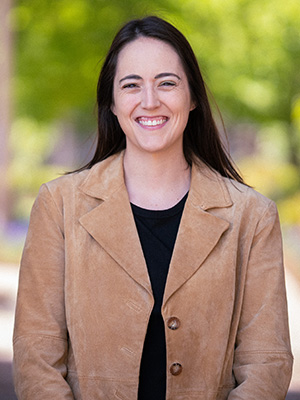
Those questions are at the center of “Freedom Papers: Narrative of Race and Nation,” a course taught by Bridget Kelly, a new faculty member of African American Studies at the University of South Carolina. Through examining America’s founding documents, including the Declaration of Independence, U.S. Constitution and the Bill of Rights, Kelly asks students to consider how ideas about freedom, citizenship and belonging have been historically defined.
A transplant from Missouri, Kelly is a historian who earned her Ph.D. from Washington University in St. Louis. Her research explores a recurring tension in American history: how Black Americans have fought to exercise the rights and freedoms of citizenship while government institutions have subjected Black communities to policing, surveillance and other forms of supervision. She traces those questions from the Civil War era into 20th-century cities, examining how ideas about who deserved freedom became embedded in laws and public institutions.
Her current book project, “Harlem on Probation,” centers on the 1943 Harlem uprising, which erupted after a white police officer shot and wounded a Black U.S. Army soldier. As word of the shooting spread, anger over policing, racial discrimination and wartime inequality fueled protests across Harlem. Kelly examines the uprising and its aftermath to understand how Black New Yorkers asserted greater control over their communities and how city officials responded by expanding systems of supervision, including probation.
Kelly recently shared more about the questions that drive her research, what students can learn by revisiting familiar American texts through a different lens and how our founding documents encourage them to think about the meaning of citizenship.
Q: How are you settling in at USC and in Columbia?
Wonderful! My family and I created a running list of restaurants, museums, parks and nearby road trip destinations that we plan on visiting this year. I used to live in the other Columbia in the SEC [the University of Missouri in Columbia, Missouri], so I can confidently report that both Columbias are fantastic places to live.
Q: What first sparked your interest in your research area?
History was always my favorite subject, and I actually began my career teaching social studies to middle and high school students. That experience shaped the way I think about our connection to the past and my belief that history should invite questions, curiosity and conversation. I feel especially fortunate to have found a home in African American Studies. Being part of AFAM at USC gives me the opportunity to learn from and work with scholars across disciplines, which expands and improves the quality of my research.
Q: How would you describe your research to someone new to the field?
I am a historian of the United States, working on a book titled “Harlem on Probation: The Uprising of 1943, Black Self-Determination, and the Formation of Probationary Citizenship.” The book examines Black life and politics in Harlem before, during and after World War II. More broadly, my research explores the history of probation in the United States and how it became a powerful way of governing communities that were deemed “problematic” or in need of “supervision.” I’m particularly interested in how Black Americans responded to these forms of governance and, in doing so, developed new ideas about citizenship, self-determination and Black Power.
Q: What is your approach to teaching?
Students today have extraordinary access to information and powerful tools for processing data. I think that makes it even more important to create spaces where they can take their time with complicated questions, think for themselves and be comfortable with uncertainty. In my classes, I want students to have fun grappling with big questions about our nation’s founding principles and to understand that not every historical question has a simple or settled answer.
Q: What is your favorite thing about USC so far?
The limestone and red-brick buildings are beautiful, and I am moved by the sense of history on campus. As an American historian, I especially appreciate living and working in one of the original thirteen colonies. There’s something powerful about being surrounded by places and landscapes that have been part of the American story for centuries.
Q: What do you enjoy outside of work?
I love hunting for treasures at vintage markets and consignment shops and attending concerts or festivals. My family and I are also determined to make progress with our Cola dining and site-seeing tour.
Interested in African American Studies?
Explore African American history, culture and society through the interdisciplinary African American Studies program in the McCausland College of Arts and Sciences.