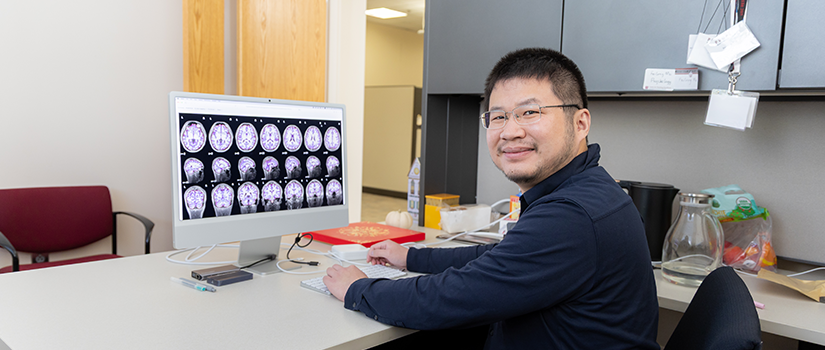
After a stroke affects someone’s ability to speak, read or understand language, can the brain reveal clues about how that person may recover? That’s a challenge Feilong Ma and a team of University of South Carolina researchers hope artificial intelligence can help solve.
Ma, an assistant professor of psychology in the McCausland College of Arts and Sciences, is leading a project to develop an AI tool that can create personalized maps of the brain’s language system, including in people whose brains have been damaged by stroke. The long-term goal is to better understand how stroke affects language and how the brain changes during recovery.
Mapping the human brain is a bit like mapping a city. Scientists know the general neighborhoods where certain activities happen, but the exact addresses — the exact brain regions that perform specific functions — vary from person to person. A stroke makes finding those areas even harder because it can damage the brain’s physical structure and cause surviving areas to reorganize.
“The location of the language areas is idiosyncratic for each brain,” Ma said. “They are typically not far from the general location, but the size, location and shape differ across individuals. Therefore, the general location may be the actual language area for some brains but not for others.”
Those differences present a challenge for studying aphasia, a condition that can affect a person’s ability to speak, understand language, read or write after a stroke.
Normally, researchers identify brain regions involved in language using functional magnetic resonance imaging, or fMRI. A person might read sentences or perform another language task while researchers measure which parts of the brain respond. But that creates a Catch-22: The people whose language systems researchers most need to understand may be unable to perform the language tasks traditionally used to map them.
Ma’s research aims to give researchers another option.
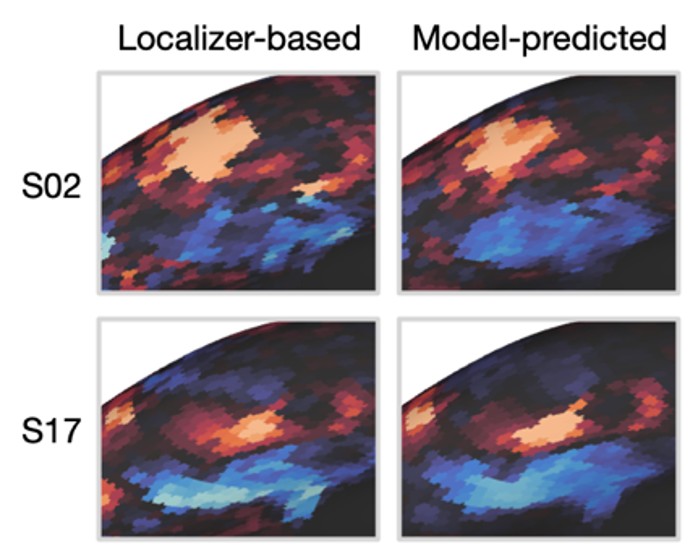
Comparing brain maps
Researchers are testing whether computational models can predict an individual's language regions with results similar to those identified through traditional language-localization methods.
AI learning each brain’s map
His team will use a machine-learning technique called hyperalignment. To understand hyperalignment, think of each person’s brain as having a slightly different map. Rather than assuming the same physical location performs exactly the same function in everyone, hyperalignment compares patterns of brain activity to learn how one person’s map corresponds to another’s. Researchers can then use those relationships to predict the language map of an individual brain.
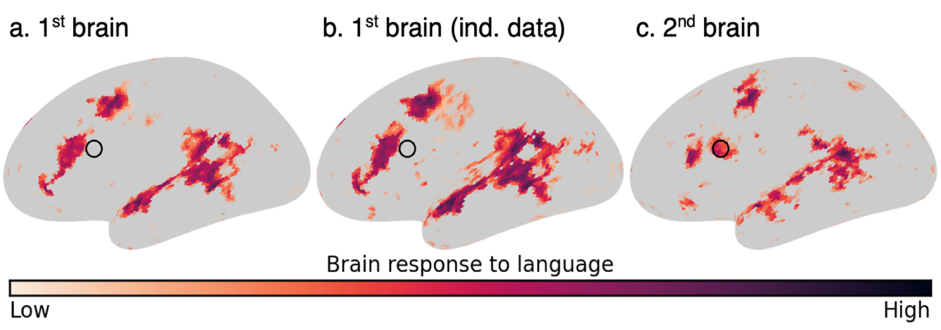
Brains respond to language
Hyperalignment allows researchers to compare patterns of language-related brain activity across individuals.
Importantly, the method could work with fMRI brain scans collected while someone is simply watching a movie or resting instead of completing a demanding language task.
The project, which is supported by a USC ASPIRE AI grant, has two main goals. First, the researchers will use existing brain scans from people without stroke to determine the best approach for predicting an individual’s language regions. Then they will tackle the harder problem of making the method work in brains damaged by stroke.
Stroke lesions can distort the anatomy that computer programs normally use to map the brain. One solution the researchers will test uses another AI tool to computationally adjust the brain image, filling in the damaged area so the computer can reconstruct the brain’s anatomy. This doesn’t heal the patient’s brain, but it creates a complete image for analysis. The team will also test an alternative method that relies less on anatomy and more on patterns of brain activity.
Looking toward recovery
Ma’s immediate goal for this project is to build a tool that could facilitate future investigations into whether a patient will recover or determine which treatment they should receive.
The project is expected to produce an open-source software for estimating language regions in both healthy and stroke-affected brains. The researchers eventually hope to apply the method to the Aphasia Recovery Cohort, an existing collection of brain scans and language data from people who have had strokes.
Once Ma's team has developed and tested their method, they anticipate the AI model could use brain scans that have already been collected to predict where language functions are located in each stroke survivor's brain.
Those observations could then inform future research to determine whether a stroke damaged a brain region that actually handled language in a particular person and track how that person’s language system reorganizes during recovery.
Ultimately, that knowledge could contribute to better predictions of recovery.
“We hope hyperalignment will provide precise, individualized evaluation of lesions of language regions in aphasic brains and will inspire new personalized treatment strategies,” Ma said.