Forget zipping through a drive-through or popping a frozen dinner in the microwave. Imagine instead foraging, hunting or even migrating for your supper. For humans and animals thousands of years ago, finding a meal was a much more complex task than for Earth’s modern citizens. What happens when the food a community depends on becomes scarce or its environment begins to change?
People have confronted food-finding challenges for thousands of years, and archaeologist Sarah Noe looks to the past to understand how they adapted.
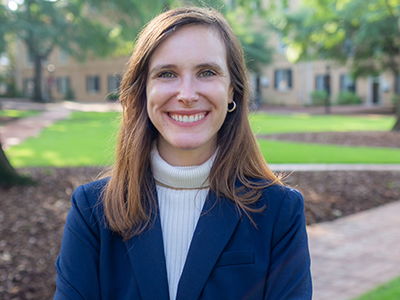
Noe is a new faculty member with the South Carolina Institute of Archaeology and Anthropology at the University of South Carolina. She studies the relationships between people, animals and their environments, such as how they interacted and how they found food. Her research has taken her from the Lake Titicaca Basin in Peru, where she studies the history of llama and alpaca domestication and herding, to the Midwest U.S., where she examines how Native American communities adapted their hunting practices during periods of drought and social change.
An NSF Graduate Research Fellow who earned her Ph.D. in anthropology from the University of California, Santa Barbara, Noe has published research on ancient foodways, human-animal relationships and responses to environmental change.
She recently shared about what drew her to archaeology, what the past can teach us and how connections across the college enrich her work.
Q: How are you settling in at USC and in Columbia?
The transition has been wonderful. The campus is beautiful and full of energy, and my colleagues have made me feel very welcome. Columbia is already beginning to feel like home. I’ve even found a few favorite barbecue spots, breweries and coffee shops. I’m also excited to experience my first Gamecock football season!
Q: What first sparked your interest in your research area?
Growing up in an Irish family in Boston, Massachusetts, history always felt personal. The city’s Revolutionary past was everywhere, and my own family history was shaped by ancestors who survived the Irish famine. When I was 15, I volunteered on an archaeological excavation in Boston focused on reconstructing historic foodways. That experience showed me that archaeology could help answer the questions I cared about most: how people obtained food in the past, how they adapted when it became scarce and what their experiences can teach us about food insecurity today.
Q: How would you describe your research to someone new to the field?
My research asks how people respond when their food systems face environmental and social changes. In the Andes, I combine paleogenomics [field of science based on the reconstruction and analysis of genomic information in extinct species] and isotope analysis to examine how people managed llamas and alpacas from the Pleistocene [2.58 million to 11,700 years ago] to the present. I focus specifically on the collapse of camelid [camel] populations following European colonization and the resulting loss of diversity and resilience. Because ancient herds embodied millennia of human management, recovering this history can help strengthen and revitalize modern camelid populations. This interest also guides my work in the southeastern and midwestern United States, where I use archaeological animal remains to reconstruct how Native American communities responded to drought by transforming their hunting and fishing practices. This work identifies strategies for responding to climate change while preserving a record of lost biodiversity that can inform restoration efforts today.
Q: What is your approach to teaching and doing research?
My teaching and research begin with the recognition that archaeological materials are the heritage of living descendant communities, not simply evidence for archaeologists to claim or interpret. In the Southeast and the Andes, I work directly with descendant communities to develop research questions that reflect their priorities and interpret evidence through their knowledge of their own histories. I bring this same principle into the classroom by asking students to consider whose histories they are studying and who should have a voice in interpreting them. This approach provides critical context, strengthens archaeological research and allows insights from past foodways to inform modern food systems.
Q: What is your favorite thing about the McCausland College of Arts and Sciences so far?
What I value most about the McCausland College is that it brings the humanities, social sciences and natural sciences together within one college. This is a rare and underappreciated structure. As an anthropological archaeologist, my own research combines questions and methods from across these fields, and I value being in a college where conventional academic boundaries do not dictate how a problem is approached. It also allows students to build their training around the questions they want to answer rather than arbitrary divisions between disciplines.
Q: What do you enjoy outside of work?
I love playing board games, whether during long field seasons in remote locations or at home with friends and family. I enjoy how games bring people together through a mix of strategy, creativity and friendly competition.
Interested in archaeology?
Explore how researchers at the South Carolina Institute of Archaeology and Anthropology study the past and preserve cultural heritage.
Explore the South Carolina Institute of Archaeology and Anthropology