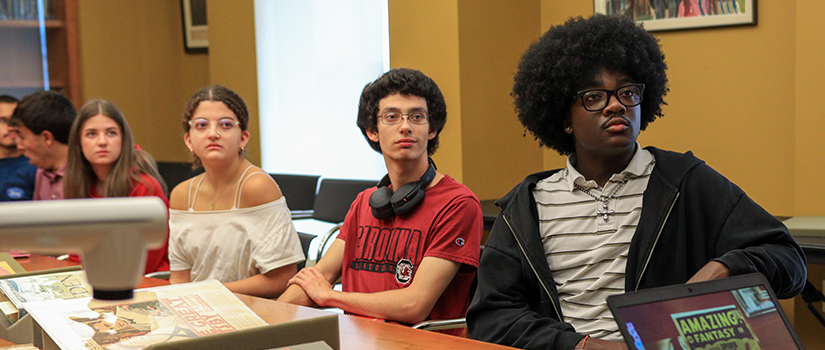
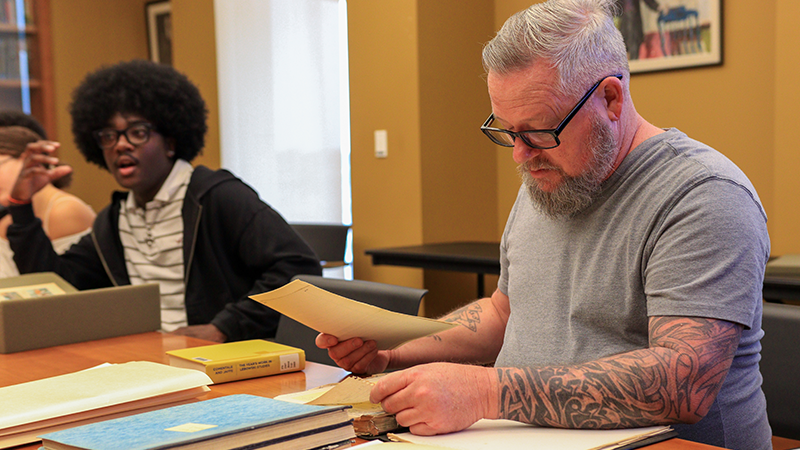
Surrounded by centuries-old books and historical documents in the University of South Carolina's rare books collection, Kevin Brewer noticed something he wasn't expecting. It was a handwritten report from Revolutionary War leader Francis Marion listing 15 military bandsmen. For a retired Army musician returning to college after 30 years, it was an unexpected connection between his own life and the material he was studying as part of USC's new Carolina Core Cohort.
The Carolina Core Cohort builds on USC's general education curriculum, known as the Carolina Core, by forging a small community of students taking three connected classes. In addition to drawing insights between the three classes, students enjoy small classroom environments where they get to know each other and their professors. The program launched in fall 2026 featuring classes in rhetoric and composition, American founding documents and contemporary moral issues. A similar group of classes will be offered for the Spring 2027 cohort.
Back in the rare books room, Brewer experienced more connections first-hand. He encountered original editions of books that he’d read in class, including Washington Irving's “Rip Van Winkle” and Thomas Paine's “Common Sense.” He even had the chance to read production notes from “Blue Velvet,” one of his favorite films.
"The trip to the rare books collection was a definite highlight for this semester," says Brewer, who is majoring in history.
The personal attention that we all receive from our professors is priceless. It has been a life changing experience so far and it has rekindled my love for learning.
Brewer read “Rip Van Winkle” in Erica Fischer's English course. In the book, the protagonist sleeps through the American Revolution and awakens to a transformed country. The story raises questions about how much actually changed with American independence, and students explore those same questions when they examine historical documents in a Founding Documents history course taught by James Risk.
Rachel Mann's ethics course encourages students to consider how the values expressed in those documents and stories continue to shape contemporary disagreements.
"We explore how constitutional ethics and civic conflict emerge, discovering that there's more than 'one story' so to speak," Mann says.
The connections appear in classroom discussions, too. Fischer recalls one student drawing on their historical learning to interpret a contemporary short story about Native American identity. Another brought an ethical argument from Mann's course into their literary discussion.
"The idea of separate classes being able to connect themselves as smoothly as they do in this program surprised me because honestly I didn't think it could ever be like that," said physics major Josue Rivera, who transferred to USC from a technical college.
He says the coordinated coursework has made his first year at USC more manageable and helped him recognize how ideas from one subject can deepen his understanding of another.
Mann has noticed students discussing historical debates on their way into her class and continuing conversations about ethics as they head to English. Their familiarity with one another also makes them more comfortable expressing opinions and considering perspectives different from their own.
"Even among those differences there is always respect," Mann says.
For biological sciences major Rayna Ellwood, being in smaller classes with the same classmates has enabled her to participate more.
"With smaller class sizes, it has been easier to connect with and build closer relationships with my peers and professors, which lets us have in-class conversations that help me understand the content more thoroughly," Ellwood says.
Risk has also observed growing confidence among cohort students participating in a semester-long historical role-playing exercise in his class, where they must speak and debate from the perspectives of assigned historical figures.
For Brewer, the close-knit environment has made returning to college after three decades less intimidating. He credits the thoughtful connections between courses, his professors and his classmates with transforming his experience.
"The personal attention that we all receive from our professors is priceless," he says, "as is the consistent encouragement. It has been a life changing experience so far and it has rekindled my love for learning."