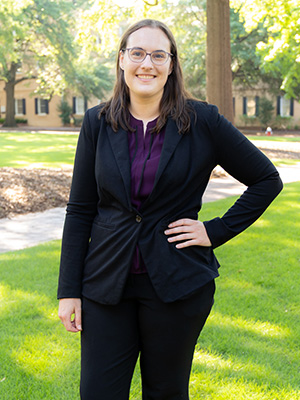
Neurons have complicated jobs. As specialized cells that carry messages throughout the brain and nervous system, they sometimes stretch remarkable distances through the body. Yet the materials they need in order to function must get to the right place at the right time. When that intricate delivery system breaks down, the consequences can be devastating.
Veronica Ryan wants to understand what goes wrong.
Ryan is a new assistant professor in the University of South Carolina’s Department of Chemistry and Biochemistry. She studies the cellular and molecular processes behind neurodegenerative diseases, particularly frontotemporal dementia, a rare type of dementia that can affect personality, behavior and language, and amyotrophic lateral sclerosis, or ALS. Her research examines how neurons transport messenger RNA, the molecules that carry genetic instructions for making proteins, and produce proteins where they are needed within the cell.
Those questions have taken Ryan from studying neuroscience at Brown University to conducting research at the National Institutes of Health, where her recent work helped uncover connections between the movement of materials through neurons and TDP-43, a protein closely associated with ALS and frontotemporal dementia.
At USC, Ryan is building a research program aimed at answering questions about neurons with a long-term goal: finding insights to contribute to more effective treatments for neurodegenerative disease.
Ryan recently shared more about what drew her to neuroscience, the mysteries her lab is working to solve and what she hopes to discover at USC.
Q: How are you settling in at USC and in Columbia?
My place is unpacked and I’m starting to order things for my lab. Although I’ve been told my office still needs more decoration!
Q: What first sparked your interest in your research area?
I study neurodegeneration because my grandmother had Alzheimer’s disease. I became really interested in understanding the cellular and molecular mechanisms of what goes wrong in neurodegeneration and how we could use that information to identify more effective therapies.
Q: How would you describe your research to someone new to the field?
My research focuses on how the messages (mRNAs) that contain the instructions for making cellular machines (proteins) are moved around neurons, how those machines are made where and when they are needed, and how these processes go wrong in neurodegeneration. In other words, mRNA transport and local translation. Many of the disease-associated mutations and disruptions in frontotemporal dementia/amyotrophic lateral sclerosis, the neurodegenerative diseases I focus on, are found in proteins that bind mRNA and participate in their transport and translation, but we still don’t fully understand how these processes work in healthy cells, nor how they go wrong in disease. My work aims to fill these gaps as hopefully, with a better understanding of these processes in health and disease, we will be able to develop new ways to treat neurodegeneration.
Q: What is your approach to teaching and doing research?
Whether teaching or mentoring in the lab, I try to take an individualized approach and meet students and mentees where they are to help them get to where they want to go. As for research, it should be fun; and if it is not fun and interesting anymore, then maybe it is time for a new research question or direction.
Q: What is your favorite thing about the McCausland College of Arts and Sciences so far?
The people! Everyone has been very nice and helpful. And the students I’ve interacted with are very motivated and engaged!
Q: What do you enjoy outside of work?
I like to read, knit, crochet, garden and be outside!
Interested in chemistry and biochemistry?
Explore undergraduate study and research opportunities in the McCausland College of Arts and Sciences Department of Chemistry and Biochemistry.