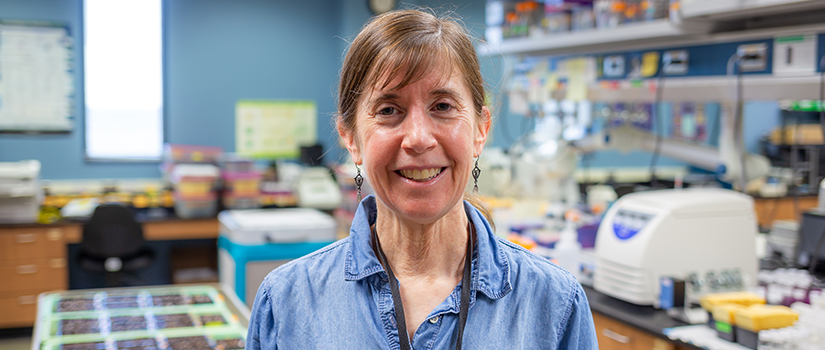
When Beth Krizek went to college, she asserted her independence by deciding not to follow in her parents’ footsteps.
“My dad was a plant physiologist,” she said. “I swore away from plants. I was never going to study plants.”
Clearly, that decision didn’t stick. The American Association for the Advancement of Science recently elected Krizek as a fellow in honor of “distinguished contributions to the field of plant molecular and developmental biology.”
The path that brought Krizek back to her roots and to a successful career as a biological sciences professor makes her a mentor for University of South Carolina students exploring their own possibilities. Krizek proves that what you study doesn’t lock you into one career.
Krizek’s turning point came when she was finishing her Ph.D. in chemistry. She had been studying transcription factors, proteins that can influence which genes get expressed, but she had focused on “designer” proteins made in a lab. She grew curious about natural proteins, which led her to a post-doctoral fellowship in a lab studying transcription factors in flower development.
“I really wanted to switch to understand proteins that actually work in an organism,” she says. “I could learn the plant biology, and I could bring my expertise in transcription factors, and it worked out really well.”
Krizek’s research centers on how transcription factors determine the destiny of cells in the plant Arabidopsis thaliana, commonly called the thale cress, a member of the mustard family that produces small flowers with four white petals.
Every cell pretty much has the same genome, but they use those genes differently.
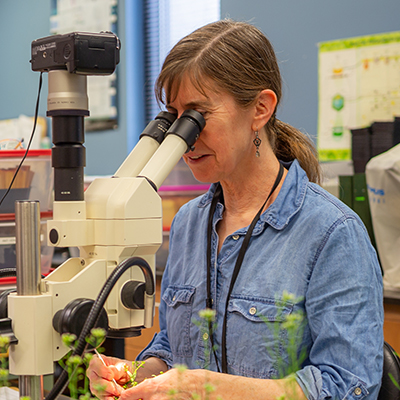
“Every cell pretty much has the same genome, but they use those genes differently,” she says. That’s because transcription factors turn certain genes on or off, controlling which genes get copied into RNA and therefore used to make proteins.
That’s how plant cells containing the same DNA become parts of such different organs. One cell within a leaf makes chlorophyll turning light into cellular energy. Another becomes a pigment-producing cell in a petal that attract pollinators. Another becomes part of a carpel that produces seeds.
The transcription factors Krizek studies affect the size of flowers and fruit, meaning Krizek’s discoveries could someday help feed the world.
“Flowers give rise to fruits and seeds and grains, so if we understand their molecular behavior maybe we can increase crop yields,” she says, giving the example of influencing transcription factor activity to get larger tomatoes.
Krizek, a past winner of USC’s Mungo Undergraduate Teaching Award, enjoys teaching courses on cell and molecular biology, but her favorite course is Biology 523. The plant biology class gets students reading the scientific papers that led to big discoveries in the field. That allows them to see how scientists identify gaps in understanding, design experiments to fill those gaps, interpret data and deal with challenges in the process.
But the highlight of her work might be conducting experiments with students in her lab. “A lot of students learn better when they’re actively doing something,” she says.
Three undergraduates work in Krizek’s lab now, and all three are presenting at Discover USC, the university’s statewide student research symposium. Although their research is in plants, most of her students choose other paths after college; off the top of her head, Krizek mentions one who got a fellowship with the National Institutes of Health and will pursue a master’s degree in public health.
But working in a science lab gives her students skills that serve them well in a multitude of careers: Designing an experiment, effective planning, focused thinking, interpreting results, giving a presentation. “There are a lot of thinking skills involved,” she says.
Additionally, there are the lessons that plant cells teach about the possibilities ahead. Just as transcription factors can cause different types of flower cells to grow, a student can take what they learn in the lab and pursue any other career.
That’s a lesson students learn from Krizek’s experience, too.
“In some cases, I made a difference and helped students figure out what their interests are,” she says. “I’m one of those people who changed my direction midstream, so I know it’s good to find out the things you like as well as the things you don’t like to do.”