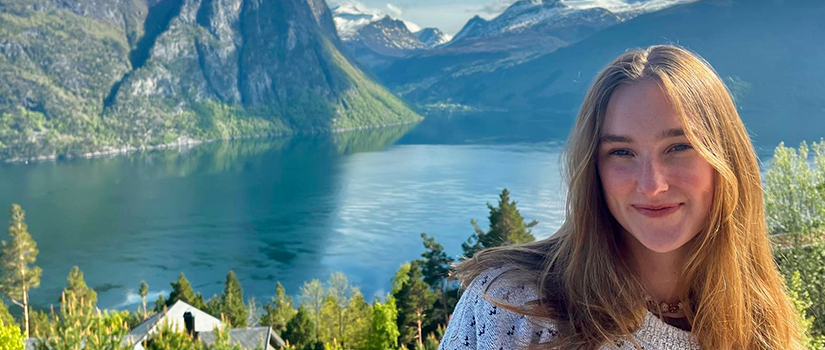
Spending a week under the northern lights in the Arctic Circle isn’t a typical classroom experience for most, but it was for Ella Michel.
At the University of South Carolina, Michel’s education took her out of classrooms and into research labs, into Columbia communities and across Scandinavia. What began as a plan to pursue law became a passion for energy policy. In the Honors College, Michel designed her own major focused on environmental policy and conservation, with most of her courses found in the McCausland College of Arts and Sciences. In her four years at USC, she studied in Sweden, Copenhagen and Germany and helped run a grant-supported energy efficiency program.
Each experience added a layer to her understanding of how policy, research and community action intersect. Now, she’s preparing to bring that perspective into her role as an energy efficiency evaluation intern with utility consulting firm E Source. Read on to hear from Michel how she forged her path at USC.
How did your beyond-the-classroom experiences shape your academic and career goals?
In Honors, we’re required to complete at least one beyond-the-classroom experience,
but I completed eight — two internships, two study abroad experiences, two research
labs and two service-learning courses.
My favorite was studying abroad at the University of Gothenburg in Sweden. My courses focused on international relations and policy, giving me a global perspective on environmental solutions. Gothenburg is one of the most sustainable destinations in the world, supported by strong renewable energy infrastructure and emissions targets, which deepened my understanding of how policy supports sustainability goals.
Beyond academics, I traveled throughout Scandinavia and into the Arctic Circle, where I spent a week under the northern lights, skiing and learning about the Indigenous Sámi culture. I also visited Copenhagen and Stockholm and reconnected with my host family in Germany from a Maymester studying renewable energy.
What skills did you gain from your major that you didn’t expect?
The course ENVR 490: Applied Research in Water and Energy Equity stands out. I expected
to learn research methods and challenges to equitable access, but I gained much more. During
a project on weatherization programs in South Carolina, my classmate and I saw an
opportunity to turn research into action. With support from our professors, we applied
for a grant and launched our own weatherization program.
We learned how to conduct interviews, synthesize data, write a literature review and present findings and also how to manage a grant, design trainings, build partnerships, conduct outreach and install energy efficiency retrofits. It showed me that with strong mentorship and initiative, the skills you gain from one course can be far-reaching.
When you began, did you have an idea of what your career would look like? Has that
changed?
I thought my path would be clear-cut — study political science, go to law school and
become a lawyer, but I realized there are many other ways to make a positive impact.
Experiences like volunteering at Lobby Day with the South Carolina Conservation Coalition
and piloting a weatherization program opened my eyes to the variety of careers in
the energy field. My straight path turned into a winding one.
What’s the biggest challenge you faced in college?
Learning how to prioritize commitments that aligned with my passions. As a freshman,
I wanted to do everything. I joined as many organizations as possible. Over time,
as I took on more professional and volunteer roles, I became overwhelmed. I had to
learn it was okay to step away from things that no longer aligned with my priorities.
When I was spread too thin, I couldn’t show up as my best self. Focusing on what mattered
most helped me succeed in the long run.
What connections do you see between your major and your next step?
Pursuing a BARSC degree allowed me to tailor my studies to a niche field. I built
technical skills like GIS and coding, took energy-focused courses and gained hands-on
experience. Those directly translate to my work in energy efficiency program evaluation,
policy analysis and mixed-method research.
What has been the most meaningful part of your college experience?
The most meaningful part has been the community I found. I’m so grateful to be surrounded
by people who make me want to be the best version of myself. The people make Carolina
home.
What are you most looking forward to after graduation?
I’m most looking forward to having the flexibility to travel. I hope to return to
Sweden and spend as much time outside as possible.