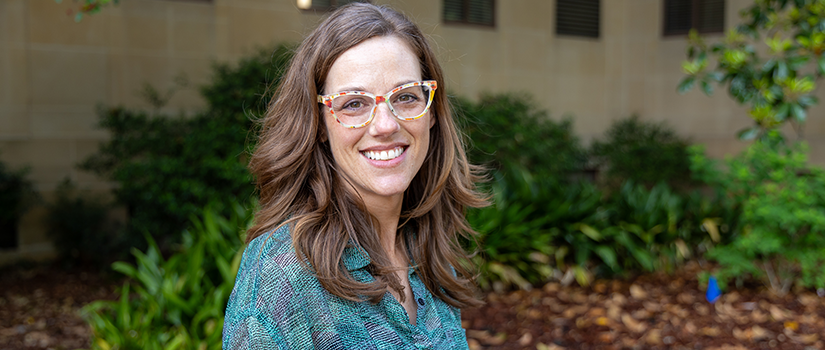
Students in Rachel Mann’s English classes debate, question, collaborate and sometimes continue conversations long after class has ended. For Mann, that kind of energy is the point. She believes learning happens best when students take an active part in the process, discovering how to think through difficult questions together.
This year, Mann was recognized with the Professional-Track Faculty Teaching Award from the McCausland College of Arts and Sciences, honoring her outstanding impact in the classroom.
Her department chair Susan Courtney describes her as “extraordinary,” praising her ability to create “a genuinely open intellectual community” where students feel comfortable engaging with different perspectives.
As a senior instructor in the Department of English Language and Literature, Mann teaches courses that ask students to engage with complex moral and ethical issues. Her classroom philosophy centers on curiosity and what she calls a “beginner’s mind,” an approach that values openness, possibility and shared learning.
Beyond her teaching, Mann is also an accomplished scholar whose work spans literature, rhetoric and digital humanities. She says some of her proudest moments come when students pursue opportunities they once thought were out of reach or when she overhears them still talking about class on their way out the door.
In recognition of her achievement, we asked Mann to share a few thoughts about her approach to teaching.
What inspired you to become an educator?
I love learning, and I learn best by listening to and interacting with my students. They remind me of the importance of a beginner’s mind, in which there are so many possibilities and paths to follow as opposed to that of an expert. While I may know a lot about a lot, so do my students. Together, we create new and shared knowledge, and that process is really beautiful and inspiring. I received my Ph.D. from USC and benefited from numerous amazing educators and mentors, both in and out of my department. I’m always learning from those around me.
How do you approach teaching, and what should students expect when they enroll in one of your classes?
I see teaching as a collaborative act. I genuinely think learning can be fun and that the knowledge gained in class or lived experience is transferable and relevant. My students should expect to be active participants in their own education. We engage in a lot of collaborative in-class activities and play games. If they’re looking for answers, my class isn’t for them. Instead, we’re focused on thinking and learning how they might come to an answer for themselves. Nothing makes me happier than a noisy and often messy classroom!
What are some of the moments or accomplishments that make you most proud of your work
at USC?
Along with the research I’ve published and projects I’ve collaborated on, I love to
hear about my students’ accomplishments. As a first-generation college student, I wasn’t always
aware of the opportunities that were available to me. So any time a student reaches
out with designs to continue their education, pursue an internship or present at a
conference, I feel privileged to be part of that journey. On occasion students will
tell me that they talked to their parents or friends about the conversations we’ve had
in class, or I’ll hear them continuing class conversations in the hall after class
is over — these moments make me feel like I’m doing something right.
What do you hope your students remember about you and your courses in 10 years?
I hope my students remember how I made them feel. And I hope that I made them feel heard, empowered and inspired. I hope they remember that we all have value and strengths and by considering multiple perspectives and listening to others, we become better thinkers, better learners and better people.