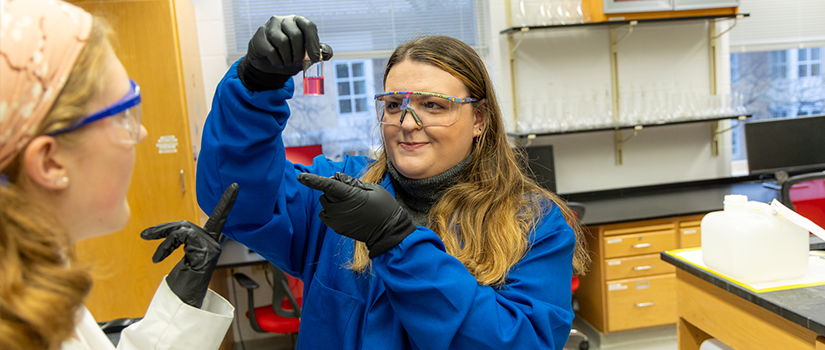
University of South Carolina chemistry professor Olja Simoska has been named a recipient of the 2026 Cottrell Scholar Award from the Research Corporation for Science Advancement, one of the nation’s most competitive honors for early-career faculty in the physical sciences. The award provides $120,000 to support a three-year research and science education project.
As part of the award, Simoska, an assistant professor in the McCausland College of Arts and Sciences, will study how extremely small metal particles — known as nanoparticles — form on surfaces under the influence of electricity. These materials play a critical role in technologies ranging from medical diagnostics, such as glucose monitoring and blood testing, to renewable energy systems.
“Most people may never see a nanoparticle, but they benefit from them all the time,” Simoska says. “The performance of these technologies depends heavily on how materials are structured at the nanoscale.”
By learning to better control how nanoparticles form, researchers hope to improve the efficiency, reliability and sustainability of next-generation devices.
USC students will have opportunities to work on this research with Simoska through a two-semester research course that integrates authentic nanomaterials research into the curriculum, allowing even first-year students to participate as part of their coursework.
The first semester of the yearly course helps students learn the basics of laboratory research ― safety, electrochemistry, scientific literature analysis and how to use instruments. In the second semester, students will design and conduct research projects exploring how electrical pulses affect nanoparticle formation. Students will collect and analyze original data and present their findings at a spring research symposium.
Students can learn more through the Undergraduate Research Initiative, introductory chemistry courses and partnerships with USC’s Office of Undergraduate Research and First-Generation Center.
About the Research
Simoska’s work focuses on understanding how metal nanoparticles form on surfaces when exposed to electrical potential — the electrical equivalent of pressure.
Just as water flows when pressure pushes it through a pipe, chemical reactions occur at a surface when sufficient electrical “pressure” drives them.
By switching that electrical potential on and off in carefully timed pulses, researchers can influence how materials assemble at the nanoscale.
“These particles are thousands of times smaller than the width of a human hair,” Simoska says. “Even subtle differences in their size, spacing and arrangement can significantly change how a material behaves.”
In her lab, researchers use rapid, short pulses of electrical potential separated by brief pauses, rather than applying a constant signal. Those pauses are critical: They allow the surrounding chemical environment to rebalance, influencing how particles begin to form and grow.
The goal is to understand how these dynamic on-and-off signals shape the earliest stages of material formation.
“We are not designing a specific device,” she says. “We are uncovering general principles that explain how materials assemble at electrified surfaces. That foundational knowledge matters because nanostructured metal surfaces are widely used in technologies people encounter every day.”
Simoska is one of 24 outstanding early-career academic scientists nationwide and only the fourth faculty member in the USC’s history to receive the RCSA award.
How to apply
Undergraduate students interested in joining Simoska’s research can learn more from undergraduate academic advisors in the chemistry department. The application process prioritizes access for early-career students who may not have prior research experience.