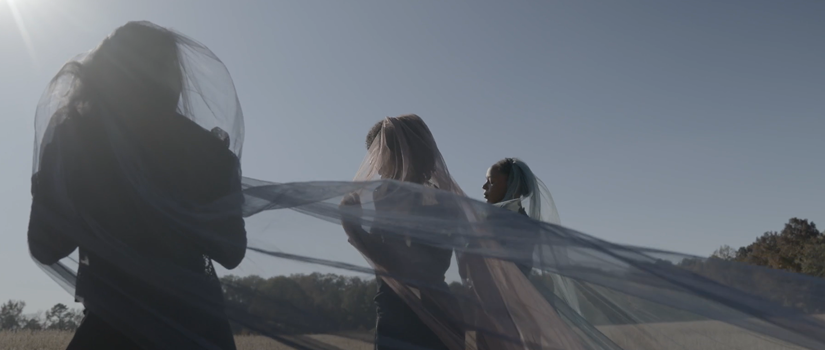
Six performers dance elbow-to-elbow beneath the skeleton frame of a pint-sized dance hall. Around them, knee-high grain stalks ripple across an open field in Harpersville, Alabama.
The frame is spare and unfinished, the beams suggesting walls that are no longer there. It is here that Tanya Wideman-Davis and Thaddeus Davis chose to rebuild a vanished space — Hapersville’s last Black-owned dance hall, once the town's lone refuge where Black joy was encouraged.
The building itself is gone. What remains are memories.
One of Harpersville’s living historians described the dance hall before it was demolished to make way for agriculture. Wideman-Davis and Davis took those spoken memories and pieced them together until the dance hall stood again, this time in bodies and lightness.

The performance and oral history are works created by Wideman Davis Dance, the Columbia-based company led by two University of South Carolina professors of African American studies. It is part of what earned them recognition as 2026 United States Artists Fellows in Dance.
The fellowship, among the most prestigious honors available to working artists in the country, includes $50,000 in unrestricted funding. The fellowship considers not just a single project but an artist’s broader vision and influence. Selection signals confidence in the work they have been assembling for years.
For more than two decades, Davis and Wideman-Davis have created dance performances across the South and the nation. Their academic research combines with choreography, oral history, visual design and digital media to create expressive performances.
Their earlier composition, Migratuse Ataraxia, supported by a Mellon Monuments Project grant, received national acclaim for its portrayal of enslaved Africans’ humanity in the antebellum South. Rather than presenting bondage as a spectacle, the work focused on interior life — the quiet spaces people made for themselves within confinement.
“We were thinking about Black life despite bondage, the architectural spaces that Black bodies moved in and the restrictions and spaces of resistance inside of plantation existence,” Davis said.
Ideas of architecture, space and restriction shape their choreography. They ask how people built lives within systems not designed for them.
Field and fabric
During their Mellon Monuments Project research, the artists created extensive visual and digital material. They are now reworking that content, layering in new explorations of Southern life, including textile production and its place in Black daily experience — something both artists have personal connections to.
“My grandmother would start sewing on Friday and have a new outfit for church on Sunday,” Davis said. “I remember being bored to death at the fabric store, but that language of textiles has been with me all my life.”
For Wideman-Davis, fabric also carries questions of identity. Her mother sewed clothing for her father so that “he could perform his identity of Blackness.” She now explores that idea with students in her Black Fashion course at USC. Cloth becomes a way of constructing selfhood, shaping how one is seen in the world.
That same attention to construction carries into their performance process. Their work often begins with written accounts and oral histories, but it does not end on the page. Video footage gathered during the Monuments Project, including images of cotton fields, rural roads and other Southern landscapes tied to the history they are studying, is projected onto the walls of makeshift performance spaces, becoming part of the choreography.
“Taking the written word of what happened — how life existed in that period — we try to bring it to life in a digital form,” Davis said. “There are layers of things that we are trying to create that will get us to the dance component of it; it lives in the performance.”
“Video content is in conversation with the live bodies that are moving around the video content,” Wideman-Davis said.
Place itself is another layer. During two years living and working in Alabama, the couple drove rural roads, passing cotton fields that stretch toward the horizon.
“Being in Alabama for two years, we drove those roads in all the seasons,” Davis said. “You drive by fields of cotton and acknowledge the history of enslavement, but also the beautiful fields. You feel the ancestors’ presence as you drive along the fields. It starts with the placement of cotton in the South.”
Cotton is both crop and cloth, labor and memory. The landscape becomes part of the work, another piece sewn into it. Their choreography grows from these encounters as an acknowledgment of pain and beauty layered into Southern soil.
In addition to the United States Artists Fellowship, Wideman-Davis recently received the inaugural Creative Capital State of the Art Prize, which includes $10,000 in unrestricted funding for new performing arts projects. The prize supports artists working across disciplines, from dance and theater to technology-driven and socially engaged forms.
Together, the honors support the work they have long been doing: gathering what remains, piecing together what was erased and constructing spaces where history can move again.