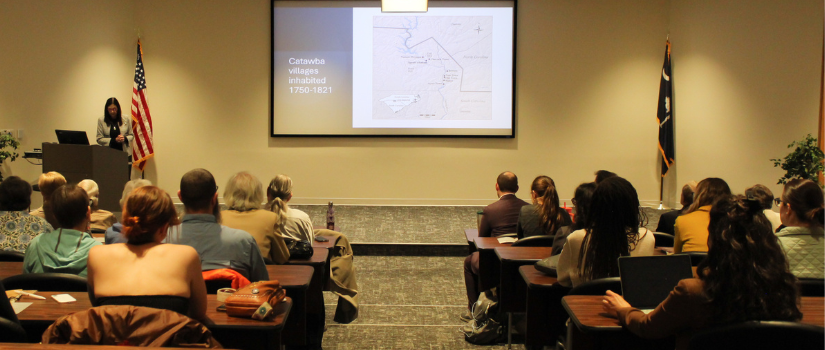
On Tuesday, March 24th 2026, keynote speaker Dr. Brooke Bauer, presented “Surrounded and Beset By Enemies: Eighteenth-Century Catawba Women's Responses to War”, for the Department of Women's and Gender Studies’ 9th Annual Dr. Mary Baskin Waters Lecture.
Dr. Bauer, is a citizen of the Catawba Nation in South Carolina and an Associate Professor in the Department of History at the University of Tennessee at Knoxville. With this expertise and personal experience, Dr. Bauer was able to give insight and connect the oral accounts of her lineage to her research of the Catawba women’s resilience during the 1700s in the Carolina Piedmont Region.
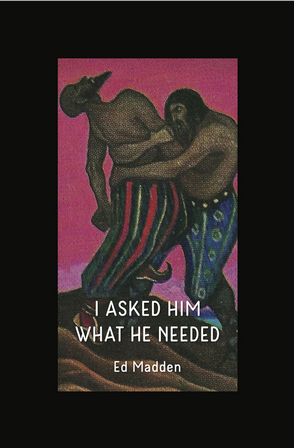
The lecture was opened by Dr. Ed Madden, USC Professor of English Language & Literature and Women’s and Gender Studies, who read a collection of poems from his latest book, I Asked Him What He Needed. Madden first began writing postcard poems the day of Mahmoud Khalil’s arrest and he describes the book as taking shape around “not just the deportation regime but the administration’s broader attacks on history, truth, law, democratic norms—and in the face of such fears, my own mortality.”
Following an introduction by WGST Department Chair Dr. Leland Spencer, Dr. Bauer provided an in-depth analysis of how Catawba citizens reshaped their lives in response to the displacement they experienced on their own land. Bauer noted the strong-willed Catawba women who worked endlessly to protect their tribe through economic and social upheavals as a result of encroaching European settlers on their homeland. Catawba women emotionally and physically exhausted themselves in order to preserve their religion, food preservation, and sovereignty. Catawba women, as Bauer expressed, “Stood at the center, not the margins of the Revolution.” Not only were the native women in charge of maintaining the condition of the land; orchestrating trade and politics; safekeeping burial practices; and managing agricultural production, they were also protectors who assumed traditionally “male” roles by hunting, butchering livestock, facilitating defense strategies, and training with weapons. The lecture emphasized the role Catawba women played as “key political actors and cultural custodians”, upholding their families and community during the American Revolution.
Further, Dr. Bauer shared details from her book, “Becoming Catawba” which analyzes the impact Catawba women had in keeping traditions alive as well as safeguarding and distributing resources during a time of political strain and hardship. For those with university emails, her book can be read online here.
During the Q&A period, Bauer described how as an ethno-historian, she incorporates not only written documentation from a combination of legislative records, archival documents, archaeology, maps, and newspapers, but also oral histories and personal knowledge that comes from within Native communities. Bauer explained that because so much of Native history is lost due to erasure, much of her research is dependent upon personal accounts, traditional oral storytelling and educated interpretations of literature and maps.
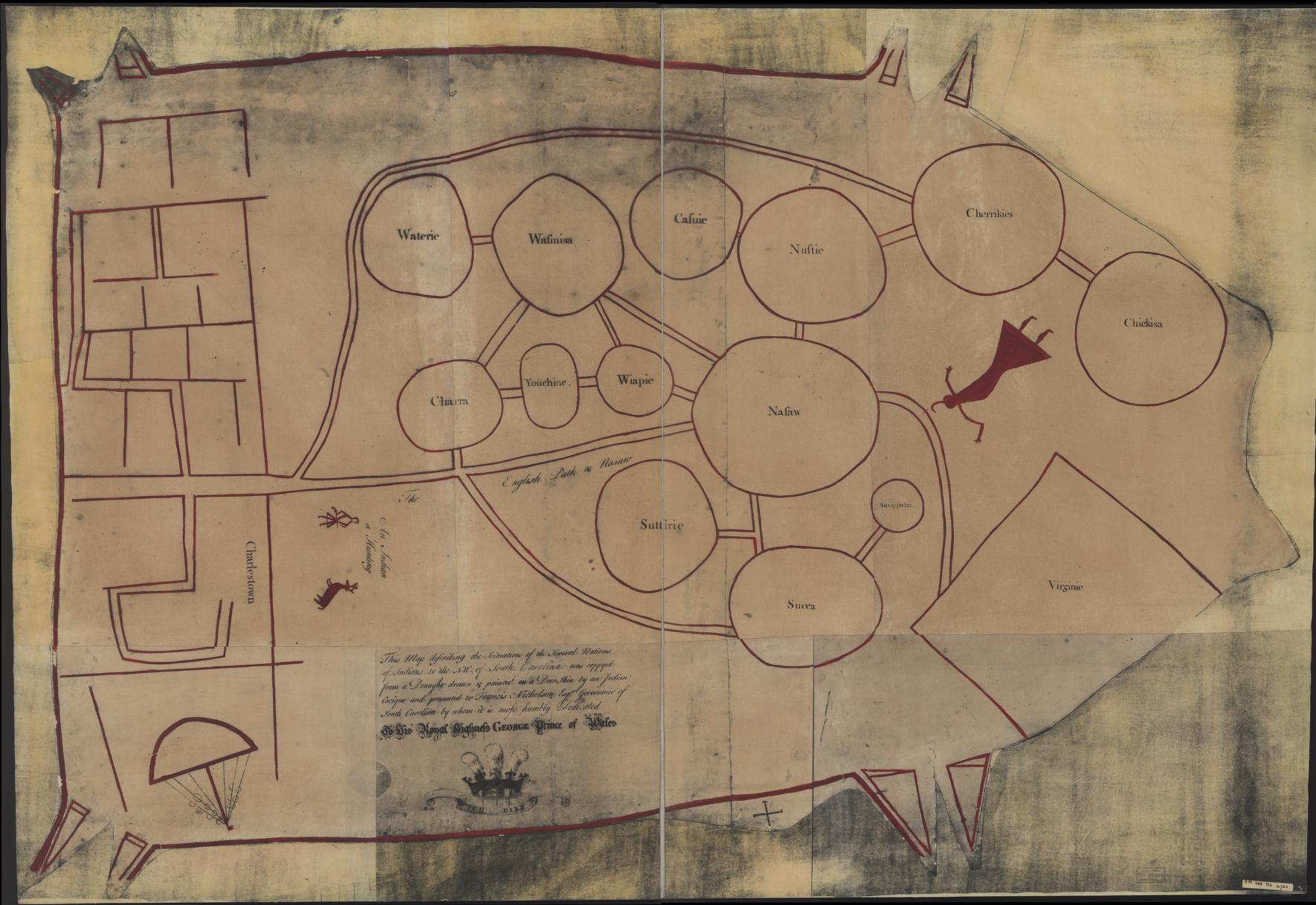
Dr. Bauer expressed her love for maps and highlighted that many of the symbols and groupings of tribes that can be seen in the maps she uses are telling of what was important and central in Catawba citizens’ minds. One map indicated the likely importance of deer hunting to the tribe through an antlered animal symbol. Meanwhile, the largest circle at the center of the map, labeled Nasaw, indicates that the mapmaker was likely a Nasaw citizen.
Earlier in the day, Dr. Bauer had lunch with Women’s and Gender Studies students and the department had the privilege of hosting her for a more in-depth conversation with student assistant Amiya Ramkissoon, on the podcast, Women’s and Gender Studies: Unboxed. Listen to the podcast episode here. You can view the gallery of photos taken by McCausland College of Arts and Sciences student ambassador Lilly Kosoglow here.
To learn more about Women’s and Gender Studies’ annual lectures visit this page or sign up for our email list by contacting wgst@sc.edu.