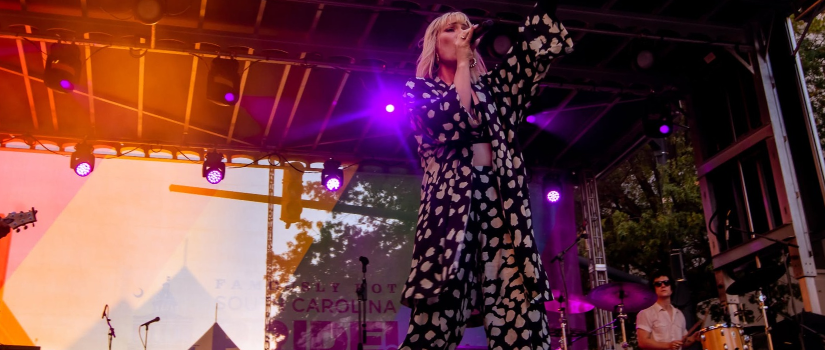
WGST Student Assistant Grace Ariss recently sat down with South Carolina Pride Movement President Dylan Gunnels to discuss Columbia's Famously Hot SC Pride festival which takes place annually in October.
The South Carolina Pride Movement is a nonprofit organization dedicated to ensuring the rights and representation of the LGBTQ+ community in South Carolina. Since 1989, the organization has served the community through celebrations of love and diversity, community outreach, and connectional opportunities. Through intentional programming and collaborative efforts, South Carolina Pride Movement creates spaces that elevate the queer and trans community and advance the truth that we belong in South Carolina.
How did Famously Hot SC Pride get started? What is the South Carolina Pride Movement’s mission and how did you gain recognition across the state?
That’s a fitting and timely question because Harriet Hancock just passed away. She is such a huge component of our story and how our organization got started. Harriet was a mom of a son who came out as gay and really lived out what it means to be an ally and to use your power and privilege as an opportunity for marginalized communities. Back in 1989, she walked around Finlay Park during a PFLAG meeting gathering signatures with ambitions set for a march down Main Street to the State House.
After gaining approval by the City of Columbia in 1990, she grabbed her son’s trembling hand and marched down Main Street with 2,000 supporters, realizing that they were a part of history in that moment. Clown makeup was utilized for participants who were too scared or cautious to be public about who they were, further emphasizing the lengths queer people have to go to make sure they’re protected and not completely disregarded in a system that doesn’t always recognize our full authenticity.
At that time, the march was enacted to demand equal rights, access to healthcare, and guarantee protections around housing and employment. 37 years later, we are continuing her mission: to advance the truth that the LGBTQ+ community belongs in South Carolina. Today, we create spaces for representation and elevate the queer and trans community across the state through our connectional opportunities and pride celebrations.
The importance of these opportunities is that there are now pride celebrations popping up in different cities across the state, all of which we continue to support and collaborate with! The importance of these celebrations is that people are seen, connected, and able to live authentically. That makes people feel safer at home. It’s a wonderful byproduct that prides are popping up across the state. We also understand there are a lot of rural queer folks who don’t have access to those events, so holding a festival every year is not only important to Columbia and the greater Midlands but allows people from all over the state or region to celebrate. We are one of the few statewide prides in the country, and we, as a board, are excited that we’ve moved into the next phase of South Carolina pride’s life!
How has Famously Hot SC Pride adapted to changes in local/federal legislation surrounding LGBTQ issues?
From a funding perspective, we’ve never been reliant on any federal grants or income, which has made change a little easier. What we have had to maneuver is our relationship with the city and the county because they provide H Tax and A Tax funding. That’s where I’ll be very frank, on the one hand I am very grateful that the city and county continue to offer funding every year since I’ve been in this position. At the same time, we recognize that our events bring people into town, have them stay in hotels, visit restaurants, and engage in tourist activities. We understand that it’s a smart economic decision on behalf of the city and county to continue to provide that funding. I wouldn’t necessarily say this behavior comes from allyship, but I don’t feel push back from the city or county about our events.
Overall, I don’t think they “stand in our way”, but we have had to adapt to the ways we honor the city’s requests. Outside of that, we’re very fortunate that a lot of our sponsorships have sustained through this moment in time. We have seen an influx of local businesses and leaders who are willing to stand up and provide smaller sponsorships. Maybe we’ve lost sponsorships, or the relationship has changed, but we also hear from others and continue to grow in our donor base. We’re really driving the sustainability piece of our fundraising by diversifying our portfolio of funding and navigating the nuance of living in the South. We are very mindful of the type of language or rhetoric we can or can’t use in certain spaces, but when it comes to long-term growth and our mission, we aren’t going to stop.
What are some ways the organization works to foster diversity and inclusion?
In the nature of being a pride organization and caring about the community, we are always thinking about ways to become more inclusive. In the past, we’ve heard that pride wasn’t sapphic enough and wasn’t inclusive of more femme-presenting people. So, we started a Sapphic Mixer and Tea for T (a monthly event for trans and non-binary folks) to open dialogue about what’s changing around us and where different groups feel supported or not. We try hard to listen to our community and gather survey responses to hopefully alleviate those feelings of not being included or not being a part of the whole.
We have a great relationship with South Carolina Black Pride, so we make sure to hear from them and partner up when we can. Darius Jones is a co-leader in the statewide coalition, so it was extremely important to us that South Carolina Pride and South Carolina Black Pride have that close relationship. All the way down to our pride events, we share the float together at the Pride Parade because we want to show the community that these are two separate organizations that unite for a shared reason, stemming from a deep place of Black folks needing their own space while also signifying we’re in this together.
Soon we’re relaunching our town hall meetings to hopefully allow opportunities for people to come, share, and be open and vulnerable about our work and representation. We work with Able SC and New Disabled South to have conversations about accessibility, as well as do audits of our festivals and events to try and become more accessible every year. Partnering with the Harriet Hancock Center has given us a way to provide an accessible space at the pride festival annually.
There’s always work to do, and we recognize our executive board is really white, and we don't like that. We are continuing to diversify our executive leadership and the board itself, but on the ground from committees to volunteers to festivalgoers, it’s very diverse..
Can you walk me through the fundraising and organization processes?
Ideally, we would like to get to a place where we’re planning even further in advance. As our pillar events become closer, we are planning for next year’s celebrations while we put a bow on this year’s events. Festival weekend ends in mid-October of this year, so we’ll take a couple weeks off and then reconvene in November to determine the theme for next year. Thankfully, our dates are pretty set-in-stone: Outfest is always the first Saturday in June, and Revelry is always the first Saturday in August. The Pride Festival is a little trickier because we work with Atlanta Pride in partnership for entertainment. We have to maneuver according to their schedule as well as consider the State Fair, Gamecock Football, and police availability.
There are a lot of factors that contribute to the October festival, but our hope is that after this year, we can stick to the third weekend in October as designated Pride Weekend. This would help us internally because our schedule would flow seamlessly, and people moving forward wouldn’t have to figure out their calendar. Once the theme is determined, we work backwards to figure out when the smaller details need to be finished, when meetings need to be held, and what deadlines logistics require. There’s a lot that goes into festival planning; it’s a constant pulse balancing many plates and cleaning up the details along the way.
From January to March is kind of slower; we try to give volunteers a little bit of downtime, begin restarting our monthly mixers, and plan our upcoming fundraising strategies. By March, it’s time to tie up any loose ends and get ready for Outfest in June. June to October is a sprint of polishing the details, connecting with our partners, and biweekly committee meetings. I love how we’ve nailed down our structure with committees that focus on different events or tasks. We hold office hours every Monday and Friday and constantly have the executive team check in and offer a helping hand where needed.
Has social media changed the way you promoted your events or serve the community?
Yes and no. I feel like social media at this point, with any organization is just a necessity. I’ve felt like over the past decade, you couldn’t not do social media or get away without any type of digital presence. Now I feel the trends have shifted, and people would much rather watch an organic video instead of curated content. On the one end, it’s helpful because people aren’t expectant and you can post whatever you want, but I wouldn’t argue it’s changed the way we do things now other than checking a marketing and advertising box.
For us, word-of-mouth has proven just as effective. I’ve been surprised by posters and flyers seen around coffee shops and local businesses. I often hear from people that that’s where they first heard about our events. We do everything from billboards to digital campaigns to word-of-mouth promotion. I would say social media usage is a part of a larger marketing strategy but not necessarily something we expect to popularize us. We started using Posh and sending out direct messaging and links to our supporters. Because there are so many ways to reach people, things like direct messaging and word-of-mouth are really what contributes to our promotion.
What are some ways USC students can get involved with Famously Hot SC Pride and the South Carolina Pride Movement? Can you elaborate on the volunteer application process?
Y’all USC students are on our minds! We table on Greene Street a couple of times a year to bring attention to our organization and link that community to campus. We also participate in Birdcage and Pridechella. Whether it’s partnering with Garnet Media, IRIS, or the Daily Gamecock, we work hard to make our resources and events accessible to the college community. We are open to students reaching out and telling us how we could open up dialogue and become more accessible for the college crowd. Our events are open to anyone and everyone, whether you want to attend as an ally or work as a volunteer. Our application process is simple: head to our website and click the link on the volunteer tab. When we’re approaching our major events, the volunteering we ask for is for that specific event due to the sheer volume of people we need. All the application requires is your name, availability, contact information, and a little bit about your background and interests.