“Book banning” refers to restricting and regulating the reading of specific materials, understood as a form of censorship. It has been described as a controversial act in opposition to a democratic society as well as an encroachment on free media literacy (Volle, 2025).
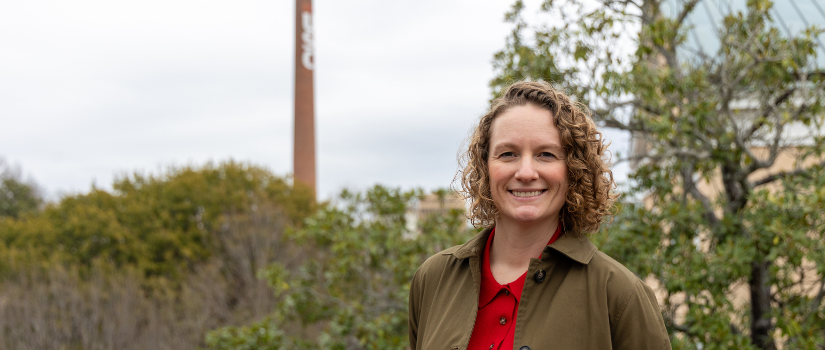
In an interview with Dr. Jenna Spiering, USC’s School Library Concentration Coordinator and an Associate Professor of Library and Information Science and WGST Student Assistant Sage Braddock, the two explored the troubling rise of book banning in school libraries. Due to the widespread interest around regulation and publication of queer media, many school libraries have faced backlash regarding queer literature that is deemed inappropriate by some to be kept in educational institutions.
Dr. Spiering depicts her interest in the field as originating around the regulation of what material young people can read. “What are the long-lasting implications of saying, ‘this is controversial, or this is not controversial’ and who gets to decide that?” Additionally, she described her own relationship with literature and how it further prompted her interest in the issue: “I come to [this] from my own experience of being a person who loved to read and loved to find books that were too old for me (or at least what people thought were too old for me). I credit that experience to why I love to read now. I got to read what I wanted to when I was a young person”.
Topics like these led Dr. Spiering to begin teaching USC’s online master’s program for Library and Information Science. "Those are some of the things that came up when I worked as a librarian, that brought me to some of my research, that brought me into a PhD program, and led me here, doing teaching and research in this area”.
When asked how materials are curated in the school libraries, she expressed “...there's a lot of panic out there about teens these days not wanting to read anymore or not having time because of their schoolwork. So, for librarians they really just want to keep a collection that's relevant and that is interesting, and they're never telling anybody what they have to read. They're simply providing the books and then it's up to kids, teens, and sometimes their parents when they involve them, especially when they're young, to decide what's right for them.”
Further, librarians are trained in selecting materials that align with children's aspirations and interests: “We say a librarian really knows the population of our school. They listen to what the kids and the teens want. They know some of the personal situations that students are going through, so they can purchase books that relate to that. Part of my job is to teach school librarians how to do that; how to select materials. And honestly, it's a really systematic process. There are professional book review journals, like the School Library Journal, Publishers Weekly, and Book List, that come out monthly with all the books that are being published. We look through those to find what books are reviewed for our age range that we’re serving and if the book looks like it's reviewed for that audience, I read the review, and I see if there are good things in it.”
During this process, the librarians take recommendations and requests as well, reflecting that the overall curation of the library is to serve the children's desires. “Typically, we also take recommendations from teachers and students, but always you vet the book before you put it in the library to make sure it's reviewed for the age range. That just used to be a lot more of a subjective process...librarians in South Carolina have a master's degree; they take multiple classes in selecting materials, so we've always kind of relied on their expertise in that area. That's really come under some scrutiny in the last couple of years, more than usual. There's always been challenges to library materials, but of course there's a lot more now.”
Despite the negative lens librarians are seen through by some, their good intentions are evident: “We want to support the curriculum, we want to make sure that students see themselves in the books, we want books to reflect their experiences, and we want the books to be popular so that they read them and they enjoy reading.”
Dr. Spiering noted that “There's just a lot of people saying that librarians are trying to indoctrinate kids, or they're groomers and it’s really hard to be under that kind of scrutiny when you just are trying to go to work and get kids to check out books and help them with research. It's hard to have people make you kind of the villain...”
When asked how these regulations come forth, Dr. Spiering explained they are often motivated on the basis of parental testimonies: “Most parents are happy to just let the library let their kids check out something and then if they have a problem with that book, they can talk to their own child about that but it's a really vocal group that are not happy with that.”
The state of South Carolina has made drastic legal changes in this area: “[T]hey wrote Regulation 43170, said that books must be age-appropriate and that they should not contain any sexual activity. Now, if a parent doesn't like a decision from the district, they can appeal that to the state Board of Education. [The Board] makes a decision about the book, and that decision goes for every school in South Carolina. Quite a few of those titles are LGBTQ titles. Sometimes there is sexual activity in them, but there is sexual activity in a lot of young adult titles, because it's a big topic for young people as they're trying to figure out where they fit in with that. They're trying to learn about what is right and wrong, what is safe and unsafe, what's consensual and not consensual. There's all sorts of ways that young people are engaging with that topic.”
Content within libraries has always been a concern, but now seems to be reversing efforts made over a decade ago to widen the range of media available: “There was really a movement to make collections more diverse, to have more LGBTQ books, and there was more effort put into the awards for those books. There's been a real boom in that area, and now there's a lot of backlash, and that is typically I think, because gender and sexuality get kind of conflated when people talk about the problems they have with those books. They assume that any book that has any kind of LGBTQ representation in it is automatically going to have sexual activity in it, and that's just not the case. For elementary school students and picture books and middle grade books, they never have sexual activity in them. Even the presence of a character who represents the LGBTQ umbrella makes that book a target for censorship. We've seen a huge uptick in the number of books that have been challenged and banned over the last few years, and a disproportionate amount of them are books that would be considered to be LGBTQ titles.”
Dr. Spiering put it perfectly in defining the special nature and outlet of reading, “...if you think about any book that you've read, that you loved, it's because it resonated with you in some way. There was something that you could relate to the character or the plot about. And maybe the character's totally different than you, but they had a similar situation, and you find this common ground with somebody who's completely different than you. That's what's really important about reading and that's why we need as many perspectives and stories as possible, and we need access to them.”
“I personally believe that if we find really relevant and interesting materials, people will watch full movies, they will read full books. I really worry about some of the efforts to censor what they're reading and to tell them that what they're reading's not appropriate, because I think that will be really counterintuitive to getting teens and kids to read more...”
While some may suggest public libraries as an alternative to school libraries, as Dr. Spiering expressed, “... a lot of kids just don't have access to that. They may not have a ride to the library, or they don't have a library nearby. Some students don't want to go ask a librarian for the book, or they don't want to draw a lot of attention to what they're checking out. There's all sorts of barriers that might keep a kid from going to the public library.”
For those that do have access, even our public libraries face backlash: “ We're also seeing public library collections being challenged more often, too, particularly in more conservative, more rural areas. There's been some recent articles in the news about books being pulled, or Pride displays being taken down, etc.”
Even with new regulations and discourse around queer literature, there are still people fighting to support freedom of expression and individual exploration in all forms of media. Leaving us all with a positive reminder, Dr. Spiering had this to say: “...we're always going to have people that are coming into the profession because they want to stand up for kids and their right to access information; their right to read what they want to read.”
References
Volle, A. (2025, October 1). book banning. Encyclopedia Britannica. https://www.britannica.com/topic/book-banning