
Physical activity declines begin in late childhood and continue into young adulthood, and they are due to interacting personal, social and environmental factors.
June 8, 2026 | Erin Bluvas, bluvase@sc.edu
A multi-year research project led by members of the Arnold School’s Children’s Physical Activity Research Group (CPARG) has illuminated an array of factors related to the decline in children’s physical activity as they move from elementary to middle and then high school. With support from two National Institutes of Health grants, the Transitions and Activity Changes in Kids (TRACK) Study team* collected data from the families of more than 1,000 children as they moved from fifth grade to 11th grade – discovering physical activity trends across various groups and the different elements that influences these changes.
“We’ve known for some time that adolescence is a critical risk period for declining
physical activity but one that also offers opportunities for instilling lifelong healthy
habits,” says exercise science professor and CPARG director Russell Pate. “By identifying the varying trajectories of children’s physical activity and the
various factors that impact them, however, we are confident that carefully designed
interventions can make a difference in maintaining or increasing physical activity
as young children grow into adulthood.”
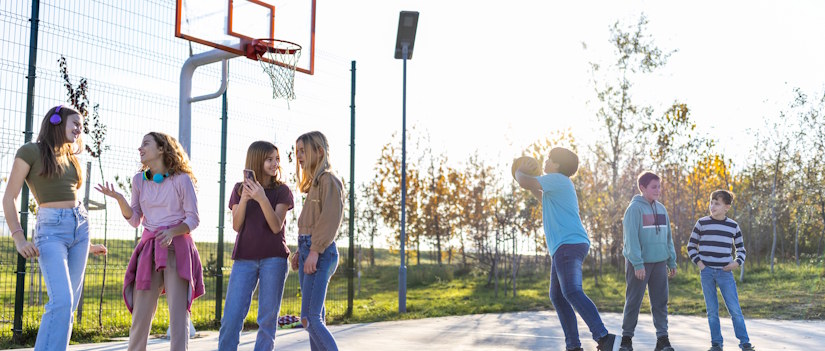
Physical activity declines begin in late childhood and continue into young adulthood, and they are due to interacting personal, social and environmental factors.
Up until the 1950s, children engaged in high levels of physical activity as part of their daily lives – it was not something that parents, clinicians or teachers had to plan for them. Walking and biking were primary methods of transportation and play. Outdoor free play was the default activity for children’s leisure time. Chores like pulling weeds or mopping required much more physical exertion compared to today’s shorts cuts using automated tools.
The suburbanization of America that followed WWII changed our transportation methods – making cars a necessity and buses collecting kids for school. One of the biggest changes was the introduction of the television. At the start of the decade, only 9% of U.S. households had one. By 1960, that number had climbed to 90%, along with the rapidly increasing sedentary time Americans engaged in as a new form of recreation.
This time frame also saw scientists begin linking sedentary behaviors to adverse health outcomes, but society-wide changing lifestyles far outpaced this methodical research. Between the 1980s and 2000s, children’s decline in physical activity further accelerated due to the introduction of video games and computers as well as the use of technology in schools. Unstructured outdoor play also decreased alongside dedicated physical education and recess time at school.
The advent of activity trackers and the commitment of additional resources to studying
these changes have made the past 25 years a period of tremendous insight into this
phenomenon – even as physical activity continued to drop alarmingly both in the U.S.
and globally. Recognizing the long-term health risks, government agencies and other
funding bodies awarded grants to researchers like Pate to better understand why America’s
youth have been experiencing physical activity declines at younger and younger ages
followed by a progressively downwards slope as they head into adolescence.
As one of the earliest researchers to study children’s physical activity, Pate has secured more than $28 million in the field – training dozens of students and fellow researchers across five decades of projects. From infancy to young adulthood, across various settings, and using emerging technologies, CPARG has studied children’s physical activity from every angle.
The TRACK Study built on their breadth and depth of expertise by measuring both physical activity and surrounding factors across diverse groups of children across each stage of adolescent development. In terms of trends, the team found that physical activity declines begin in late childhood and continue into young adulthood; however, this downward trend is not uniform across all children in all circumstances.
Effective interventions must target multiple factors simultaneously through sustained engagement in structured, supportive – both socially and in terms of resources – settings to address declining physical activity among youth.

They found the steepest declines took place prior to age 14. Further, these decreases were more pronounced among girls (especially those who mature early), youth with less-educated parents, and those who live in disadvantaged neighborhoods (i.e., ones without parks and other safe spaces/resources that encourage activity). Declines were similar across race/ethnicity.
Some children maintained very high activity levels, often as a result of participation in organized sports. In fact, structured activities, including after school programming, helped prevent decreases in overall physical activity whereas children who engaged in unstructured activities like going home after school were more vulnerable to decreases in activity and increased sedentary time.
The authors point out that environmental factors, such as safe and consistent access to parks, home equipment, and recreational facilities, also contributed to higher activity levels – as did parental support, peer involvement, enjoyment of being active, motivation and self-efficacy. In other words, context matters. This includes physical location, social environment, time of day, and structure of the activity.
The youth who maintained higher levels of physical activity over the course of the study (from fifth to 11th grades), had healthier weight and fat mass index measurements across all groups. Previous research has already shown – and their study provided further evidence – that sustained physical activity during adolescence is important for long-term obesity prevention.
“The results from the TRACK Study show that the physical activity declines throughout adolescence are due to interacting personal, social and environmental factors – not one or two variables in isolation – and this is why single-strategy solutions won’t work,” says Pate, whose team published 36 peer-reviewed papers on their findings. “This means that effective interventions must target multiple factors simultaneously through sustained engagement in structured, supportive – both socially and in terms of resources – settings to address declining physical activity among youth.”
*Numerous faculty, staff and students contributed to the TRACK Study over the years. In addition to Pate, some of the key team mebers include Marsha Dowda, Ruth Saunders, Kerry Cordan, and Sharon Ross.