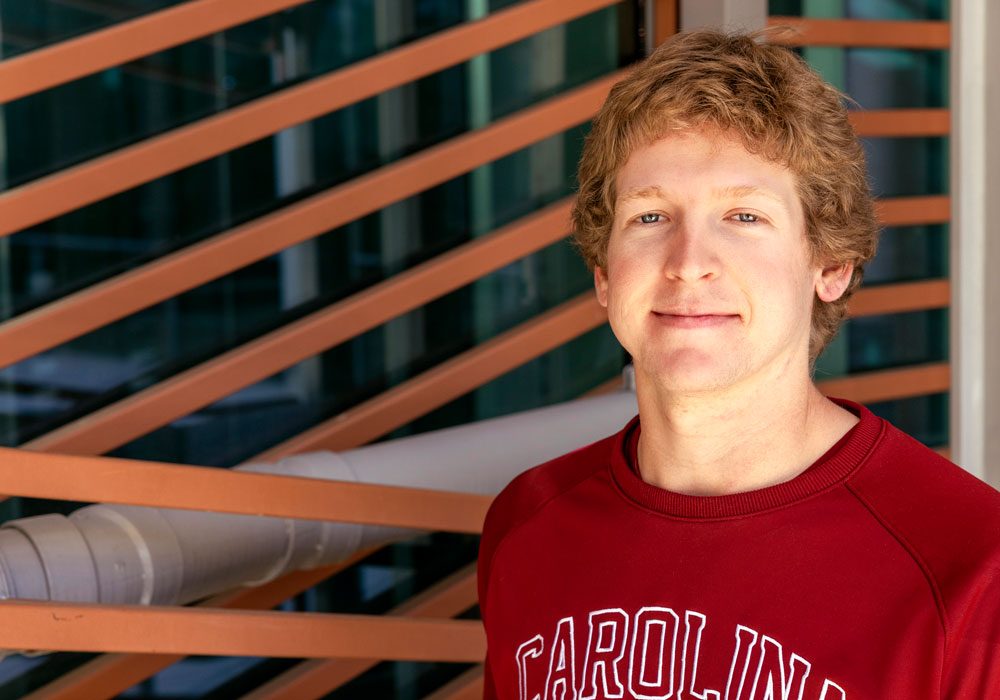
Growing up the son of engineers, it was never a question that William Joyce would pursue a mechanical engineering degree. But when he was in his final year at the Molinaroli College of Engineering and Computing, he started thinking about a way to merge his mechanical engineering degree with his interest in business.
The 4+1 pathway partnership between the engineering school and the Darla Moore School of Business was just what he was looking for. The program prioritizes engineering and computing graduates for direct admissions into the Moore School's one-year Master of Business Administration or the Master of Science in Business Analytics programs. Joyce, a kicker on the Gamecock football team, was one of the first students selected to participate in the program after earning his undergraduate degree in May 2024.
The program allows students to earn an undergraduate degree in engineering and a master’s in business from the Moore School in five years. A combination undergraduate and master’s degree readies graduates to enter the job market with high-demand technical and leadership skills and creates a pipeline for retaining talent within the Palmetto State. Seventy percent of engineering and computing students are South Carolinians, and many alumni choose to remain and work in South Carolina postgrad.
“All, or most, of the classes are very case study focused. So, we're taking real life problems and applying what we learn to determine solutions for those cases and working through them with the professors,” says Joyce, who is from Spartanburg, South Carolina. He started his MBA in business analytics in August 2024. “Also, the same people are in almost all my classes, so it's really easy to be able to talk with everybody and work through everything with them.”
For someone with no prior business knowledge and a football schedule to keep up with, the transition from undergrad to a master’s program was difficult. He says the pacing of the courses and his schedule were an adjustment for him, but working with his advisors, professors and coaches made it less daunting.
“The biggest difference is just learning a bunch of new content,” he says. “With engineering, I felt like the classes were building off each other, and while that's the case for some of the classes in the MBA program, a lot of the time you're learning something completely new in every class. You’ve got to hit the ground running. There are a lot of half semester classes, so you're learning a lot of content very quickly, but the way the program is set up, it's possible for anybody.”
After graduating in December, he would like to work in the manufacturing industry. He says the program’s real-world, data-driven learning approach has given him confidence for the future.
“I was told by not only my peers, but my dad and other older people that have worked in the industry, that a lot of people start off as engineers then as they work their way up and start getting into the business side of things,” he says. “That’s what I want to do eventually, and I figured there's no better way to get a head start on it than getting an MBA.”