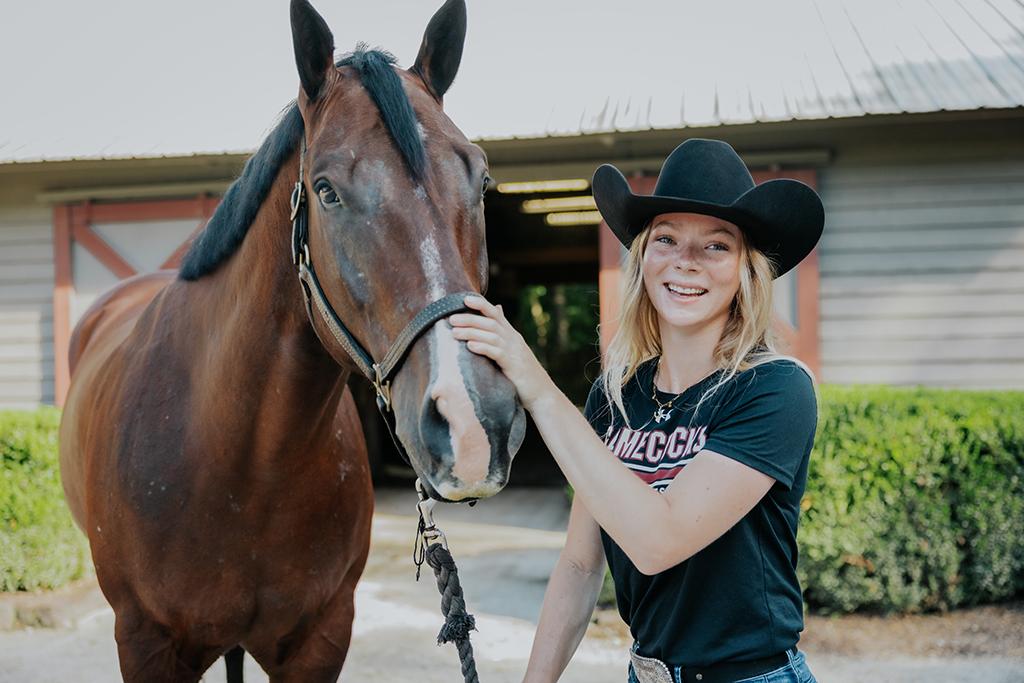
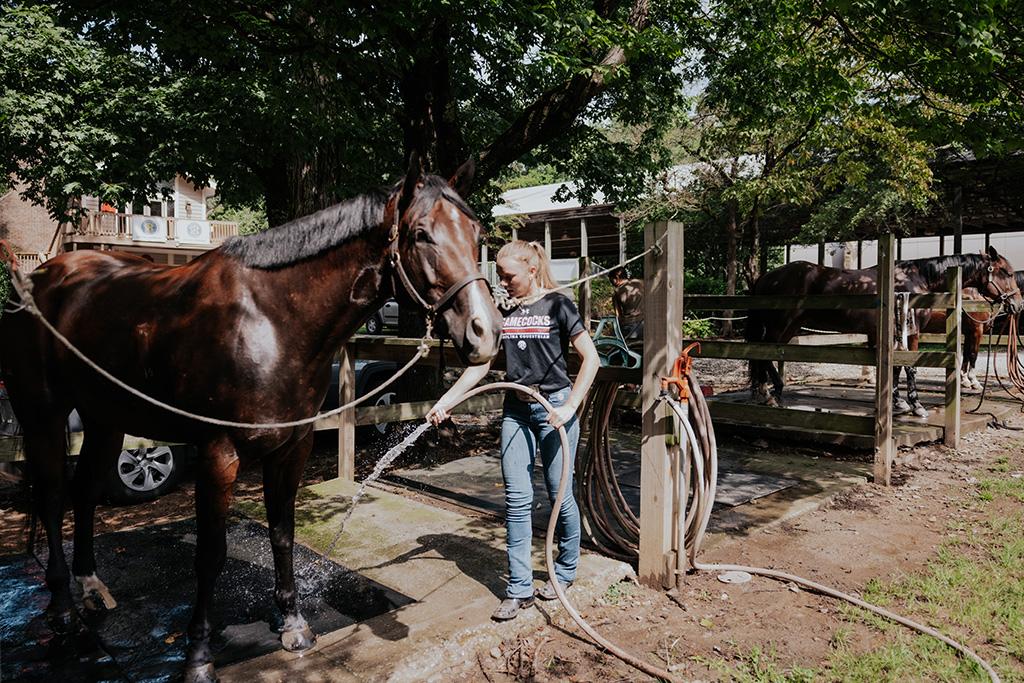
Inside a barn, Ruby Voortmeyer leads a brown horse out of its stall. She brushes the hair at the horses’ forehead. Then she is seen riding a horse in the arena. Inside a laboratory, Voortmeyer positions high-tech equipment to run an engineering experiment.
For senior Ruby Voortmeyer, it all comes back to leadership. As a member of the University of South Carolina’s equestrian team, she competes in the horsemanship event, leading her horse to perform complex maneuvers with grace and accuracy. As a mechanical engineering major, Voortmeyer leads by putting her best effort into her studies, whether in the classroom or the research lab.
In both arenas, Voortmeyer gives it her all. “I like to view everything I do as something for others to potentially look up to, and I try to show a positive way to lead your life,” she says.
Voortmeyer felt pulled in two different directions when she was choosing what to do in college: Her love of riding horses is lifelong, and she also has a passion for engineering. USC offered her the opportunity to pursue both.
“Horses have always been a part of my life, so continuing to ride in college was important to me. What actually convinced me to come to USC was my official team visit,” she says. “It showed me the whole campus, and I got to learn all about the engineering program. USC checked a lot of boxes for me: great schooling, because that's my No. 1 priority, a great athletics program and a beautiful location.”
Voortmeyer grew up in Holladay, Utah. She has trained extensively since she was young and traveled to compete. She says the experience helped to shape her values.
“Before college, I competed with youth across the nation and learned about being a leader as the president of the American Junior Paint Horse Association. But even before that, I learned a lot about being in a community,” she says.
“Equestrian is a hard sport because it's very individual. Your horse is really your partner, but other than that, you’re going head-to-head against all these other riders. Although they are your competitors, they’re also your friends – many since childhood – and they share your passion not only for the sport, but for the horses and the community.”

Leading in the arena
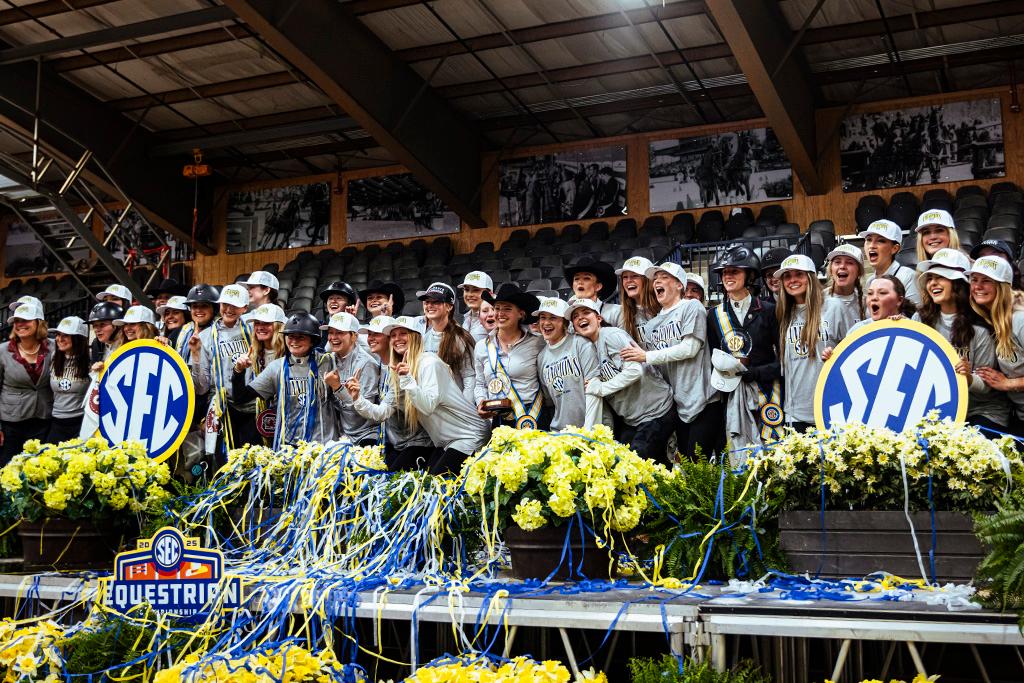
She found a new community with the equestrian team at USC, though it was challenging to adjust to living so far away from home.
“I came to USC not knowing anyone, which was difficult at first, but I quickly connected with the equestrian team members. Even though we may all be different, we have a bond through our love of the horses,” she says.
Voortmeyer rides horsemanship, one of four different events in Division 1 equestrian. For her event, judges assess the rider’s ability to get the horse to do patterns of movements, which the rider practices in advance. The rider’s job is to subtly communicate to the horse what it needs to do.
“For example, I'll apply some pressure with my leg or my foot. The areas of the calf versus the thigh versus the foot all communicate different things,” she says. “It has to look sharp, like the horse is with you. It has to look like you're doing nothing, even though you're definitely not doing nothing. You’re mostly being judged on the horse’s willingness to listen to you and your ability to control the horse while looking good doing it.”
At the event, riders have only four minutes to get to know their horse, which is assigned to the competitors at random. Some, but not all, cues are consistent from horse to horse, and certain horses may be less cooperative. Voortmeyer says success in horsemanship comes down to what riders call “having feel.”
“There’s really no way to describe it. Having feel is just naturally knowing what that horse needs and will like,” she says.
The horses bring their own personalities and preferences to the sport, which in turn has taught Voortmeyer a lot about working well with other people.
“Leadership isn't about bossing people around – that's something you learn quickly when working with horses. You don't order them around, but you build trust and create a bond. True leadership is about finding common ground with people and inspiring them to work with you – much like the partnership you form with your horse,” she says.
“It takes a lot of leadership to be that person who steps forward to bring everyone together, but this is what makes the sport amazing. You're out there in the arena by yourself with the horse, but in the end, it's teamwork. We can't do the sport without community.”

Further. Faster. Together.
Voortmeyer believes community is an important part of her success in the engineering program, where sometimes the best way to figure out a problem is working with others.
“Engineering is challenging, and trying to get through it alone makes it even harder. Learning together and sharing ideas not only builds stronger understanding as a group but also deepens your own knowledge,” she says.
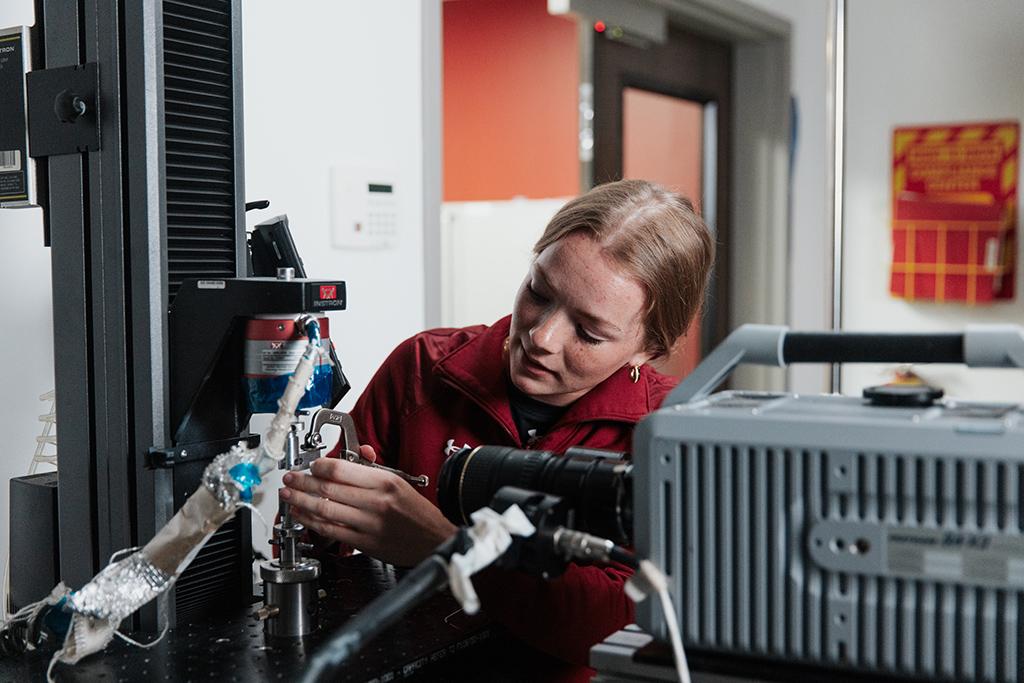
Voortmeyer has excelled in the engineering program. She has served as vice president of USC’s chapter of the Society for the Advancement of Material and Process Engineering. After earning top marks in associate professor Subramani Sockalingam’s class her sophomore year, she was invited to take on a research internship in his lab, where her work is supported in part by the U.S. Army.
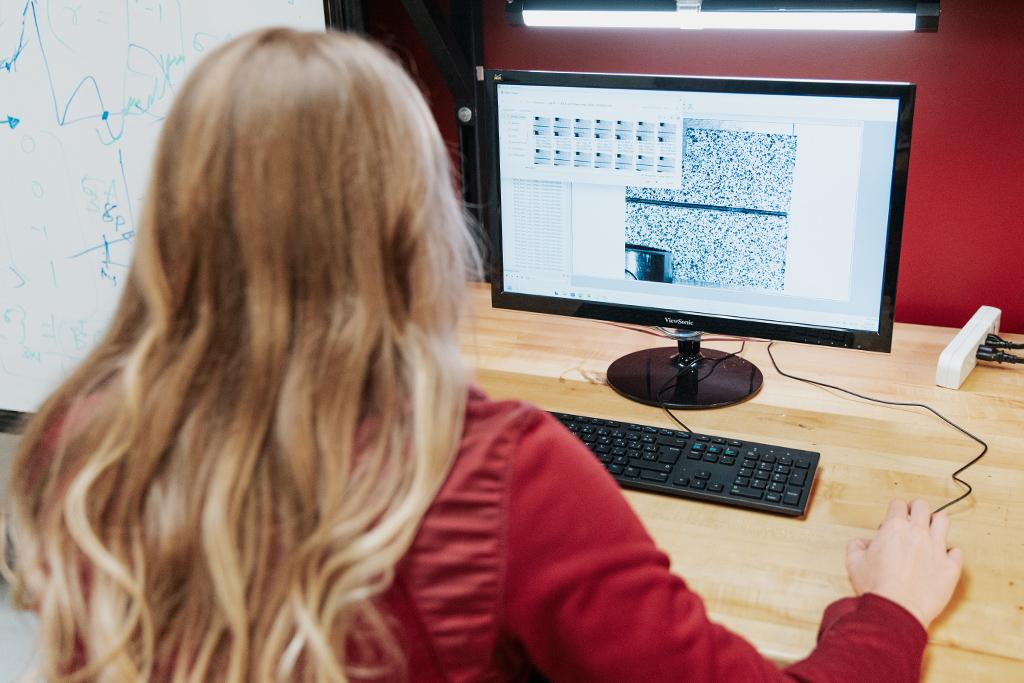
Voortmeyer studies a composite material called Tensylon, which is used in ballistic protection such as helmets and vests. Her research focuses on fracture mechanics, analyzing how cracks spread through the material and the energy that requires. While she runs tests on small samples, the resulting data is used to refine digital models with the goal of making armor design more accurate and reliable.
Beyond running tests, Voortmeyer is also working to improve methods to calculate energy release, which involves significant data analysis and problem solving.
“In the lab I work in, I have a lot of independence, which has allowed me to develop a wide range of skills. I do everything from testing and analysis to coding large data sets and giving presentations. The experience has given me constant opportunities to learn and grow,” she says.
It’s relatively rare for student-athletes to study engineering, but Voortmeyer is proud to be on this path — where she hopes to lead by example. Of the hundreds of student-athletes at USC, she is one of only 13 majoring in engineering. In addition, Voortmeyer has been accepted to the Molinaroli College’s Accelerated Graduate Program, putting her on track to graduate next summer with both her bachelor’s and master’s degrees.
“Whenever I tell people I’m majoring in mechanical engineering, I usually get a big reaction. At a Gamecock women’s athletics event, I was speaking to about 200 people, and when I mentioned my degree, I could hear the whole audience do this little gasp,” she says.
“I’m never sure if that reaction comes from me being a woman or from engineering itself, but it always catches me off guard. To me it feels normal, but hearing those responses reminds me how meaningful it is. It makes me proud to be a woman in STEM, and I feel lucky to pursue both academics and athletics here at USC.”