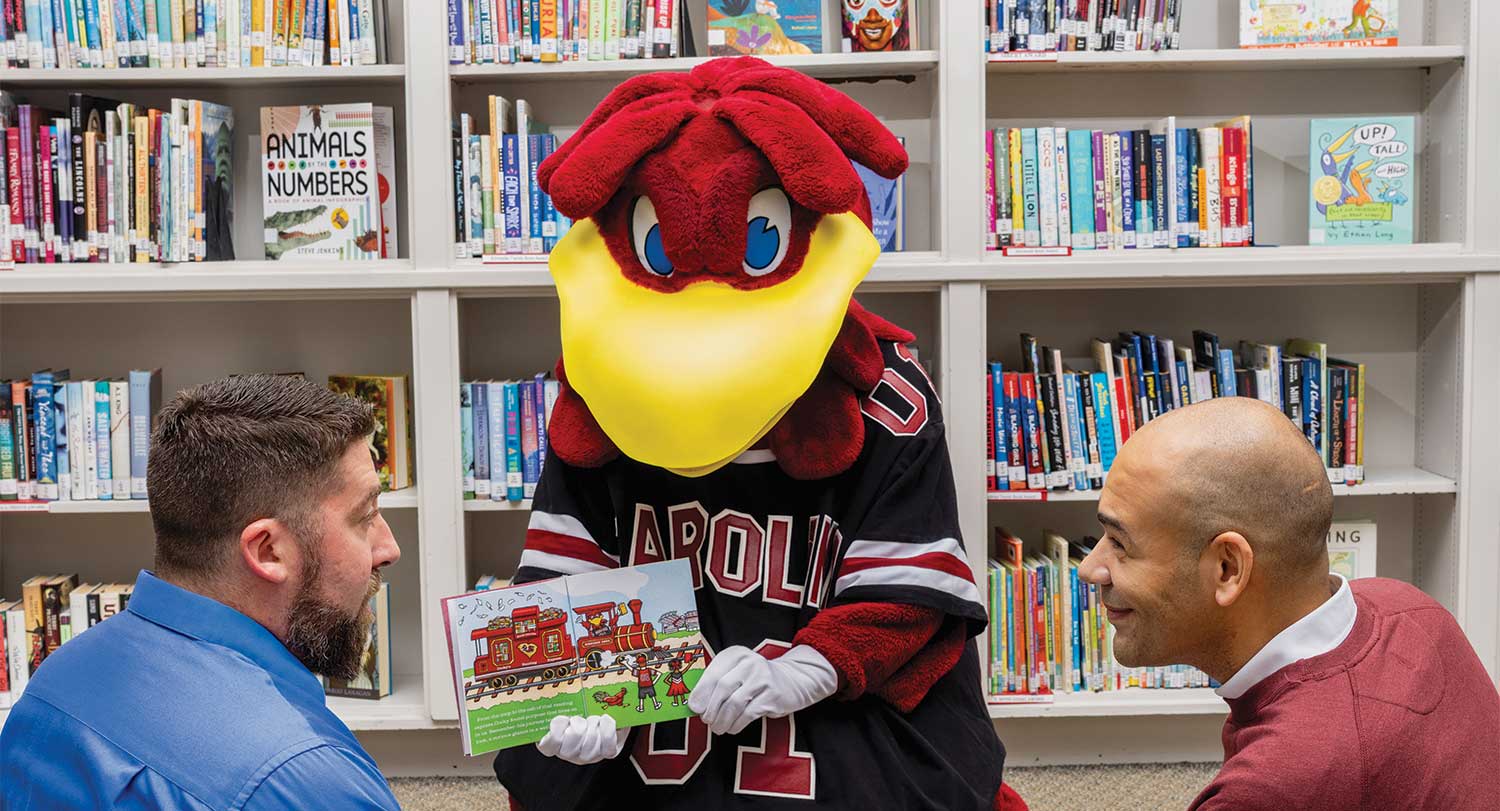
The kids go wild. That may be the best way to start a story about Cocky’s Reading Express. The University of South Carolina-based childhood literacy outreach program celebrated its 20th anniversary in 2025, and for 20 straight years now, the reception has been pretty much the same: The kids go wild.
Who can blame them? When one of the most beloved college mascots in the nation charges headlong into your elementary school gym giving high-fives and throwing spurs up like the Gamecocks just won a national championship, the excitement is contagious.
4K or 5th grade, doesn’t matter. It might as well be the student section at Williams-Brice. They clap. They stomp. They wiggle in their seats. They cup their hands ’round their mouths and chant — COCK-Y! COCK-Y! COCK-Y! And it builds from there.
But it’s not just “The Cocky Show.” The kids are primed even before the big bird’s big entrance. CRE coordinator and program emcee Margaret Jackson makes sure of that. So do the teachers and school librarians. So do CRE’s student volunteers, who warm up the kids with fun challenges designed to focus their attention before the read-alouds begin.
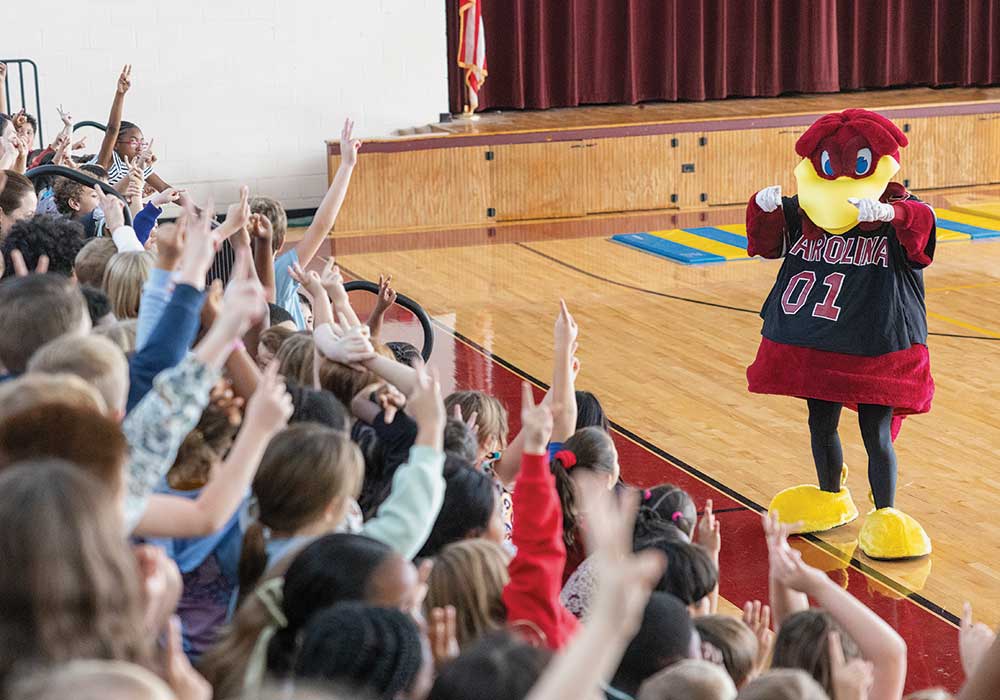
Cocky gets the kids pumped for reading at Jefferson Elementary School in Warrenville, South Carolina.
And focus they do. But they’re also kids. Excited kids. And when Cocky finally does charge in? We’ll say it again: The kids go wild.
Tommy Preston was there at the start. In fact, Preston is typically credited with hatching the idea. But the former Student Government president will be the first to tell you: Cocky’s Reading Express was always a team effort. And a lot of the credit goes to then-dean of the College of Information and Communications Charles Bierbauer.
Preston remembers clearly the day he got called into the dean’s office, along with a few other members of Student Government, to discuss an issue Bierbauer felt strongly about.
“Charles told us how South Carolina had the third highest illiteracy rate in the country, and we had an obligation to do something,” he says. “He felt that it was very important that the University of South Carolina be a leader in helping address this issue in our state, and he wanted Student Government to be a key part of that.”
That same evening, watching the news in his dorm room, he caught a clip of First Lady Laura Bush discussing libraries and literacy. Preston sat up. The world had his attention. But it was Bierbauer’s words that landed.
Now global chief talent officer at Boeing, Preston looks back on that dean’s office conversation as a pivotal moment. The 2007 political science and 2011 law school grad gets emotional talking about Bierbauer, who died in 2025. “Just his passion for the subject and the way he talked about our obligation as citizens of the state to make the state better — it left an impression on me,” he says.
Inspiration took hold. The decision to build the program around Cocky was almost a no-brainer.
“For me, it was simple,” Preston explains. “We had to get college students out talking about this issue, doing something about it, and what better face for that than Cocky, who has such a powerful brand? It was this perfect combination of college students and this powerful asset that we already had in Cocky coming together.”
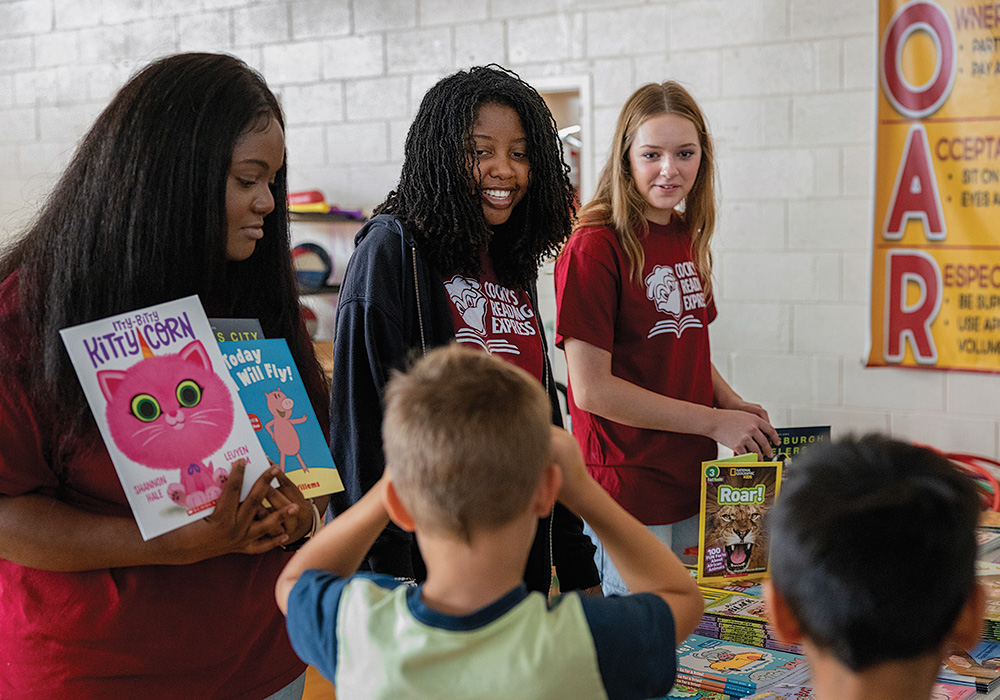
Student volunteers (from left to right) Faith Moody, Briana Vinson and Elena Pueschel hand out free books.
And it came together quickly. The team gave up a week of their winter break for a whirlwind statewide tour. Then-USC President Andrew Sorensen provided funds to purchase books. Derrick Huggins, then-vice president for parking services, provided a USC shuttle bus and driver. Cheerleading Head Coach Erika Goodwin provided a Cocky — 2003 Capital One Mascot Bowl winner Jamie Ballentine.
They also made sure to notify the media — “We worked with university communications, and we worked with the press because we wanted to make a statement,” Preston recalls — and they booked appearances from the Lowcountry to the Upstate.
They even went into “enemy territory,” visiting Clemson Elementary. Ballentine’s run as the CRE Cocky was a limited engagement, but he vividly remembers that leg. He had a sinus infection and wasn’t sure what to expect. Then, on the ride up, he got an idea.
“I said, ‘Well, what books do you have?’ and I looked through one of them. It was called Jump, Frog, Jump!, which is a very action-filled book. I was like, ‘I’ll act that one out.’”
That last-minute decision helped establish Cocky’s role going forward, which is to win kids over with his moves so the volunteers can engage their minds. It also saved the day. Remember that part about the kids going wild? Well, they went wild at Clemson, too.
“We walked into boos, everybody wearing orange, Tiger paws on the wall, and then I jump — frog jump— and they start chanting ‘Cocky!’” says Ballentine. “I was like, ‘Ha ha! I can even convert Clemson kids! This is great!'”
It was also emotional. Preston recalls being nervous at first “because there were a lot of eyes on us,” but then he saw how excited the kids got, especially when Cocky appeared. And when they got to pick out their own books, the emotions hit another level.
“I remember being in the Pee Dee that week, and a principal came up to me and gave me a big hug with tears in her eyes,” says Preston. “She said, ‘You have to realize that this is, for some of these kids, the first book that they will own in their house.’”
That was an eye opener for Preston, who grew up in the shadow of Clemson University before becoming a Gamecock.
“I grew up in a home full of books, with access to libraries and literacy, a university in my backyard,” he says. “To learn that there were kids in our state that didn’t have that same opportunity — there was no question in my mind after that trip, our lives were changed forever. We knew this was going to become a mission for students at USC.”
Twenty years on, Cocky’s Reading Express is a well-oiled machine. Literally. Since 2012, Cocky and a steady stream of student volunteers have been pulling up to elementary schools across South Carolina in a custom-wrapped bus sponsored by BP.
But that doesn’t mean it’s not hard work. CRE visits at least one Title I school each week and serves all 46 counties in South Carolina. In 2025 alone, they put more than 22,200 books in the hands of more than 15,500 students, surpassing their 20,000-book anniversary goal. They also installed 13 Little Free Libraries across South Carolina.
To keep things rolling, Jackson leans on a core group of 10-15 student volunteers, but over the course of the academic year as many as 100 will climb aboard the CRE bus. Since 2005, more than 4,000 volunteers have logged more than 16,000 service hours at more than 800 events.
“There’s a lot of people involved and a lot of moving parts,” says Jackson. “You don’t build a program this big and last this long on the back of one person. You absolutely can’t do it without the support of our entire program.”
“I grew up in a home full of books, with access to libraries and literacy, a university in my backyard. To learn that there were kids in our state that didn’t have that same opportunity — there was no question in my mind after that trip, our lives were changed forever. We knew this was going to become a mission for students at USC.”
As an initiative of USC’s School of Information Science housed at the South Carolina Center for Community Literacy, CRE taps into a pretty big brain trust. Graduate assistant Allison Hall, who completed her master’s in library and information science in December and started a school librarian job in January, has been Jackson’s right hand for the past two years. Assistant professor of information science and former CRE coordinator Valerie Byrd Fort and the center's head librarian Elizabeth Harnett are regular sounding boards. And then there’s School of Information Science Director Lyda McCartin, or as Jackson calls her, “Cocky’s Reading Express’ biggest cheerleader.”
“I have great people that I’m in my little cocoon with,” Jackson says. “And don’t even get me started on our volunteers. The magic they bring is undeniable.”
Watching the CRE team do their thing at Jefferson Elementary on a festive Friday in October, it’s hard to tell who’s having a better time. Over the course of the morning, nearly 600 kids crowd the buzzing gymnasium for a series of high-energy read-alouds, but as the volunteers hand out stickers and free books at the end of each session, it’s like they’re competing with the kids to see who can smile bigger.
For junior Faith Moody, that’s the appeal. The public health major from Kingstree, South Carolina, plans to become a nurse, but in the meantime, she is taking every opportunity to participate in CRE.
“I decided to try it out freshman year and just fell in love with it,” she says. “I love the energy, how the kids just are so interactive with you, especially when they’re getting the books and telling you thank you for even coming. Sometimes they give you hugs and everything, right?”
Right. And those good vibes don’t go unnoticed. “I think the students are even more important than Cocky,” says Jackson.
She’s not discounting the program’s marquee namesake. Listen to the enthusiasm in her voice when she announces Cocky’s big entrance. The respect is real. She’s simply acknowledging the hard work her volunteers put in — and their impact.
Briana Vinson is another good example. The Lake Wylie, South Carolina, native caught the volunteer bug in Girl Scouts. She worked as a babysitter and started tutoring when she was 14. She got involved with CRE freshman year because she didn’t have a car on campus but still wanted to connect.
“Some kids, especially at this age, don’t like reading — or they think they don’t like reading — because they don’t think reading can be fun,” says Vinson, now a junior. “My favorite part of CRE is really teaching kids that learning and reading can be interactive, and it can be enjoyable.”
Unlike the volunteers who are pursuing careers in education or libraries, Vinson is a human resources major. But childhood literacy cuts across the curriculum, and the opportunity to show the kids what’s possible is reason enough to get on board.
“Just showing up at their school and being a representation of what a college student looks like can make a difference because sometimes these kids haven’t seen a college student that looks like them,” she says. “So we’re like, ‘You can do this. You can go to college. You can go be a doctor. You can go be a lawyer. But reading is a fundamental part of that.’”
And reading can also be fun. Thus, Cocky showing off his dance moves and throwing spurs up. Thus, Jackson hyping the kids until she’s almost hoarse. Thus, student volunteers bringing the energy.
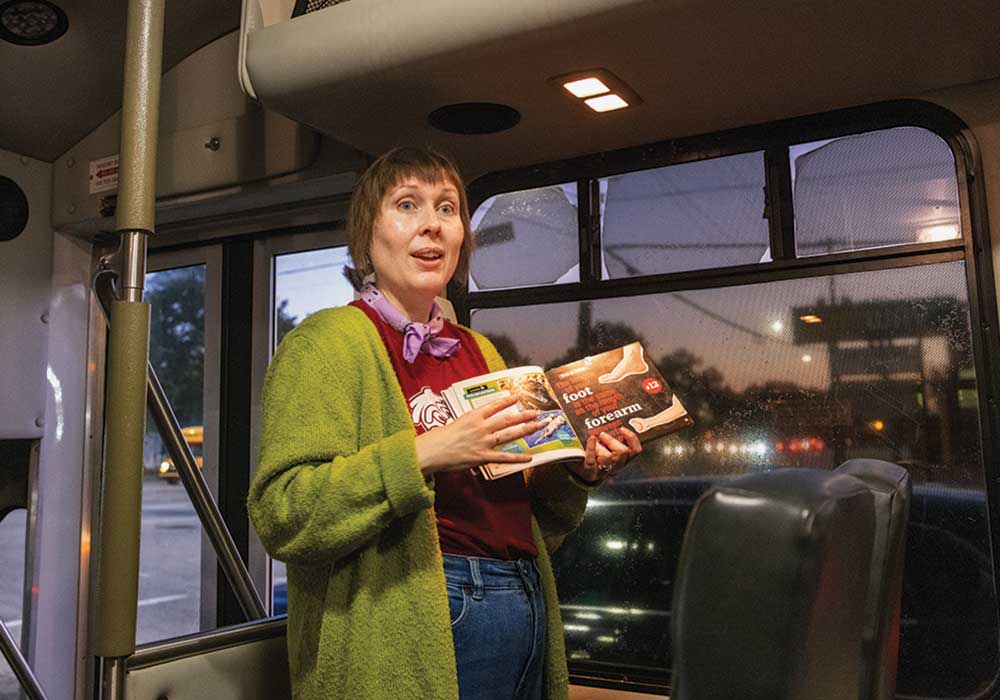
Margaret Jackson prepares student volunteers for a school visit from the front of the Cocky’s Reading Express bus.
“We don’t just get up on stage and read a book to the kids and call it a day,” says Vinson. “We make it interactive. We sing. We dance. I’ll even make up my own songs, like ‘Groovy Joe.’ I came up with that and Margaret was just like, ‘Cool! Let’s do it!’”
And yes, the kids went wild. Ask them if they had a good time, and the answer is a resounding YES. But if you really want to understand the CRE effect, ask an elementary school teacher. Ask the librarian. Ask Jessica Smoak, MLIS ’20.
Before she became the media specialist at Jefferson Elementary, Smoak spent 15 years as a classroom teacher. She originally approached Cocky’s Reading Express about coming to her school in 2024 but was waitlisted because there were so many competing requests. This year, one of her colleagues, 5th grade teacher Jessica Hutchins, reached out and was able to book a visit. The wait, it seems, was worth it.
“It’s been great,” Smoak says as a line of chattering 4th graders snakes toward the book table. “The kids are having a ball. The teachers love it. I’ve heard all kinds of rave reviews as they’re going out, kids saying how great it was, getting hugs and high fives from Cocky.”
To underscore the educational value, she echoes the teary-eyed sentiment the school principal in the Pee Dee shared with Tommy Preston 20 years ago, following one of the very first CRE events.
“It’s great just getting them excited about how a book can be fun,” Smoak says. “And then the fact that they actually get to take a book with them — so many of these children don’t have books at home, so they’re excited about that. They’ll remember that forever.”