Junior Ansley Martin came to the University of South Carolina with plans to major in neuroscience and become a doctor. As a freshman, she jumped right into neuroimaging research, investigating biomarkers for stroke and neurodegenerative diseases.
But Martin also loves art, and she’s been able to embrace her creative side through the humanities and culture minor at the McCausland College of Arts and Sciences. She’s also looked for creative ways to bring art into her work with patients – in the future and right now.
“Understanding psychology and culture around patients is really important, so I wanted to bring creativity into my education as well,” she says.
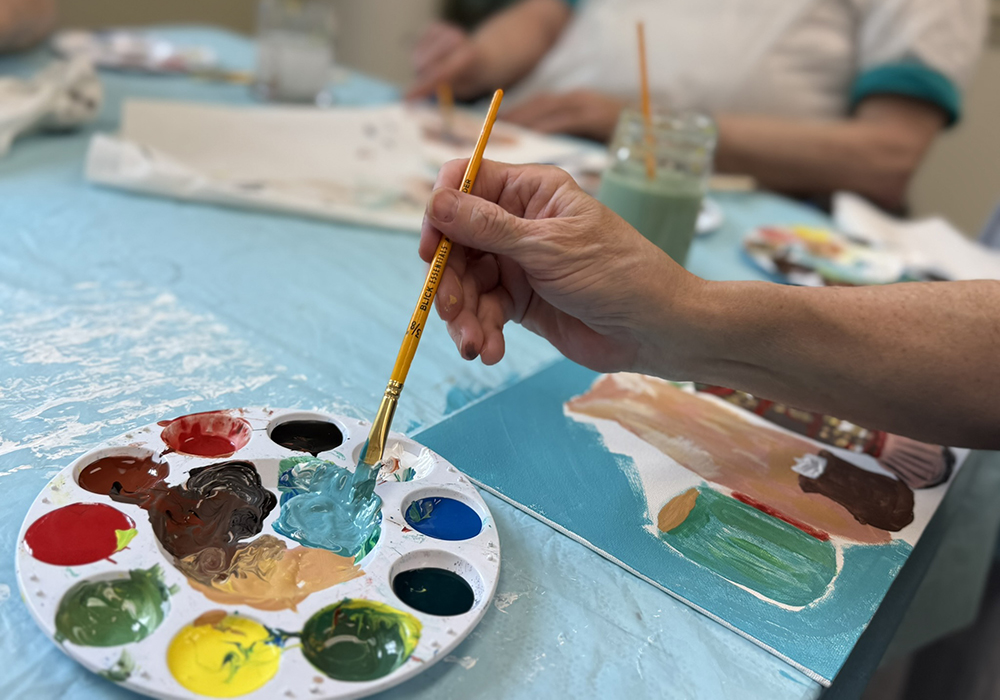
Since last year, Martin has been working with USC Brain Health to launch a program called Vibrant Minds, an expressive arts initiative that combines neuroscience, creativity and social interaction to support older adults living with Alzheimer’s disease, dementia and other neurological conditions. The program helps adults facing cognitive challenges connect with their memories and each other through art and creative projects.
Brain Health is committed to improving access to cognitive care for underserved residents throughout the state of South Carolina. In addition to operating clinics, Brain Health also supports patients and their caregivers through services and programs, which made the idea for a creative arts program a good fit for a pilot program in the spring of 2025.
Drawing from personal inspiration
Martin had been mulling over an idea for a patient-centered arts program for some time before it became a reality. She knew firsthand how important art can be for a person’s well-being, but she had also seen the impact when someone loses their creative abilities.
“My Oma — my grandmother — was an incredible artist,” she says. “After she developed dementia and began taking medication, tremors kept her from painting, which was heartbreaking.”
In hopes of helping people like her grandmother, Martin began researching the benefits of creating art for people with dementia and neurological conditions.
“What I found was amazing. It can improve mood, reduce anxiety, aid motor skills and even slow cognitive decline,” she says.
While she knew the science, and she loved art herself, Martin needed someone with more expertise on the art education side. One afternoon at a student government event, she met Stella Tew, who would become her co-leader of Vibrant Minds.
“I asked Stella about her major, and the moment she said, ‘art education,’ I immediately told her I had a proposition to discuss with her,” Martin says.
“The students have incredible vision. My job is to help them realize their passion through the program so that it can become a permanent component of the services we offer our participants.”
“A week later, we sat down at the library and mapped out a plan,” says Tew, a senior in the South Carolina Honors College. Like Martin, Tew’s interest in creating Vibrant Minds came from personal experience.
“My great-grandmother was diagnosed with Alzheimer’s disease. Watching what she went through was very difficult. As a future art educator, I’ve always believed creativity is essential to being human. But people often lose touch with that part of themselves as they get older,” she says.
When Martin and Stew presented their concept for Vibrant Minds to Brain Health’s leadership, the team immediately saw great potential. Alyssa Blickensderfer, a Brain Health program manager, became a mentor to the two students, guiding them through the process of turning their idea into a pilot program and launching it last spring.
“What impressed me was how quickly Ansley and Stella connected their passion for art and neuroscience to the broader mission of Brain Health,” Blickensderfer says. “My role was to help them shape that vision into something impactful and sustainable.”
Creating a brighter future for cognitive patients
What began as small, occasional sessions soon grew into a powerful model that combined evidence-based art activities with reflection, storytelling and conversation.
For Blickensderfer, the program represents what Brain Health aims to achieve.
“This work isn’t only about positive outcomes for the residents,” she says. “It’s about building meaningful experiences that reduce isolation and encourage creativity, which can improve brain health.”
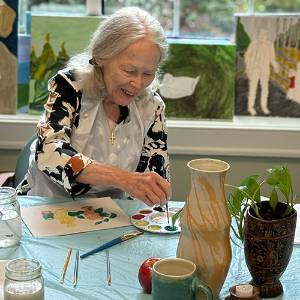
Vibrant Minds sessions are designed to spark creativity and memory. Activities range from painting landscapes and scenes of meaningful life moments to decorating picture frames for photos of loved ones. Class participants are encouraged to share stories, making the process about connection as much as art.
The team has witnessed powerful moments along the way.
“There’s a couple we work with who have been together for 64 years,” Martin says. “The husband is a veteran with post-traumatic stress disorder. After a few sessions, his wife told me she could already see a positive impact on his quality of life.”
Looking ahead, Blickensderfer is focused on expanding Vibrant Minds to more locations and developing a mentorship model to train future student leaders for the program.
“The students have incredible vision,” she says. “My job is to help them realize their passion through the program so that it can become a permanent component of the services we offer our participants.”
Even with the challenges of scaling up, Blickensderfer says the heart of the project never changes.
“At the end of the day, this is about making a real difference in lives through joy, creativity, connection and hope,” she says.