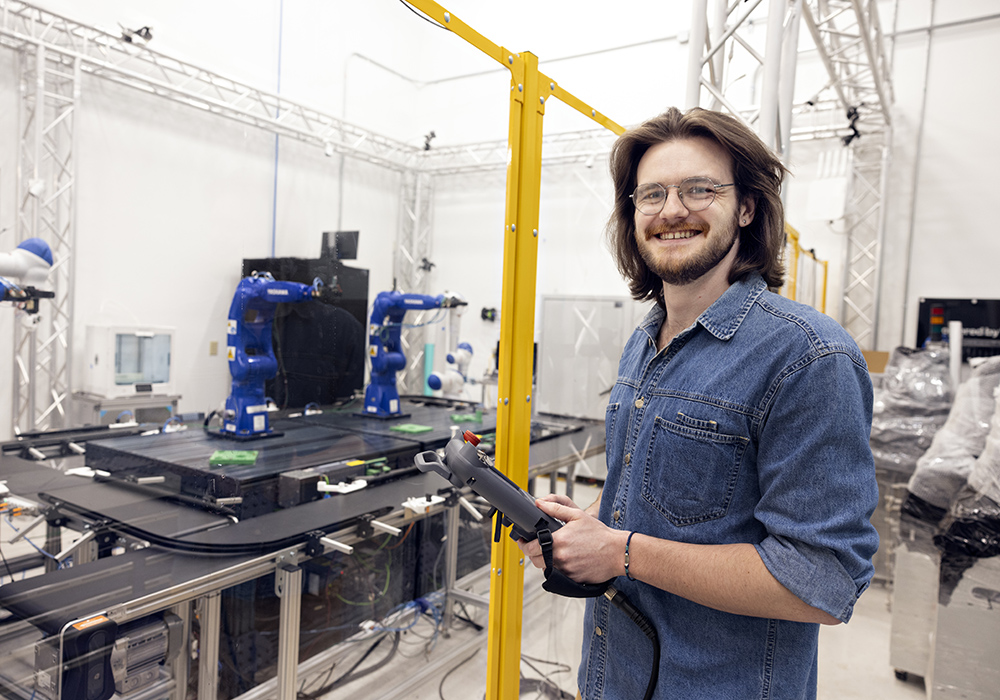
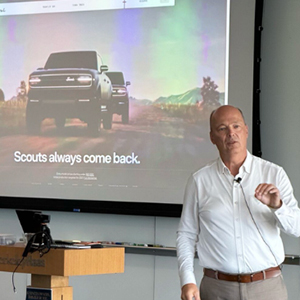
The 1.3-million-square-foot Scout Motors vehicle assembly plant under construction north of Columbia will begin building electric trucks and SUVs by 2028. But Scout’s chief technology officer Burkhard Huhnke is already building ties with USC’s Molinaroli College of Engineering and Computing.
This past fall, Huhnke was the lead instructor for a systems engineering course that exposed USC engineering students to sophisticated technology and design processes, including those the company will use to design and build vehicles at the new plant. The course, Applied Systems Engineering for Complex Systems, will be taught again in the fall 2026 semester and is offered through the new industrial engineering program, which launched in 2024.
A student in the course, Ph.D. candidate Austin Harper, says he was impressed with the scope of the content and Huhnke’s vision for systems engineering and systems thinking. Here, he shares his experience in the class.
What was it like to have an automotive engineering executive teaching the course?
Prof. Huhnke was always very responsive to our questions. You can tell he really wants to inspire the next generation of engineers, and he was always very engaged with us.
It was interesting to hear his perspective of how the car itself is a system, and how cars and other very complex engineering feats like airplanes and other robotic systems get designed, established, verified, validated — basically the whole product lifecycle.
Did you learn about how Scout Motors is going to build electric vehicles at its new plant in Blythewood, S.C.?
The course was mostly about systems engineering, not necessarily about the manufacturing process itself, but instead how Scout is using advanced technology like digital twins to upgrade their production process as it's being built — they have the technology infused and baked into what they're making — and having that insight was extremely valuable.
While I’ve always considered manufacturing from a wider process perspective, Prof. Huhnke’s course expanded my perspective to systems engineering for product design — from conception to final production — and how that can translate to manufacturing processes.
Was there anything from the course that inspired you?
It’s one thing to read papers and case studies that say, “We did this with this technology,” but it’s another thing to hear it directly from a chief technology officer on what his vision is and how it all connects. It was cool to see that this technology isn’t science fiction. It doesn't just exist in our lab — it is being implemented in manufacturing environments.
He’s just a great teacher. I have bachelor’s and master’s degrees in industrial engineering and worked in industry for a couple of years, and I had never heard or seen it from his perspective before. The amount of technical knowledge and information that he was able to give us was invaluable.
What’s next for you?
I plan to continue my research into the application of Industry 4.0 technologies in real-world production environments and educate the next generation of engineers by developing similar opportunities for collaboration between undergraduate students and manufacturers. By first understanding the needs of our industry partners, we can bridge the gaps between the issues that come with adopting new technologies in industry and prepare students to work in a constantly evolving manufacturing landscape.